NVIDIA Expands AI for Media Suite and Unveils Breakthrough Software-Defined Broadcasting Tools at IBC 2026


The International Broadcasting Convention (IBC) opened its doors in Amsterdam, welcoming more than 44,000 attendees from over 170 countries to explore cutting-edge innovations across the global media and entertainment sectors. Spanning 14 exhibition halls and outdoor spaces, this year’s conference—running from September 11 to 14—has rapidly emerged as a defining proving ground for artificial intelligence in live production, broadcasting, and streaming workflows. Against this backdrop of rapid technological convergence, NVIDIA used the global stage to announce a sweeping expansion of its AI for Media ecosystem, introducing advanced software development kits (SDKs), NVIDIA NIM microservices, and architectural blueprints designed to revolutionize video authenticity, motion tracking, and real-time content localization.
The announcements at IBC 2026 mark a critical inflection point for the media industry. For years, broadcasters have experimented with discrete AI tools, often struggling to integrate machine learning into high-stakes, low-latency live environments without compromising reliability. NVIDIA’s latest rollout addresses this challenge head-on, offering a cohesive, GPU-accelerated framework that operates seamlessly across on-premises servers, edge devices, cloud environments, and air-gapped systems. By embedding AI directly into the backbone of live production, NVIDIA aims to help media enterprises extract deeper performance insights, verify video provenance, and scale multilingual programming without increasing operational complexity.
Combatting Deepfakes with Advanced Video Authentication
One of the most pressing challenges facing modern newsrooms and digital forensics teams is the proliferation of sophisticated synthetic media. In response, NVIDIA has significantly upgraded its Synthetic Video Detector (SVD) NIM microservice, which was initially previewed earlier this year at SIGGRAPH. SVD is engineered to help organizations assess the statistical probability that a given video file is authentic or artificially generated, providing an indispensable layer of digital defense for editorial and broadcast integrity teams.
Recent benchmarks highlight the rapid maturation of the technology. Since its initial release, SVD’s classification accuracy has climbed to 99.3% for text-to-video content and 97.7% for image-to-video content, registering particularly dramatic performance gains in complex, edge-case image-to-video scenarios. Major industry players are already moving to operationalize these capabilities. Dalet is actively integrating SVD into its secure, cloud-hosted verification workflows, allowing journalists and editors to submit incoming footage, inspect confidence scores, and review granular metadata directly within familiar newsroom interfaces.
Similarly, TwelveLabs announced the general availability of Compliance by TwelveLabs, its premier application built upon a robust video intelligence platform. The tool enables media organizations to rapidly screen extensive asset libraries against custom and regional compliance standards. By integrating NVIDIA’s SVD, Compliance by TwelveLabs now embeds frame-level authenticity signals and confidence scores directly into compliance pipelines, empowering teams to flag synthetic media concurrently with regulatory checks. Meanwhile, Wowza—whose streaming engine technology underpins over 35,000 video deployments across 170 countries—is distributing SVD via the Wowza Video Intelligence Framework. Powered by NVIDIA accelerated infrastructure, this integration permits broadcasters to analyze live feeds in real time for signs of AI manipulation, object tracking, and scene classification.

Unlocking Structured Data Through 3D Body Pose and Generative Video
Beyond content verification, NVIDIA’s expanded suite targets the structural transformation of live sports and entertainment production. The newly enhanced NVIDIA 3D Body Pose technology estimates 2D and 3D human joint locations and angles from standard video feeds captured by a single camera, effectively eliminating the need for cumbersome, marker-based motion-capture systems.
For sports leagues and athletic organizations, this capability unlocks unprecedented avenues for player tracking, biomechanical assessment, officiating adjudication, and enhanced instant replays. Furthermore, by translating human motion into structured data, the technology streamlines content creation workflows. Animators can map joint and motion telemetry directly to compatible character rigs, accelerating character retargeting, digital double generation, and virtual production pipelines. Vizrt, for instance, has integrated Body Pose technology into live virtual-studio environments, utilizing tracked body movements to drive real-time 3D lighting phenomena, including dynamic shadows, reflections, and environmental rendering.
Complementing motion tracking is Video Frame Generation (VFG), a generative AI tool designed to smooth out fast-motion sequences by synthesizing intermediate frames between original captures. VFG can elevate frame rates by factors of 2x or 4x while preserving strict visual quality and temporal consistency. Ross Video is leveraging this innovation within its Rio Replay platform to deliver 6x slow-motion generation for sports broadcasting, with active development underway to achieve 8x interpolation. This advancement frees production teams from the logistical constraint of deploying ultra-high-frame-rate source cameras for every angle without sacrificing visual fluidity.
Real-Time Upscaling and High Dynamic Range Transformation
To address the heterogeneous nature of legacy content libraries, NVIDIA has updated its Video Super Resolution (VSR) and TrueHDR technologies. VSR employs neural networks to upscale low-resolution video while actively mitigating noise, blur, and compression artifacts. Developers can now utilize flexible streaming modes to balance real-time performance against maximum visual fidelity, supported by newly added 10-bit video processing.
When paired with NVIDIA TrueHDR—which converts standard-dynamic-range footage into vibrant high-dynamic-range output reaching up to 2,000 nits—media companies can modernize legacy archives for contemporary streaming, gaming, and creator workflows within a unified, GPU-accelerated processing pipeline.
Holoscan for Media and the Open Media Exchange Layer
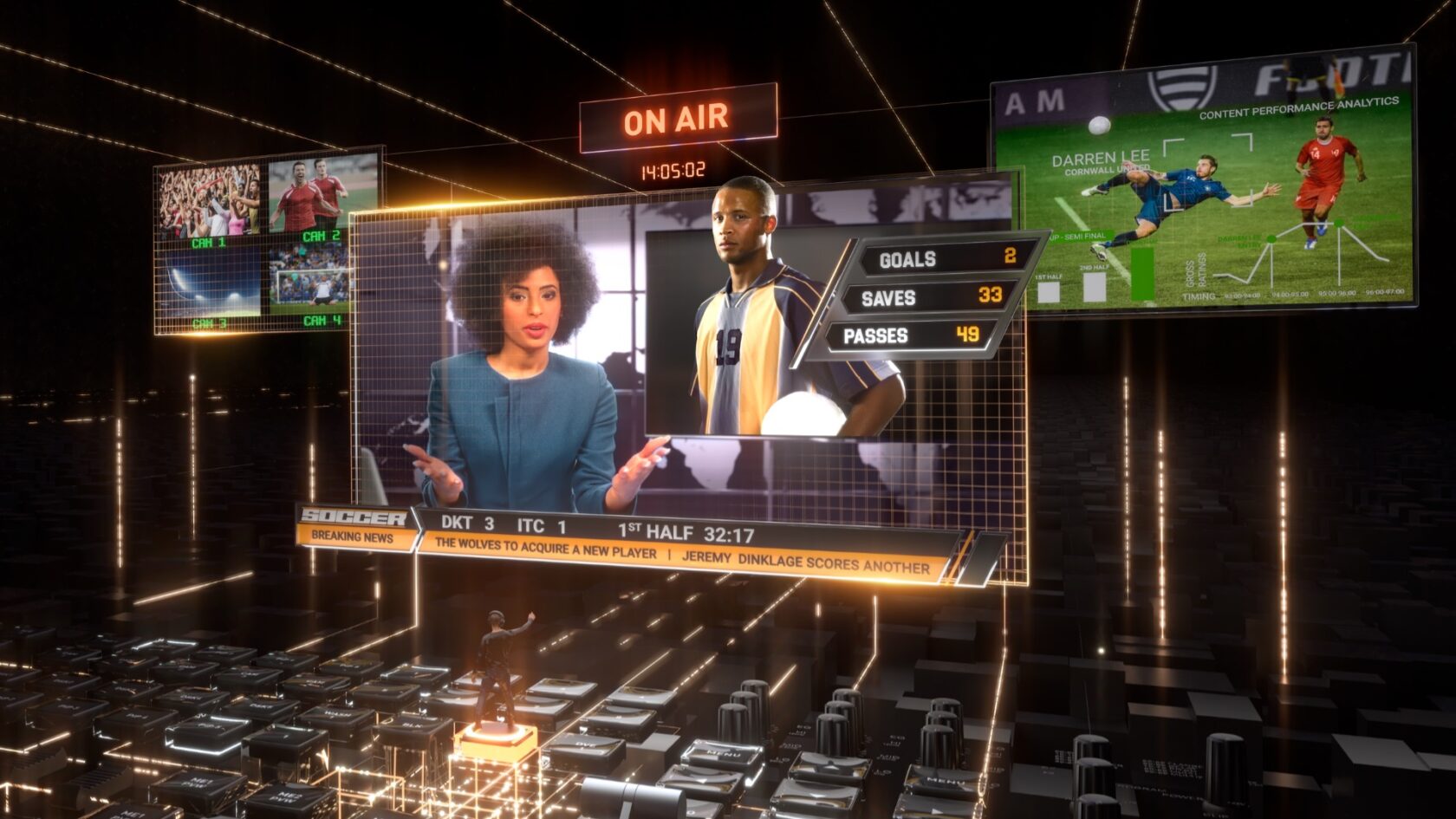
To facilitate the shift toward software-defined broadcasting, NVIDIA highlighted the integration of the Media Exchange Layer (MXL) with NVIDIA Holoscan for Media. Holoscan for Media serves as an open reference architecture and developer toolkit tailored for live, software-defined production environments.
By incorporating MXL, the architecture establishes a standardized mechanism for disparate software-based media functions to exchange live video, audio, and metadata across distributed networks. As broadcasters transition away from rigid, hardware-centric master control rooms toward flexible, IP-based infrastructures, this open exchange layer enables third-party vendors and media enterprises to build modular applications that share accelerated computing resources. The result is a more resilient, interoperable ecosystem capable of adapting dynamically to evolving broadcast standards and emerging AI workloads.
Scaling Multilingual Localization Through Sports Intelligence Playbooks
Addressing the economic and logistical hurdles of global distribution, NVIDIA introduced comprehensive Content Localization reference workflows integrated directly into Holoscan for Media. Reaching international audiences traditionally required siloed infrastructure for translation, voice dubbing, subtitle generation, and localized graphics. NVIDIA’s unified approach combines advanced LipSync capabilities—which accurately adapt mouth movements in video to match translated audio tracks while preserving natural head poses and facial textures—with Active Speaker Detection NIM microservices that streamline multi-speaker identification.
Innovators such as AI-Media, CAMB.AI, Chyron, and Panjaya are utilizing these foundational tools to automate regional adaptation. Similarly, NDI is incorporating NVIDIA AI for Media to enable real-time translation and lip-synced dubbing across existing broadcast streams, drastically cutting bandwidth and production overhead for global media networks.
In the sports sector, NVIDIA unveiled Sports Intelligence Playbooks, designed to help leagues and rights holders fine-tune open foundation models—such as Nemotron and NVIDIA Cosmos—using proprietary video archives and telemetry data. Early evaluations demonstrate dramatic performance gains: when tested on domain-specific queries, fine-tuned models saw multiple-choice accuracy jump from approximately 53% to 94%, and open-ended evaluation scores rise from 5.7% to 66%. By bridging domain expertise with accelerated computing, these playbooks empower sports organizations to develop bespoke AI agents capable of automating complex analytics, enhancing live broadcasts, and unlocking entirely new monetization streams across global fanbases.