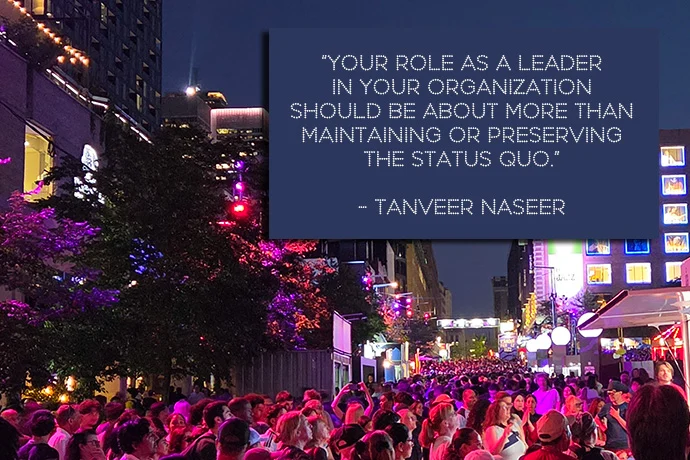
The recent conclusion of the Montreal International Jazz Festival, the largest event of its kind globally, has served as a catalyst for a deeper examination of how the principles of musical improvisation can be applied to modern corporate governance. As organizations grapple with an era defined by rapid technological shifts and economic volatility, the parallels between a functioning jazz ensemble and a high-performing leadership team have become increasingly relevant. The festival, which has historically attracted over two million visitors and featured thousands of musicians across hundreds of performances, provides a unique laboratory for observing how collective excellence is achieved through a delicate balance of structure and spontaneity.
In a recent installment of the Leadership Espresso Shot series, leadership expert Tanveer Naseer explored how the fundamental tenets of jazz—specifically active listening and adaptive change—offer a blueprint for leaders seeking to navigate the "uncertain waters" of the contemporary business landscape. The analysis suggests that the traditional, "orchestral" model of leadership, which relies on a strict adherence to a pre-written score and a singular conductor, is increasingly ill-suited for a world that demands agility and decentralized decision-making.
The Historical Context of the Montreal International Jazz Festival
To understand the weight of these leadership insights, one must first consider the scale and history of the Montreal International Jazz Festival (Festival International de Jazz de Montréal). Founded in 1980 by Alain Simard, the festival began with a modest lineup including Ray Charles and Chick Corea. Over the ensuing four decades, it has evolved into a massive cultural phenomenon, holding the Guinness World Record as the world’s largest jazz festival.
The festival’s evolution mirrors the shift in global organizational structures. In its early years, the event was a centralized effort; today, it is a complex ecosystem of indoor venues, outdoor stages, and spontaneous street performances that require immense logistical coordination and the ability to pivot in real-time—much like a global corporation. For leaders, the festival represents more than a musical gathering; it is a case study in managing massive scale while maintaining the "soul" of the organization.
The Jazz Metaphor in Organizational Management
The concept of "organizing as jazz" is not entirely new to management science. In the late 1990s and early 2000s, organizational theorists like Karl Weick and Frank J. Barrett began championing the "Jazz Metaphor." Their research argued that in environments where the rate of change exceeds the ability of a centralized hierarchy to respond, improvisation becomes a necessary competency rather than a sign of disorder.
In a jazz quartet, there is no "boss" in the traditional sense. While one musician may be the bandleader, the leadership is fluid. When the saxophonist takes a solo, the rest of the band "comps" (accompanies), providing a supportive harmonic structure that allows the soloist to shine. This "distributed leadership" is a critical requirement for modern companies that need to empower subject matter experts at every level of the hierarchy.
Core Pillar One: Active Listening as a Strategic Tool
The first insight highlighted in the recent leadership discourse focuses on the transformative power of listening. In jazz, listening is not a passive act; it is the primary driver of the music. A drummer must listen to the bassist’s "walking" line to maintain the groove, while the pianist must listen to the soloist to know which chords will best complement the improvised melody.
Data from the Harvard Business Review and various organizational psychology studies indicate that "listening gaps" are a primary cause of employee disengagement. A 2023 study on workplace communication found that 86% of employees and executives cite a lack of effective collaboration and communication as the main cause of workplace failures. By adopting a "jazz mindset," leaders move beyond merely hearing words to "listening for intent."
This form of active listening allows leaders to:
- Identify Emerging Trends: Just as a musician senses a shift in tempo, a listening leader senses shifts in market sentiment or internal morale before they become crises.
- Foster Psychological Safety: When employees feel heard, they are more likely to take the creative risks necessary for innovation.
- Enhance Connectivity: Listening bridges the gap between a leader’s vision and the employee’s daily reality, ensuring that everyone is "playing in the same key."
Core Pillar Two: Navigating Change Through Improvisation
The second insight revolves around the inevitability of change. In a traditional classical performance, a mistake is a failure to adhere to the plan. In jazz, a "wrong" note is simply an invitation to find a new direction. As Miles Davis famously said, "There are no mistakes in jazz; only opportunities."
For modern organizations, "the plan" is often obsolete by the time it is printed. The COVID-19 pandemic, the rise of generative AI, and shifting geopolitical alliances have rendered long-term strategic rigidity a liability. Leaders who study jazz learn to view change not as a disruption to be minimized, but as a "groove" to be explored.
Chronologically, the most successful companies of the last decade—such as Netflix or Amazon—have demonstrated this improvisational agility. They have pivoted their entire business models (from DVD rentals to streaming, or from an online bookstore to a cloud computing giant) by listening to the "feedback" of the market and adjusting their "melody" accordingly.
Core Pillar Three: Empowering Unique Talents Toward a Shared Purpose
The final insight concerns the empowerment of individual talent. A jazz band succeeds because each member brings a unique voice, tone, and set of influences to the stage. However, this individuality is always tempered by a "shared purpose"—the song’s structure, the tempo, or the emotional intent of the piece.
In the corporate world, this translates to moving away from "command and control" toward "connect and collaborate." Data from Gallup’s "State of the Global Workplace" report consistently shows that organizations with high employee engagement—driven by autonomy and the use of individual strengths—are 21% more profitable.
By encouraging employees to contribute their "unique solos," leaders can:
- Increase Retention: High-performers stay where their specific talents are recognized and utilized.
- Drive Innovation: Diverse perspectives prevent "groupthink," ensuring that the organization’s "sound" remains fresh and competitive.
- Achieve Alignment: When employees understand the "shared purpose" (the organization’s mission), they can be trusted to improvise within that framework without constant supervision.
Analysis of Implications for Future Leadership
The shift toward a jazz-inspired leadership model has profound implications for the future of work. As the workforce becomes increasingly decentralized through remote and hybrid models, the "orchestral" style of management becomes physically and logistically impossible. Leaders can no longer "conduct" every movement of their employees from a central podium.
Instead, they must become "bandleaders" who set the "key" and the "tempo" and then trust their "musicians" to perform. This requires a higher level of emotional intelligence (EQ) and a willingness to share power. The risk of this model is a potential lack of cohesion, but this is mitigated by the first pillar: deep, systemic listening.
Furthermore, the "jazz model" provides a framework for addressing the "burnout" crisis. When employees are treated as interchangeable parts of a machine (the orchestral model), morale declines. When they are treated as vital contributors to a creative process (the jazz model), work becomes a source of meaning rather than just a source of income.
Conclusion: The Enduring Rhythm of Effective Leadership
The lessons derived from the Montreal Jazz Festival and the broader world of jazz music offer a compelling alternative to stagnant management practices. By prioritizing listening over speaking, agility over rigidity, and empowerment over control, leaders can create organizations that are not only more resilient but also more human.
As the 2024 edition of the festival concludes, the message for the global business community is clear: the most successful organizations of the future will not be those that follow the score most accurately, but those that can listen most intently and improvise most effectively. In the words of many jazz greats, the music is not in the notes, but in the space between them. For leaders, the "music" of success is found in the spaces between the people, the purpose, and the ever-changing world around them.