Why Your Best Meeting Ever: 7 Principles to Designing Meetings That Get Things Done Is the Antidote to Modern Corporate Gridlock

The modern knowledge worker’s calendar has quietly transformed into a battleground of back-to-back video conferences, audio calls, and synchronizations that leave little to no room for actual execution. Ask almost any workforce what single intervention would most improve their daily productivity, and the near-universal response is simple: fewer meetings. Corporate leadership has not been entirely deaf to this plea. Over the last several years, organizations across the globe have introduced a wide array of policy interventions aimed at curbing meeting proliferation. Initiatives like “No-Meeting Fridays,” mandatory reductions in meeting durations—such as swapping standard 60-minute blocks for 25 or 50 minutes—and strict caps on attendee lists have become standard playbook items for forward-thinking enterprises.
Yet, despite these well-intentioned administrative guardrails, corporate calendars remain stubbornly overstaturated. Meetings continue to consume the lion’s share of the average workday, pushing actual strategic thinking and deep-focus deliverables to the after-hours periphery. This persistent structural failure raises a critical question for modern executives: why do organizations continually struggle to eradicate an internal obstacle that is universally acknowledged to stifle peak performance? According to organizational behavior experts, the root of the crisis lies not in a lack of rules, but in the fact that contemporary corporate gatherings are anchored in inherited habits rather than deliberate, intentional design.
Examining the Meeting Epidemic and Its Toll on Corporate Productivity
To understand the scale of modern meeting bloat, one must examine the broader economic and psychological toll it takes on global enterprises. Numerous workplace studies conducted over the past decade point to a compounding phenomenon often described as “meeting debt.” Just as financial debt accumulates interest when left unmanaged, meeting debt piles up when organizations continuously schedule synchronous sessions without auditing their long-term utility or alignment with overarching corporate goals.
Recent workforce analytics from major HR consulting firms indicate that middle managers and senior executives now spend upward of 85 percent of their working hours in collaborative settings. This leaves a minuscule fraction of the workday for uninterrupted focus—the cognitive state required for coding, strategic planning, complex writing, and financial analysis. The consequences extend far beyond mere administrative frustration; they manifest as widespread employee burnout, diminished creative output, and a systemic slowdown in project velocity.
When workers are perpetually transitioning from one conference room or virtual link to another, their brains absorb a heavy cognitive load known as context-switching fatigue. By the time an employee finally sits down to tackle a substantive deliverable, their mental energy reserves are already depleted. Leaders frequently mistake this busyness for productivity, rewarding teams for their high calendar visibility while silently penalizing them through missed deadlines and stagnant innovation pipelines.
The Evolution of Workplace Collaboration and the Shift Toward Intentional Design
The historical trajectory of corporate meetings underwent a fundamental shift with the mass migration to remote and hybrid work models in the early 2020s. Before this paradigm shift, physical meeting spaces imposed natural friction: conference rooms had finite capacities, and booking them required forethought. The sudden ubiquity of video conferencing software effectively removed these physical constraints, turning every employee’s desktop into an open invitation portal for instant, frictionless gatherings.
As digital collaboration tools proliferated, organizations neglected to update their cultural norms regarding when a meeting is genuinely required versus when an asynchronous update, shared document, or email would suffice. Meetings quickly became the default mode of communication for decisions that previously would have been resolved in a brief conversation or delegated autonomously.
Recognizing this growing dysfunction, organizational theorists have increasingly focused on how behavioral psychology and structured frameworks can reclaim corporate time. Among the prominent voices in this field is Dr. Rebecca Hinds, a leading researcher on the future of work and organizational behavior whose empirical investigations into collaboration technologies and artificial intelligence have been featured in top-tier publications including the Harvard Business Review, The New York Times, Forbes, TIME, and Fast Company.
Dr. Hinds’ extensive research forms the backbone of her bestselling book, Your Best Meeting Ever: 7 Principles to Designing Meetings That Get Things Done. Her work provides a rigorous, data-backed blueprint for dismantling broken meeting cultures and replacing them with intentional frameworks that respect employee time and drive organizational purpose forward.
Insights from Leadership Discourse: The Tanveer Naseer Interviews
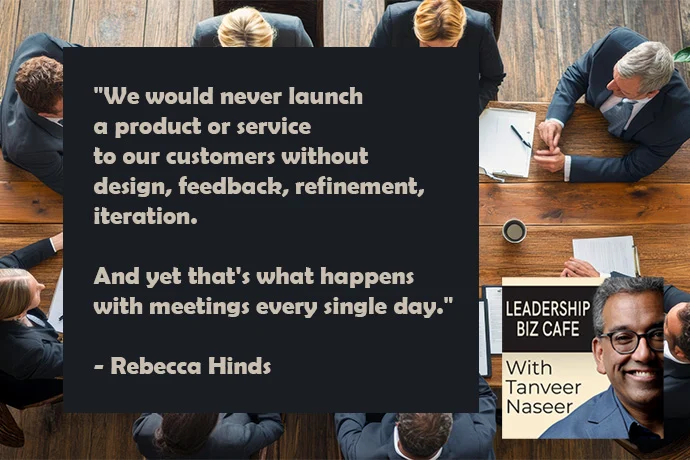
To dissect the mechanics of modern meeting dysfunction and explore viable pathways toward cultural reform, leadership expert and podcaster Tanveer Naseer recently welcomed Dr. Rebecca Hinds as a featured guest on his widely recognized program, the Leadership Biz Cafe podcast. The episode dives deep into the invisible forces that turn standard corporate gatherings into productivity sinks and outlines actionable strategies for leadership teams seeking a genuine cultural reset.
During the conversation, Dr. Hinds highlighted that the core pathology of modern meetings is their reliance on legacy blueprints. Most corporate leaders design meetings the way they were designed decades ago, treating them as default social gatherings or status updates rather than high-stakes operational engines. This lack of intentionality breeds what Dr. Hinds identifies as “energy-sucking bugs”—subtle behavioral patterns, lack of clear agendas, wandering discussions, and disengaged participants that quietly drain the vitality and momentum from team interactions.
Addressing these invisible drains requires a systematic overhaul of how meetings are conceptualized, scheduled, and executed. Rather than relying on blunt instruments like blanket bans on specific days of the week, Dr. Hinds advocates for a fundamental redesign grounded in seven core principles that prioritize cognitive efficiency, psychological safety, and decisive action.
Practical Strategies for Cleansing Corporate Calendars and Eliminating Meeting Debt
Implementing a sustainable meeting culture demands more than superficial policy changes; it requires proactive administrative hygiene. One of the primary recommendations highlighted in contemporary organizational research is the systematic execution of a calendar cleanse to eliminate accumulated meeting debt.
A calendar cleanse involves a comprehensive audit of all recurring meetings within an organization. Leaders and teams evaluate every standing appointment against strict criteria: What is the specific decision being driven by this gathering? Who are the essential stakeholders required to reach that decision? If a recurring sync lacks a clear purpose or measurable output, it is immediately canceled or converted into an asynchronous workflow.
Furthermore, organizations are beginning to leverage advanced analytics tools integrated into modern productivity suites to monitor meeting health metrics. These tools provide visibility into aggregate time spent in meetings across departments, helping executive teams identify operational bottlenecks and curb the tendency toward over-invitation. By establishing clear thresholds for who attends meetings—such as limiting groups to those with direct decision-making authority—companies can drastically reduce the size of gatherings, which behavioral studies consistently link to higher engagement and faster consensus-building.
The Broader Implications for Organizational Performance and Employee Well-Being
The stakes for resolving the meeting crisis extend deep into the financial and operational health of modern corporations. As global markets demand greater agility, innovation, and efficiency, organizations burdened by heavy meeting debt find themselves outpaced by leaner, more intentional competitors.
When meetings are designed with clear purpose—empowering employees to think critically, make definitive choices, and execute collaborative work effectively—the psychological contract between employer and employee is strengthened. Workers regain autonomy over their schedules, experiencing a renewed sense of agency and mastery in their daily responsibilities. Conversely, organizations that fail to address meeting bloat risk accelerating employee attrition, as top talent increasingly gravitates toward cultures that respect deep work and outcome-based performance over calendar presence.
Ultimately, transforming a broken meeting culture is not an administrative afterthought; it is a vital leadership imperative. By shifting from inherited habits to intentional design principles—such as those articulated in Dr. Rebecca Hinds’ research and explored on the Leadership Biz Cafe podcast—organizations can successfully reclaim their time, restore workplace momentum, and align their daily operations with their long-term strategic vision.
Related posts: