Programming Legend John Carmack and Tech Author Jeff Atwood Place $10,000 Wager on the Timeline of SAE Level 5 Autonomous Vehicles

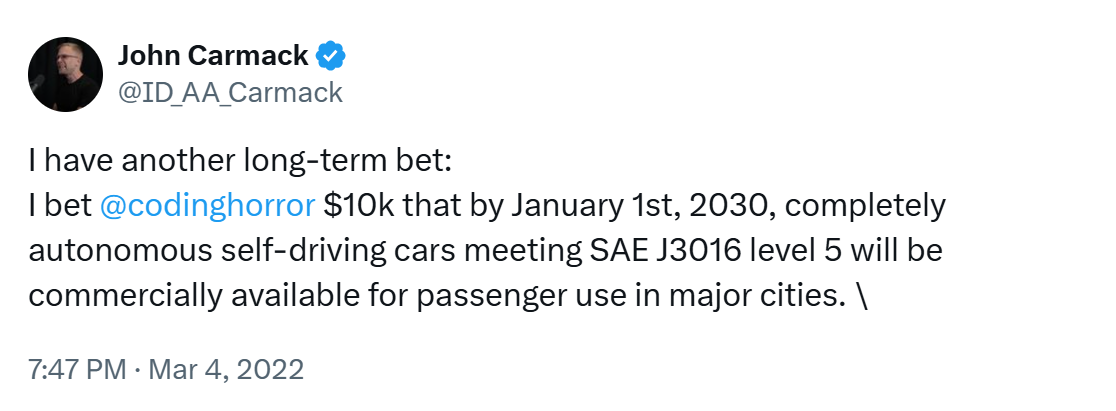
Software engineering pioneer John Carmack and prominent technology author Jeff Atwood have entered into a high-stakes, philanthropic wager regarding the commercial viability of fully autonomous vehicles. The friendly bet, valued at $10,000, centers on whether true Level 5 self-driving cars will be commercially available for general passenger use in major metropolitan areas by the turn of the decade.
The terms of the agreement dictate that by January 1, 2030, completely autonomous vehicles meeting the Society of Automotive Engineers (SAE) J3016 Level 5 classification must be available for commercial passenger deployment within at least one of the ten most populous cities in the United States. Carmack, renowned for his foundational work on video game engines such as Doom and Quake, as well as his subsequent contributions to aerospace and artificial intelligence, has taken the affirmative stance, betting that the technology will arrive on schedule. Conversely, Atwood—best known as the co-founder of Stack Overflow and the author of the Coding Horror blog—is betting against the timeline, wagering that the immense engineering hurdles will not be fully surmounted by the deadline.
Should Carmack win the wager, Atwood will donate $10,000 to a 501(c)(3) charitable organization of Carmack’s choice. If Atwood is proven correct, Carmack will direct an equivalent donation to a charity selected by Atwood. Both participants noted that the final payout figure may be adjusted for inflation by the year 2030 to ensure the donation maintains its intended financial impact.
Defining SAE Level 5 Autonomy
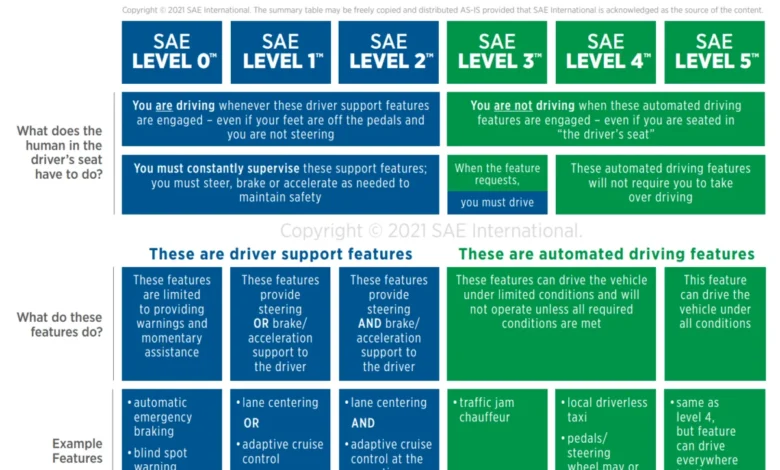
The crux of the wager hinges on the strict definitions outlined by the SAE J3016 standard for driving automation. While current advanced driver assistance systems (ADAS) and commercial robotaxis operate largely under SAE Level 4—which limits autonomous operations to specific geofenced areas, favorable weather conditions, or mapped routes—Level 5 represents the pinnacle of autonomous engineering.
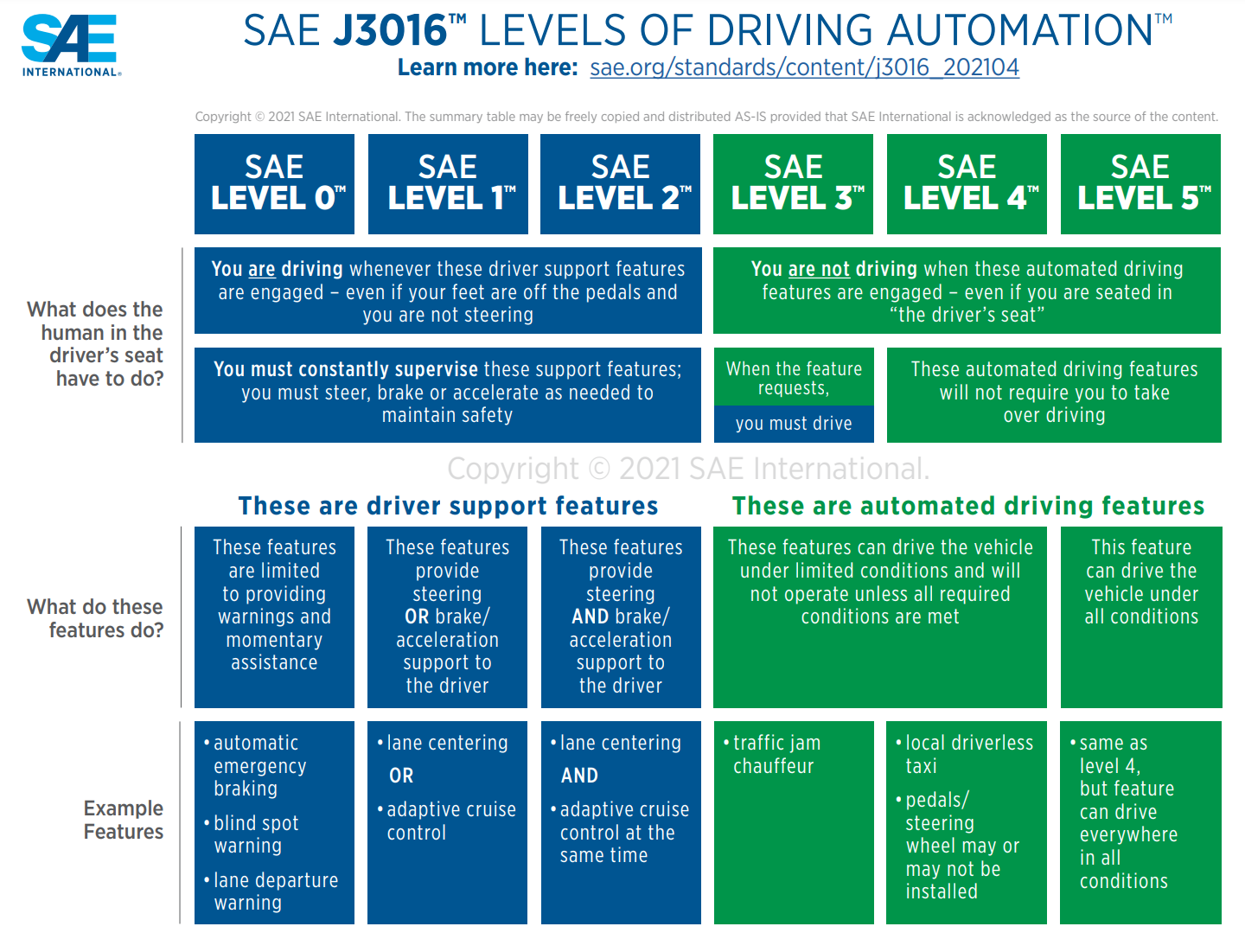
According to the SAE specification, Level 5 signifies full driving automation under all roadway and environmental conditions that can be managed by a human driver. Under this classification, a vehicle must be capable of navigating every aspect of a journey from origin to destination without human intervention, intervention readiness, or geo-fencing. The vehicle requires zero human attention, lacking even the requirement for traditional controls such as a steering wheel or pedals in certain design iterations. The only scenarios exempt from this capability are natural disasters or unprecedented emergency events that would similarly obstruct human drivers.
By restricting the bet to the top ten most populous cities in the United States—a list that includes urban centers like New York, Los Angeles, Chicago, Houston, and Phoenix—the wager specifically challenges developers to transition from controlled testing environments to the chaotic, highly variable infrastructure of major metropolitan American cities.
Technological Landscape and Current Industry Realities
The bet arrives at a pivotal juncture in the autonomous vehicle (AV) industry, which has experienced both monumental technological breakthroughs and severe regulatory and financial setbacks over the past decade. Companies such as Alphabet’s Waymo and Amazon’s Zoox have made significant strides, successfully deploying commercial robotaxi services in dense urban environments like San Francisco, Phoenix, Los Angeles, and Austin. However, these current deployments operate strictly at SAE Level 4, relying on extensive high-definition mapping, remote assistance operators, and strict operational design domains (ODDs).
Industry analysts and computer scientists remain sharply divided on the feasibility of bridging the gap between Level 4 and Level 5. Proponents of rapid AV adoption point to exponential improvements in machine learning architectures, sensor fusion, and neural network efficiency, arguing that computational hardware will soon outpace human reaction times and environmental processing limitations. Breakthroughs in foundational AI models are increasingly being integrated into autonomous driving stacks, potentially allowing vehicles to reason through novel, unmapped traffic scenarios rather than relying solely on pre-recorded spatial data.
Conversely, skeptics argue that the "long tail" of edge cases—unforeseen road hazards, erratic pedestrian behavior, erratic weather phenomena, and degraded infrastructure—presents an intractable mathematical problem. Achieving the six-nines reliability (99.9999% uptime) required for unmonitored, universal Level 5 deployment demands safety margins that far exceed current statistical safety rates of human drivers, let alone existing autonomous algorithms.

Atwood’s Rationale: Respect for the Problem, Not the Product
In detailing his decision to bet against the 2030 timeline, Atwood emphasized that his skepticism is rooted entirely in the extreme complexity of computer science and systems engineering, rather than an ideological opposition to autonomous transport.
"I am betting against because I think everyone is underestimating how difficult fully autonomous driving really is," Atwood explained in his announcement. "I am by no means against self-driving vehicles in any way! I’d much rather spend my time in a vehicle reading, watching videos, or talking to my family and friends—anything, really, instead of driving."
Atwood further framed the debate as a challenge to the broader engineering community. By laying down the wager, he hopes to spur innovation and empirical progress in the field. Should contemporary researchers, roboticists, and software engineers successfully overcome the hurdles of Level 5 autonomy within the decade, Atwood stated he would gladly join in celebrating the milestone.
The wager also serves as a playful homage to a history of public technological bets among prominent technologists and scientists, echoing famous intellectual gambles such as those placed by economist Julian Simon and ecologist Paul Ehrlich regarding resource scarcity, or physicist Stephen Hawking’s scientific wagers.
Broader Implications for Urban Mobility and Software Engineering
The outcome of the Carmack-Atwood bet carries significant implications for the future of urban infrastructure, public policy, and the automotive sector. If Carmack wins, society will likely witness a fundamental restructuring of personal ownership models, urban parking space utilization, and public transit logistics by the early 2030s. The widespread availability of universal autonomous transit could drastically reduce urban traffic fatalities, reclaim millions of acres of parking lot real estate for housing and green spaces, and provide unprecedented mobility options for aging or disabled populations.
If Atwood wins, it will underscore the reality that certain physical-world engineering problems resist the software-driven "move fast and break things" paradigm. It would suggest that true generalized autonomy requires foundational advancements in artificial general intelligence (AGI) and robotics that extend beyond the timeline initially projected by tech optimists.
Regardless of the final outcome in 2030, the public wager has successfully focused attention on the immense engineering challenges that remain. As both figures continue their respective endeavors—with Carmack heavily involved in artificial intelligence research through his company Keen Technologies, and Atwood engaged in educational and open-source software initiatives—the bet stands as a testament to their enduring fascination with the cutting edge of computing. Both participants have ensured that, win or lose, the ultimate beneficiary of the $10,000 contest will be the philanthropic sector, cementing a constructive legacy from a friendly debate among two of technology’s most respected minds.