ChartMogul Launches MRRaudit to Solve the Age-Old SaaS Dilemma of Discrepant Billing Metrics

For nearly as long as subscription-based software-as-a-service (SaaS) companies have relied on recurring revenue models, financial operators, Chief Executive Officers, and sales directors have faced a perplexing and recurring conundrum. During sales calls, board meetings, and routine financial reviews, stakeholders frequently confront a frustrating discrepancy: the Monthly Recurring Revenue (MRR) reported in dedicated subscription analytics platforms does not quite match the figures displayed within their primary billing and payment gateway systems.
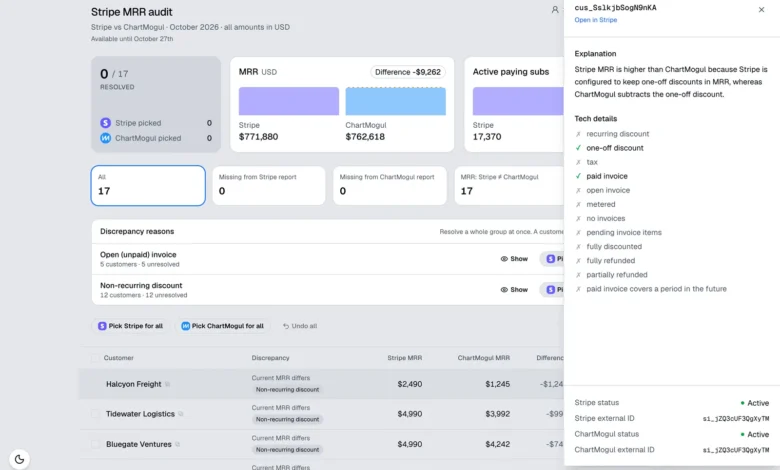
This friction has long served as a staple of customer onboarding and technical support conversations. For years, the resolution of these discrepancies required tedious, manual investigations by specialized support teams. Today, however, subscription analytics pioneer ChartMogul is fundamentally transforming how organizations diagnose and resolve these financial variances with the official launch of MRRaudit, an automated diagnostic tool designed to trace every single financial discrepancy straight back to the individual customer, invoice, and subscription event responsible for it.
The Underlying Mechanics of SaaS Metric Discrepancies
To understand why platforms like ChartMogul often report different MRR figures than billing engines like Stripe, one must examine the core mechanics of how subscription data is processed. Subscription analytics platforms and billing systems are built for fundamentally different purposes. Billing systems are transactional; they are engineered to execute payments, generate invoices, apply immediate adjustments, and manage the immediate cash flow of a business.
Conversely, analytics platforms are designed for financial forecasting and strategic evaluation. They apply consistent, standardized rules to calculate normalized revenue streams over time. When a customer misses a payment, billing platforms may register an open invoice, whereas analytics platforms must determine whether that unpaid invoice constitutes an active delinquency or an official churn event. Similarly, if a subscriber pauses their subscription for a designated two-month period, or if an account receives a one-time promotional discount, the two systems may interpret the financial impact on MRR differently.
ChartMogul operates on a specific set of configurable rules designed to reflect an enterprise’s unique operating model. Because these rules rarely mirror the exact native mechanics of every billing system on the market, minor to moderate variances are inevitable. Historically, bridging this gap required ChartMogul’s sales and support engineers to guide clients through exhaustive, side-by-side system comparisons. Support personnel routinely spent hours tracing historical data gaps back to specific customer accounts, explaining the exact sequence of invoices and subscription events that triggered a divergence. While this high-touch approach ultimately fostered deep trust in the metrics, it was undeniably labor-intensive and constrained by human bandwidth.
The Evolution of Financial Transparency in SaaS
The launch of MRRaudit represents a strategic shift from manual customer success interventions to self-service diagnostic tooling. Developed to alleviate friction across the entire subscription economy, the tool allows finance teams and executives to bypass the waiting periods traditionally associated with support ticket resolutions.
MRRaudit operates by ingesting data sets from billing environments—most notably Stripe—alongside ChartMogul analytics, executing a cross-platform comparison, and systematically categorizing discrepancies by their root cause. Crucially, the platform translates complex financial variances into plain-language explanations. Rather than simply presenting an uncontextualized numerical gap, the software links each divergence directly to the underlying customer profile, specific invoices, and chronological subscription events. This granular traceability empowers finance professionals to inspect the underlying logic independently, validating whether a variance stems from a refunded transaction, an adjusted discount, a failed payment, fluctuating usage-based revenue, or a nuanced change in subscription status.
Real-World Implications: A Case Study in Historical Billing Complexities
The necessity for such a diagnostic tool becomes acutely apparent when examining the historical billing challenges faced by scaling enterprises. Over the lifespan of a growing SaaS company, business models rarely remain static. Organizations routinely revise their pricing structures, execute bespoke enterprise contracts, grant custom discounts, or transition legacy cohorts onto updated plans.

When discrepancies arise in this environment, untangling them often demands an exhaustive archaeological dig through years of financial history. Such was the case for Lavender, an AI-powered sales email assistant, prior to adopting advanced auditing frameworks. Reflecting on the administrative burden of reconciling financial data, Lavender Chief Operating Officer Elliott Fisher recalled a scenario familiar to many modern tech executives.
"Our CEO asked a simple question: ‘What’s our ARR?’" Fisher noted, highlighting the paralyzing effect of inconsistent metrics. "None of us could answer with confidence. We had to rebuild four years of Stripe invoice history from scratch. With MRRaudit, we could have found the differences ourselves in a fraction of the time and shown exactly what was behind the number."
The narrative at Lavender underscores a broader industry truth: financial confidence is intrinsically linked to data provenance. When executives cannot definitively explain why their recognized annual recurring revenue differs from cash collected in the bank, strategic decision-making stalls. By automating the discovery phase, tools like MRRaudit effectively eliminate the paralyzing ambiguity that frequently plagues fast-growing commercial teams.
Practical Application and Accessibility
In a departure from traditional enterprise software deployment models, ChartMogul has designed MRRaudit to be accessible with minimal barrier to entry. Organizations are not required to maintain an active, fully integrated ChartMogul account nor possess pristine, flawless historical data to begin utilizing the diagnostic utility. By lowering the prerequisites for entry, the platform aims to capture a wider segment of the SaaS market, providing critical financial visibility to early-stage startups and legacy enterprises alike.
The implications for the broader subscription economy are substantial. As venture capital markets increasingly emphasize net revenue retention, gross margins, and predictable cash flows over raw top-line growth, the margin for error in financial reporting has narrowed significantly. Investors and board members demand absolute precision in revenue calculations, leaving zero room for unexplainable discrepancies between billing gateways and financial dashboards.
Broader Industry Impact and Future Outlook
The introduction of automated MRR auditing tools signals a mature phase in the evolution of the SaaS ecosystem. For years, the infrastructure surrounding subscription businesses focused primarily on forward-facing capabilities: acquisition, billing automation, and basic revenue visualization. Today, the competitive advantage is shifting toward data reconciliation, compliance, and internal auditability.
As businesses navigate increasingly complex multi-attribute pricing models—incorporating hybrid tiers, consumption-based usage fees, and dynamic discounting—the potential points of failure between transaction engines and analytics databases will only multiply. Solutions that bridge this analytical divide autonomously will likely become standard components of the modern CFO’s technology stack.
By placing investigative power directly into the hands of operators, ChartMogul’s MRRaudit removes the opacity that has historically characterized subscription metrics. Whether an enterprise is preparing for an upcoming funding round, undergoing a rigorous financial audit, or simply attempting to answer a CEO’s routine inquiry regarding quarterly growth, the ability to trace every dollar back to its source customer represents a foundational leap forward for financial transparency in the digital economy.