Optimizing AI-Driven Knowledge Retrieval: Amazon Bedrock Introduces Granular Control for RAG Workflows

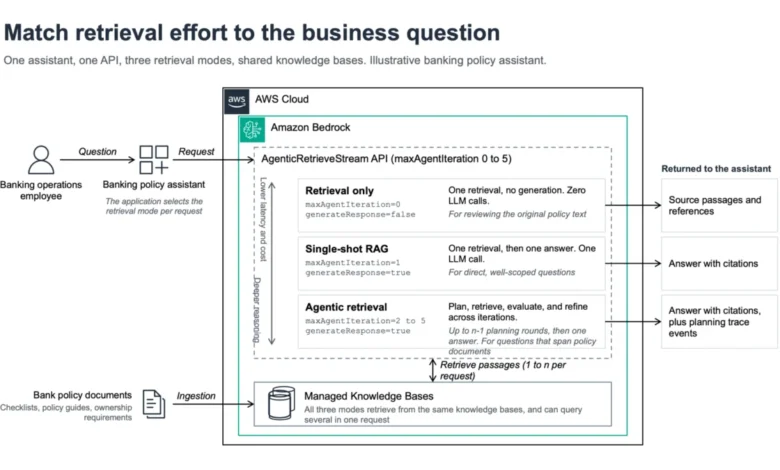
The landscape of enterprise generative AI is shifting from broad, multi-step agentic capabilities toward a more nuanced, tiered approach to information retrieval. Amazon Web Services (AWS) recently announced significant enhancements to the Amazon Bedrock Managed Knowledge Base, specifically targeting the efficiency of Retrieval Augmented Generation (RAG) systems. By expanding the functionality of the AgenticRetrieveStream API, developers can now calibrate the intensity of AI-driven search operations on a per-request basis. This update addresses a long-standing challenge in corporate AI deployments: balancing the latency and cost of multi-step "agentic" reasoning with the speed required for straightforward, fact-based queries.
The Evolution of Retrieval Strategies
For the past several years, the industry standard for enterprise AI has been the "agentic" model—a system where a Large Language Model (LLM) acts as an orchestrator. When presented with a query, the agent breaks the prompt into sub-tasks, performs iterative searches, synthesizes disparate data points, and finally generates a cohesive response. While highly effective for complex, multi-faceted inquiries, this process is inherently resource-intensive. Each step of the reasoning chain consumes time, compute power, and token credits.
In a banking environment, for instance, an employee asking for the specific documents required to open a business checking account does not benefit from an iterative, multi-step search. The answer is typically static and contained within a single policy document. Conversely, a request to compare the regulatory requirements of a sole proprietorship against those of an LLC with international owners requires a more complex synthesis of various policy guides. Previously, developers were often forced to choose between building separate systems for these disparate needs or accepting the performance overhead of using an agentic approach for simple, routine tasks.
Understanding the New Tiered Retrieval Model
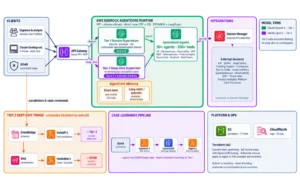
The core of this update lies in the maxAgentIteration parameter, which now supports a range from 0 to 5. This numeric control allows architects to define exactly how much "thinking" the AI should perform before returning an answer.
- Iteration 0: Retrieval-Only Mode. In this configuration, the system performs a single, optimized retrieval of relevant document passages without invoking a generation model. This is designed for applications where the end user or a secondary automated process needs to review raw source material directly. By eliminating the LLM call entirely, this mode minimizes latency and cost, providing a streamlined path for data ingestion.
- Iteration 1: Single-Shot RAG. This represents the "golden mean" for most enterprise applications. The system executes one search and one generation call. By stripping away the iterative planning phase, the architecture significantly reduces the time-to-first-token, making the assistant feel more responsive for direct, factual queries.
- Iterations 2–5: Agentic Retrieval. This mode remains the standard for complex problem-solving. By allowing up to four rounds of planning and retrieval, the system can self-correct, refine its search queries based on initial findings, and navigate multiple knowledge bases to build a comprehensive answer.
Chronology and Implementation Context
The rollout of these features follows a broader industry trend toward "agentic efficiency." Throughout 2024 and 2025, feedback from developers indicated that while the autonomous nature of AI agents was impressive, the "black box" nature of multi-step retrieval was leading to unpredictable latency in production environments.
By Q3 2026, AWS began integrating these granular controls into the Bedrock managed services ecosystem. The move acknowledges that enterprise AI is maturing from a period of "proof-of-concept" experimentation to a phase of "production-grade" optimization. By giving developers control over the loop count, AWS is effectively moving the AI closer to the deterministic behavior required by highly regulated sectors like finance, legal, and healthcare.
Supporting Data and Performance Metrics
Preliminary analysis of these retrieval tiers suggests significant improvements in system performance. In environments with high-frequency, well-scoped questions, moving from an agentic model (which typically defaults to 3–5 iterations) to a single-shot RAG (1 iteration) can reduce latency by an estimated 40% to 60%.
Furthermore, the elimination of unnecessary model calls in the "retrieval-only" (0 iteration) mode offers a direct reduction in operational expenditure. For large-scale banking operations—where thousands of queries may be processed per hour—the cumulative savings in compute costs are substantial. Furthermore, the predictability of the response time allows IT departments to set stricter Service Level Agreements (SLAs) for their internal AI assistants, as the latency of a single-shot request is far more consistent than that of an iterative, agentic search.
Implications for Enterprise Architecture
The introduction of these modes does not fundamentally change the infrastructure of Amazon Bedrock, but it does change the way architects must think about application design. The burden of "routing" now shifts from the AI’s internal logic to the application layer. Developers are encouraged to implement lightweight classification logic that directs simple questions to the single-shot path and complex, comparative questions to the agentic path.
This shift has several key implications:
- Improved User Experience: Employees interacting with internal bots will experience faster response times for common tasks, which increases overall adoption rates.
- Increased Transparency: In the "retrieval-only" mode, the system acts as a reliable indexer rather than a generator. This reduces the risk of "hallucinations" in scenarios where the user requires verbatim policy text for compliance audits.
- Cost Optimization: Organizations can now map their spending to the complexity of the query. High-value, complex queries get the full power of the LLM agent, while low-complexity queries are handled with minimal overhead.
Official Stance and Future Outlook
While AWS has not released specific usage statistics for the new parameter, the technical documentation suggests a clear strategic focus: "The lower the value, the faster and more predictable the call. The higher the value, the more the planner can decompose and refine on genuinely hard questions."
Industry analysts observe that this move is a direct response to the "agentic fatigue" seen in early AI deployments. As organizations continue to scale their generative AI efforts, the focus is shifting away from "how smart is the AI?" to "how efficiently does the AI serve the business process?" By providing these knobs and dials, AWS is positioning Bedrock as a platform that can handle both the mundane documentation lookups of a clerk and the complex, cross-departmental analysis of a senior analyst.
Best Practices for Adoption
For organizations looking to integrate these features, the recommended roadmap involves a three-stage audit of existing queries. First, administrators should review logs to identify the "top 20" most frequent, direct questions—these are prime candidates for the maxAgentIteration=1 setting. Second, they should isolate queries that historically failed or provided incomplete answers; these should be prioritized for higher agentic iteration limits. Finally, for workflows requiring strict adherence to source text—such as legal review—developers should implement the maxAgentIteration=0 mode to ensure the model acts solely as a retrieval mechanism.
As these tools continue to evolve, the distinction between a "chat bot" and an "intelligent business process" will continue to blur. With these updates, Amazon Bedrock provides the infrastructure necessary to ensure that as AI assistants grow more capable, they remain cost-effective, performant, and reliable in the high-stakes environment of modern enterprise operations. The ability to calibrate the "depth of thought" of an AI is not just a technical improvement; it is a fundamental step toward the sustainable integration of machine intelligence into the corporate workflow.