Optimizing Self-Hosted LLM Performance with Distributed KV Caching via Amazon ElastiCache and Agentic Workflows

The rapid proliferation of self-hosted large language models (LLMs) has empowered organizations to maintain strict control over data privacy, model fine-tuning, and operational costs. However, a significant architectural bottleneck has emerged: the inefficiency of GPU-local memory management. When LLMs process complex, multi-turn interactions—such as legal document analysis or extended coding assistance—they generate vast amounts of key-value (KV) attention states. In traditional configurations, these states are stored in isolated GPU memory. When a user returns to an existing session, the GPU, lacking the previous context, must perform a "prefill" operation to recompute these tokens. This redundancy leads to significant latency, often manifesting as a multi-minute delay before the first token appears. To address this, Amazon Web Services has introduced a distributed KV caching solution integrated with Amazon ElastiCache, now augmented by an automated skill within the Agent Toolkit for AWS.
The Architectural Challenge of GPU-Local Caching
In a typical production environment, GPU memory is a premium resource. Every byte dedicated to caching previous conversation history is a byte unavailable for active model computation or batch processing. Because standard inference engines store KV caches locally on individual server nodes, the system suffers from "context amnesia" whenever a request is routed to a different server or when a session is resumed after a period of inactivity.
For industries reliant on deep context, the impact is measurable. A legal AI assistant, for instance, may need to ingest 100,000 tokens of case history. If every interaction triggers a full re-prefill of this history, the latency becomes prohibitive. Studies indicate that this re-computation phase can account for up to 80% of the time-to-first-token (TTFT) in high-traffic environments. Furthermore, because GPU resources are underutilized during the heavy prefill phase—while simultaneously being expensive to lease—the financial inefficiency compounds, as organizations pay for high-performance silicon to perform redundant mathematical operations rather than generating new, valuable output.
The Emergence of Distributed KV Caching
The introduction of distributed KV caching shifts the paradigm from ephemeral, local storage to a persistent, shared tier. By utilizing Amazon ElastiCache as a secondary, high-speed memory layer, organizations can decouple the KV state from the GPU’s physical hardware. This architecture allows any server in a GPU fleet to retrieve existing KV states for a conversation, regardless of whether that specific server handled the previous turn.
The implications for cost and performance are substantial. Preliminary benchmarking by AWS suggests that implementing this distributed tier can reduce overall inference costs by up to 40% and slash TTFT by as much as 80%. By moving the KV cache to a dedicated, scalable memory cluster, the GPU is freed to focus exclusively on generation. This transition ensures that state persistence remains intact across load-balancing shifts, system restarts, and even transient server failures.
Automating Infrastructure with Agentic Skills
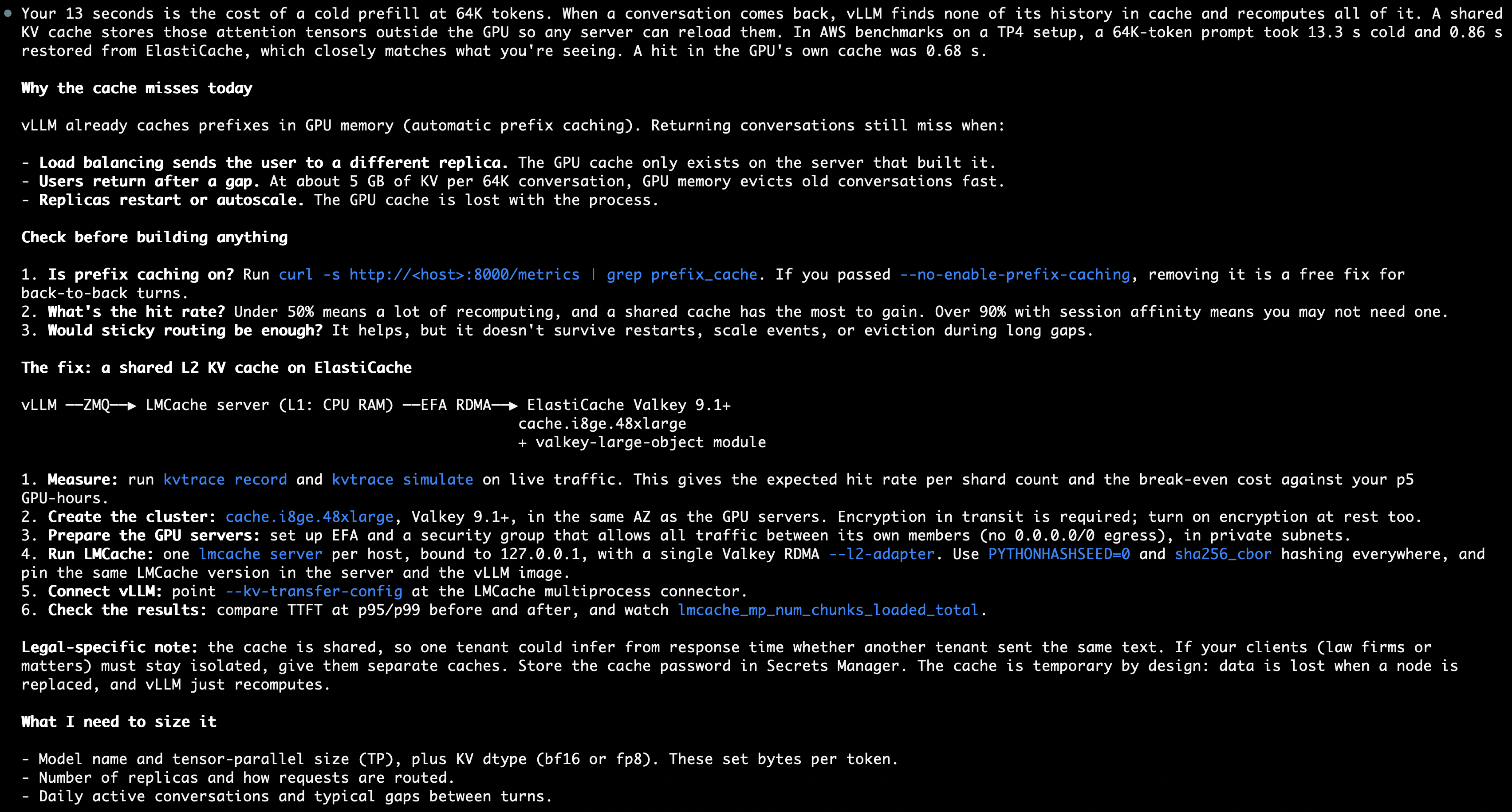
To lower the barrier to entry for this complex architecture, AWS has integrated a dedicated "distributed KV caching skill" into the Agent Toolkit for AWS. This tool is designed to work with sophisticated coding agents, including Kiro and Claude Code, allowing developers to manage the entire lifecycle of a cache deployment through natural language prompts.
The automation flow follows a rigorous four-stage process:
- Diagnostic Assessment: The agent evaluates the current workload, identifying whether the latency is indeed driven by cold-start prefill issues. It can determine if existing configurations, such as prefix caching, are already optimized or if a shift to distributed storage is required.
- Financial and Capacity Modeling: Using the KVTrace tool, the agent analyzes historical traffic patterns to estimate the necessary cache size. It cross-references current AWS pricing models for cache nodes against the potential savings gained from reduced GPU compute time, providing a clear ROI projection before any infrastructure is provisioned.
- Automated Provisioning: Once authorized, the agent configures the necessary Valkey 9.1 clusters, manages security groups, and ensures that Remote Direct Memory Access (RDMA) permissions are correctly established. This removes the manual burden of configuring high-performance networking between the inference servers and the cache nodes.
- Continuous Troubleshooting: The agent acts as an automated SRE, capable of interpreting system errors—such as failed RDMA transfers—and suggesting specific remediation steps, such as adjusting egress rules in security groups.
Technical Deep Dive: The Role of KVTrace
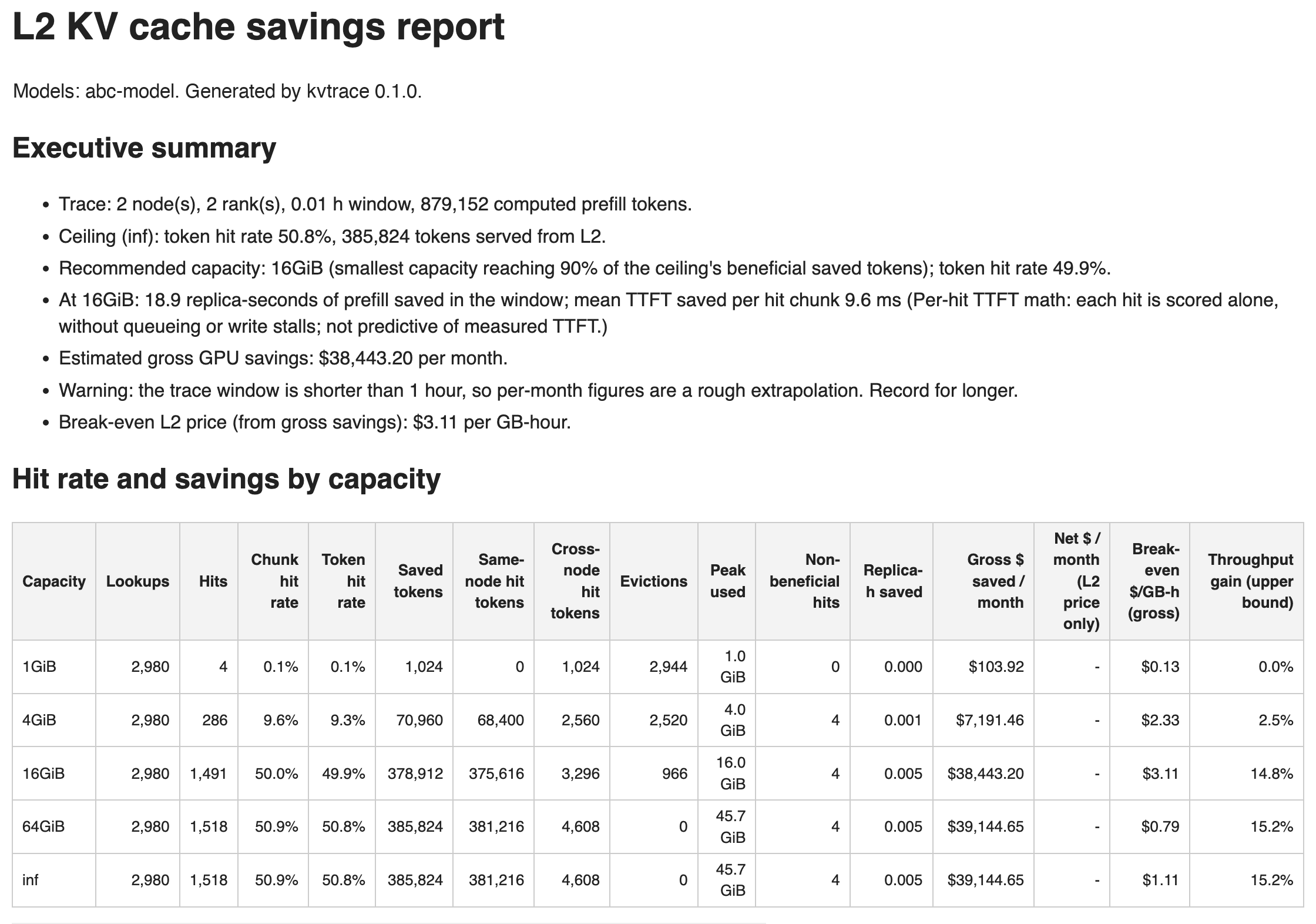
A critical component of this ecosystem is KVTrace, a tool that provides visibility into the "cache hit rate"—the percentage of recomputed tokens that could be avoided via caching. Unlike traditional logging tools, KVTrace is designed for privacy and performance. It records metadata about KV events without capturing sensitive prompt text or token IDs.
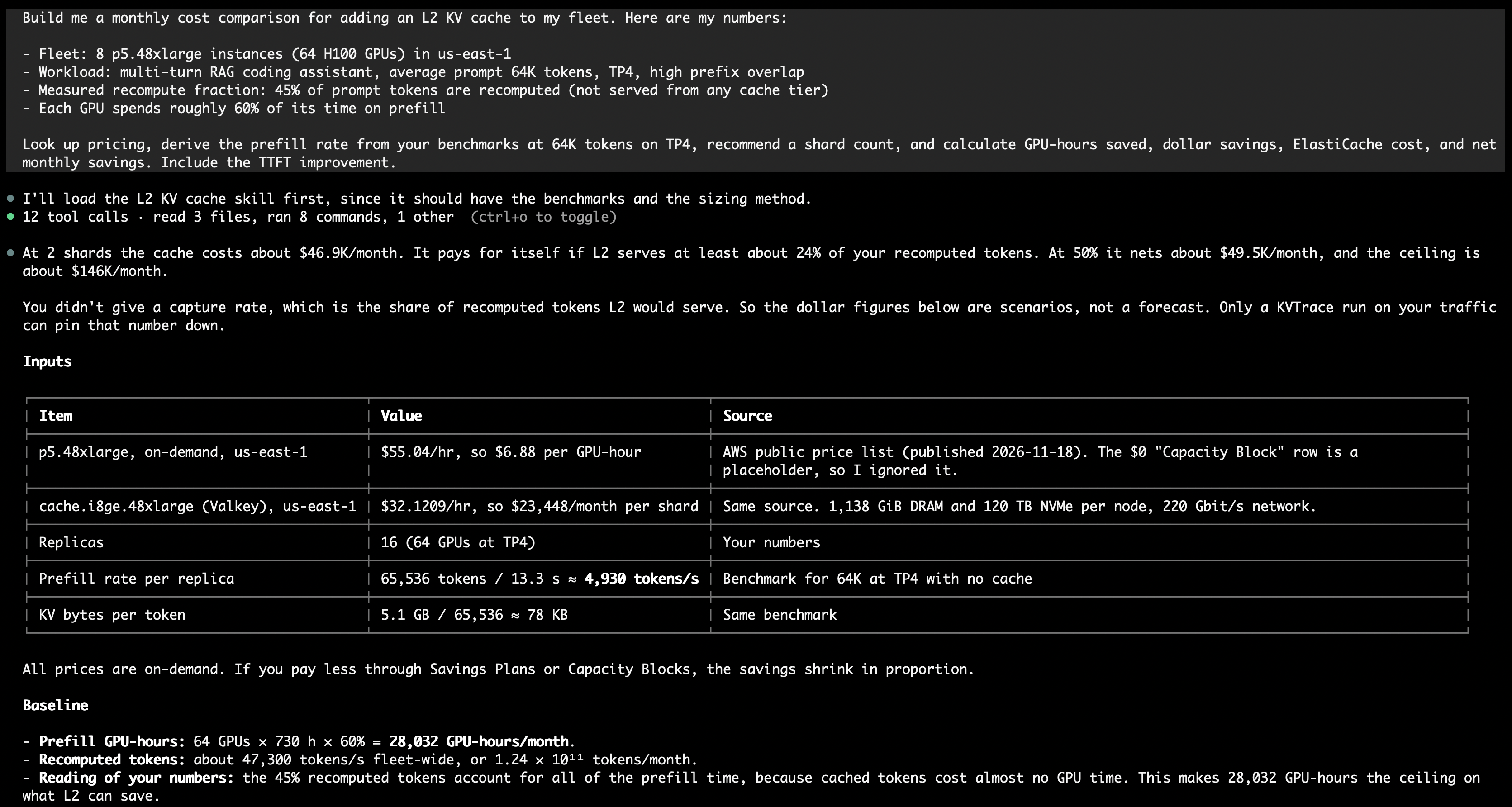
By replaying these events against candidate cache sizes in an offline simulation, administrators can accurately predict the performance impact before deployment. This data-driven approach allows for "right-sizing," ensuring that organizations do not over-provision memory, which would otherwise negate the cost-saving benefits of the system.
Strategic Implications for AI Infrastructure
The shift toward distributed state management represents a maturation of the AI infrastructure market. As enterprises move beyond initial proof-of-concept AI projects, the focus is shifting from simple model deployment to the long-term sustainability and performance of production environments.
The use of ElastiCache for this purpose is particularly noteworthy. By leveraging a battle-tested, managed database service for AI state, AWS is effectively bridging the gap between traditional distributed systems and the unique, high-bandwidth requirements of large language models. The integration of agentic workflows suggests that the future of managing these complex systems will be increasingly autonomous. Developers will no longer need to be experts in EFA (Elastic Fabric Adapter) configuration or RDMA tuning; instead, they will act as supervisors to AI agents that handle the underlying infrastructure orchestration.
Future Outlook and Operational Best Practices
For organizations currently operating large-scale GPU fleets, the transition to distributed KV caching should be approached methodically. The first step involves quantifying the "prefill tax" on current operations. If the average session length is short or the context windows are minimal, the overhead of maintaining a distributed cache may outweigh the benefits. However, for applications involving RAG (Retrieval-Augmented Generation), agentic workflows, or long-form document processing, the transition is increasingly viewed as a necessity for scaling.
Security remains a primary concern in shared-memory environments. The AWS implementation addresses this by supporting multi-tenant isolation, where separate caches or unique hash IDs are assigned to different tenants. This ensures that even in a shared cluster, one user’s data cannot be inferred from the latency or presence of another’s cache hits.
As the industry continues to iterate, the standardization of these caching protocols will likely become a cornerstone of AI architecture. By treating the KV cache as a first-class citizen of the infrastructure stack, rather than an afterthought of the GPU memory controller, organizations can ensure that their AI systems remain both responsive and cost-effective as they scale to meet the demands of enterprise-grade applications. The availability of the Agent Toolkit for AWS ensures that this sophisticated architecture is not limited to organizations with massive DevOps teams, but is instead accessible to any engineering team capable of articulating their performance goals to an AI assistant.