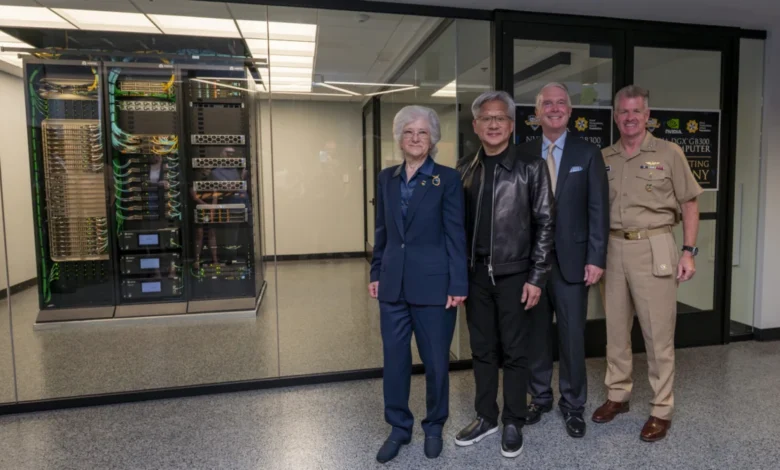
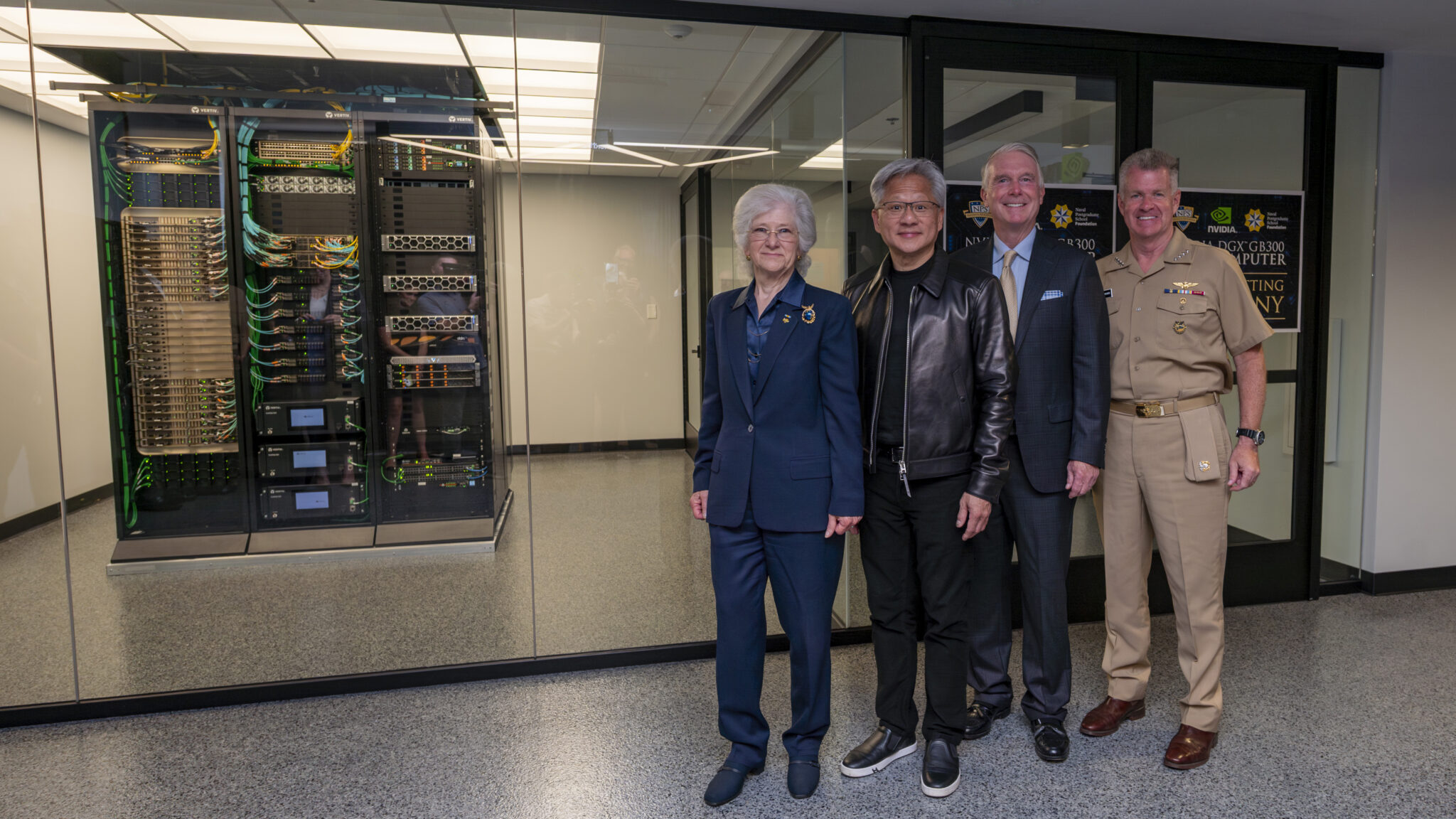
Jensen Huang, the visionary founder and CEO of NVIDIA, marked a significant milestone today by visiting the Naval Postgraduate School (NPS) in Monterey, California, to officially commission the institution’s new NVIDIA DGX GB300 system. This state-of-the-art supercomputer represents a pivotal advancement, bringing one of the world’s most powerful artificial intelligence (AI) platforms fully online for the students, researchers, and faculty at the U.S. military’s premier graduate institution. The deployment signifies a deepening commitment to integrating cutting-edge AI capabilities into defense education and research, aiming to equip military leaders with the foresight and tools necessary to navigate an increasingly complex global landscape.
"Our nation depends on our men and women who fight on the front lines," Huang stated during the commissioning ceremony, underscoring the critical importance of information and insight in defense operations. "Nothing is more valuable to you than information and insight, and information and insight in a timely way, and to understand its impact and consequence. I can’t imagine anything more important." His remarks highlighted the direct correlation between advanced computational power and the ability to provide strategic advantages through enhanced understanding and rapid decision-making.
The newly commissioned DGX GB300 system, enhanced with NVIDIA Mission Control software, will provide NPS’s extensive academic community—comprising over 1,500 in-resident students and approximately 600 faculty members—with unparalleled on-premises access to large-scale AI computing. This includes robust capabilities for both AI model training and inference, which are essential for developing and deploying sophisticated applications. The potential applications are vast, spanning critical areas such as advanced weather prediction for operational planning, strengthening cybersecurity defenses against evolving threats, and enhancing disaster resilience and response planning in complex environments.
This momentous occasion took place during the school’s three-day Converge @ NPS event, a forum designed to foster collaboration and explore emerging technologies. The commissioning of the DGX GB300 represents the latest phase in an ongoing, strategic partnership between NPS and NVIDIA, focused on the development of AI-based technologies for both educational advancement and practical, real-world defense applications. This collaboration aims to bridge the gap between theoretical AI research and its tangible implementation in military operations.
The DGX GB300 system is anchored within an NVIDIA AI Technology Center established on the NPS Monterey campus. This dedicated hub serves as a focal point for AI research and graduate-level instruction, now empowered by the formidable computational resources of the DGX GB300. This infrastructure is designed to accelerate discovery and innovation across various defense-related disciplines.
Admiral Samuel Paparo, Commander of the U.S. Pacific Command, emphasized the strategic necessity of such technological integration. "As we modernize our technology, we must also modernize how we educate our leaders," Admiral Paparo remarked. "Access to advanced computing capability means NPS students and faculty understand the opportunities and responsibilities that come with these technologies." His statement reflects a broader understanding within the military leadership that technological prowess must be matched by informed and responsible application, particularly in the realm of AI.
Training Leaders to Build and Command With AI
The Naval Postgraduate School plays a unique and vital role in educating active-duty officers from all branches of the U.S. military, as well as international partners. Its programs span a diverse array of disciplines, from highly technical fields like space operations and electronic warfare to critical areas such as ocean science, national security affairs, and business analytics. NPS awards graduate degrees, with a distinctive emphasis on applied research that directly addresses pressing real-world problems faced by the Department of Defense and other government agencies. This practical, research-driven approach ensures that graduates are not only academically prepared but also equipped with the skills to tackle immediate operational challenges.
Huang’s philosophy on leadership, shared with the NPS community, resonated with the institution’s core mission. "Leadership is about being in service of something else," he explained. "You’re in service of your team. You’re in service of your country. You’re in service of your mission. And all of this technology is just tools to help you." This perspective frames AI not as a replacement for human judgment, but as a powerful enabler for those in leadership positions.
The integration of the DGX GB300 supercomputer is poised to imbue these diverse academic programs with new technical depth. Its advanced capabilities will enable NPS to:
- Train Foundation Models In-House: This allows for greater control and customization of AI models tailored to specific defense needs, reducing reliance on external entities and fostering indigenous AI development capabilities.
- Run High-Fidelity Simulations at Scale: Complex scenarios, from battlefield simulations to logistical planning, can be modeled with unprecedented accuracy and detail, providing valuable insights for strategic decision-making.
- Develop AI Tools with Immediate Applicability: The system accelerates the creation of practical AI solutions that can be deployed rapidly to address emerging challenges in military operations and intelligence gathering.
Huang offered encouragement to those who might feel intimidated by the complexity of AI, emphasizing its increasing accessibility. "The most important advice that I would give to someone is to engage the technology," he advised. "It’s not as hard as you think it is, and the reason for that is because, on first principles, technology is supposed to get smarter and smarter over time." This sentiment aims to demystify AI and encourage broader adoption and experimentation among the NPS academic community.
NVIDIA has further solidified its commitment to NPS through its Deep Learning Institute (DLI). By providing instructor toolkits and training resources, NVIDIA empowers NPS faculty to integrate AI education seamlessly into their graduate curricula across various departments. This ensures that AI literacy becomes a foundational element of the education provided at NPS, preparing future leaders for an AI-enabled military.
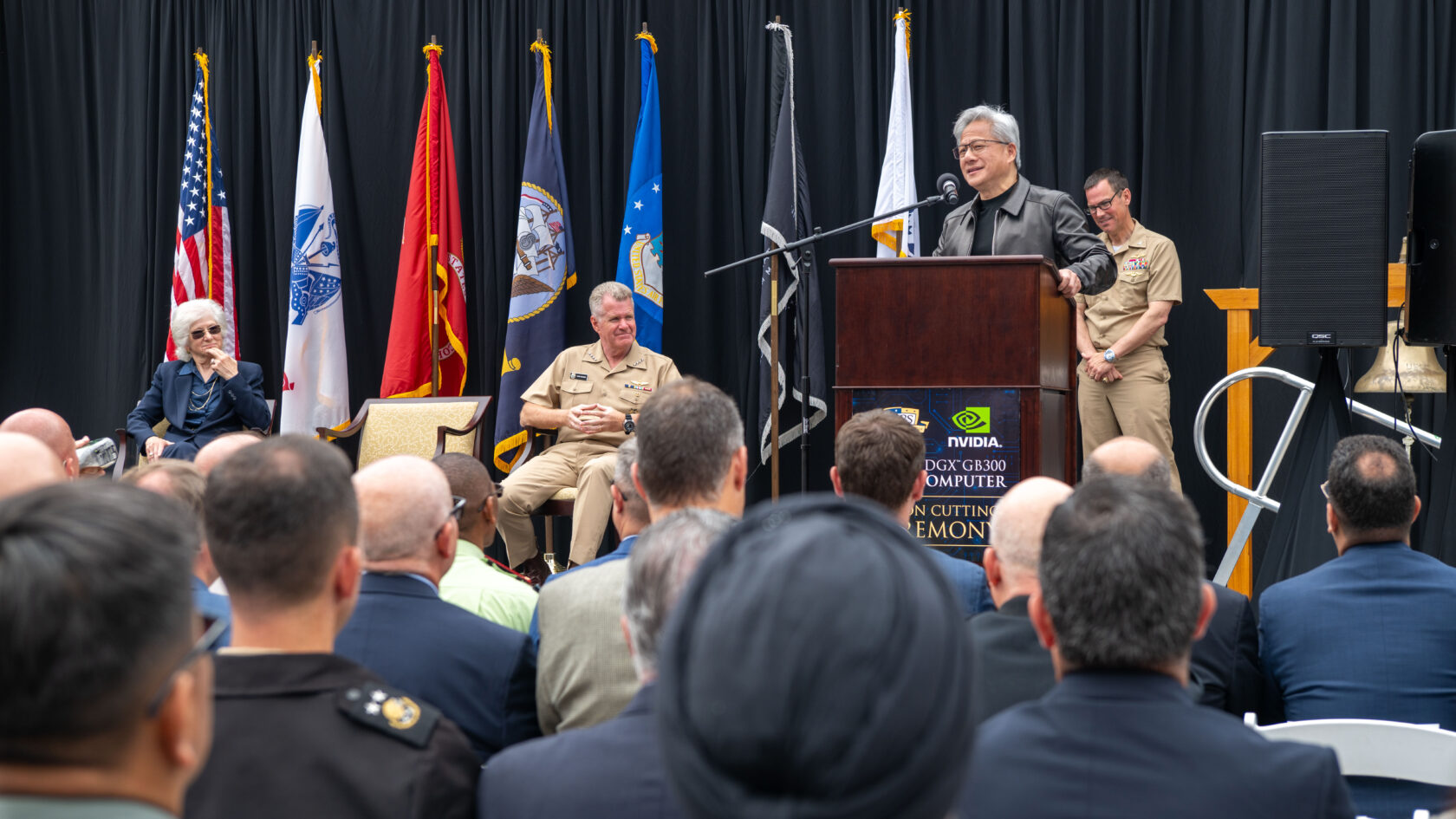
Admiral Paparo reiterated the operational implications of this enhanced AI capability for future military commanders. "Many of you will command in AI-enabled environments. Information will move at lightning speeds, compressing response times," he stated. "Our advantage will come from leaders, like you, who can use the technology to see, understand, decide and act faster while exercising the judgment, experience and leadership that machines cannot provide. That education is happening here at NPS." This underscores the critical role of human leadership in leveraging AI effectively, ensuring that technological advancements augment, rather than supplant, human strategic thinking and ethical judgment.
From Ocean Models to Digital Twins: Advancing Critical Research
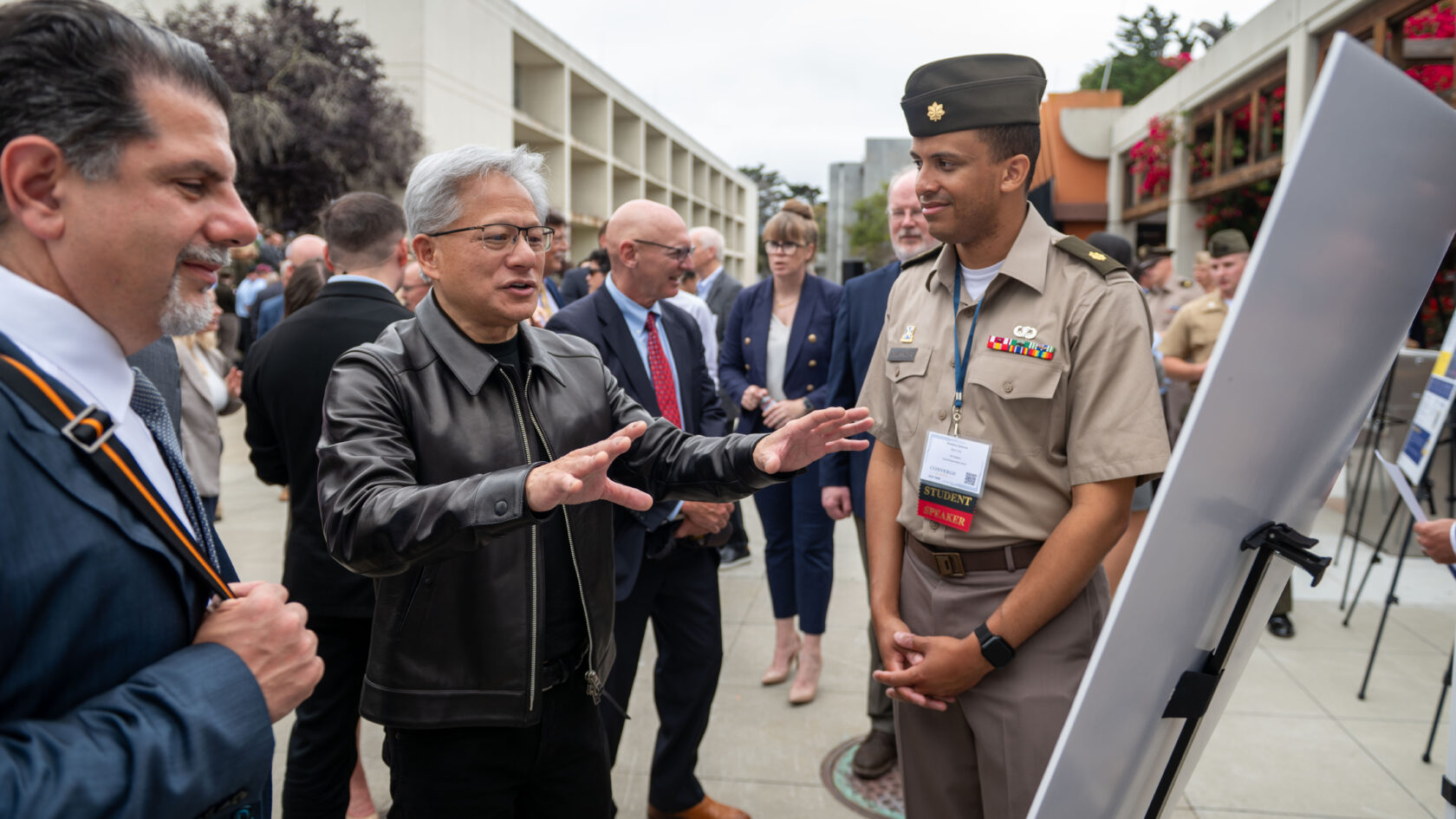
The Naval Postgraduate School has a long-standing tradition of fostering innovation through applied research, often facilitated by regular hackathons and collaborative projects. These events have historically spurred significant advancements in areas such as autonomous systems, deep ocean research, and operational planning. However, scaling these innovative concepts into practical, deployable solutions has often been constrained by computational limitations. The introduction of the DGX GB300 supercomputer directly addresses this challenge, providing the necessary power to scale these ambitious research endeavors.
Researchers at NPS are actively leveraging AI to tackle some of the most complex environmental and operational challenges. This includes developing sophisticated models for predicting sea conditions, which are vital for naval operations, maritime commerce, and understanding climate change impacts. AI is also being employed to forecast atmospheric changes with greater precision, aiding in weather prediction for tactical planning and long-term climate analysis. Furthermore, the creation of "digital twins"—virtual replicas of physical environments or systems—is a key area of focus. These digital twins, powered by AI, allow for the simulation of complex real-world scenarios, enabling researchers and students to test hypotheses, evaluate strategies, and understand the behavior of intricate systems under various conditions. This work directly feeds into the scientific domains where NPS possesses deep expertise, such as oceanography, meteorology, and systems engineering.
The DGX GB300 will now serve as the primary engine for these cutting-edge research workloads on campus, significantly accelerating the pace of discovery and development. This enhanced computational capacity is particularly crucial for projects involving high-fidelity simulations and the training of complex AI models.
In collaboration with MITRE, a non-profit organization that operates federally funded research and development centers, NPS has developed a sophisticated framework utilizing NVIDIA Omniverse libraries. This framework enables the creation of high-fidelity digital twin environments. These environments are designed to simulate real-world navigation, complex decision-making processes, and operational challenges under conditions of uncertainty, providing a safe and effective space for experimentation and training. The ability to create and interact with such detailed virtual environments is a significant step forward in preparing military personnel for the complexities of modern operations.
For those interested in delving deeper into the intersection of AI, modeling, and simulation at NPS, presentations by NPS and NVIDIA researchers at NVIDIA GTC Washington, D.C., offer further insights into their ongoing work. These sessions highlight the practical applications of AI in defense research and the methodologies employed to achieve these advancements.
NVIDIA Partner Ecosystem Brings AI Infrastructure to Life
The successful deployment of the NVIDIA DGX GB300 at NPS is a testament to a collaborative effort involving key partners from the technology industry. This ecosystem approach ensured that the supercomputing infrastructure was not only powerful but also robust, scalable, and efficiently integrated. DDN, VAST Data, and Vertiv played crucial roles as hardware and systems integration partners, contributing specialized expertise and solutions that were essential for bringing the DGX GB300 online.
DDN (DataDirect Networks), a leader in high-performance data infrastructure, contributed its expertise to ensure that researchers at NPS could efficiently access, manage, protect, and scale their data. For demanding AI workloads, particularly those involving large datasets for model training and simulation, high-performance storage and data management are paramount. DDN’s solutions are designed to accelerate data throughput and reduce latency, enabling researchers to maximize the utilization of the DGX GB300’s computational power. Their involvement ensures that the flow of data to and from the supercomputer is seamless and efficient, preventing bottlenecks that could otherwise hinder research progress.
VAST Data provided a unified data platform, crucial for enabling secure and streamlined data access and management across diverse environments. In modern research settings, data often resides in multiple locations—at the edge, in core data centers, and in the cloud. VAST Data’s platform simplifies this complexity by offering a single, coherent environment for data access and governance. This is particularly important for defense research, where data security and integrity are of utmost importance, and for facilitating collaboration among researchers working from different locations. Their solution ensures that researchers can readily access the data they need, regardless of its physical location, while maintaining stringent security protocols.
Vertiv, a global provider of critical digital infrastructure and continuity solutions, was instrumental in providing the physical infrastructure necessary to house and operate the DGX GB300 system. This included the provision of racks, advanced cooling systems, and robust power infrastructure, all of which are essential for the stable and reliable operation of high-performance computing systems. Beyond hardware, Vertiv also offered comprehensive support for installation sequencing, rigorous testing, and the commissioning process. Their expertise in fluid management and monitoring further ensures the optimal thermal performance and longevity of the supercomputer. The seamless integration of these physical components by Vertiv was critical for bringing the powerful DGX GB300 system into full operational status.
The combined efforts of NVIDIA and its esteemed partners highlight the sophisticated engineering and collaborative spirit required to deploy cutting-edge AI infrastructure within a leading academic and research institution. This integrated approach ensures that the Naval Postgraduate School is equipped with not only the most advanced AI computing hardware but also the supporting ecosystem necessary for its effective and sustained utilization, thereby accelerating its mission to educate future leaders and advance defense capabilities.