AMD Launches Helios Rack System, Challenging Nvidia’s Dominance in AI Infrastructure

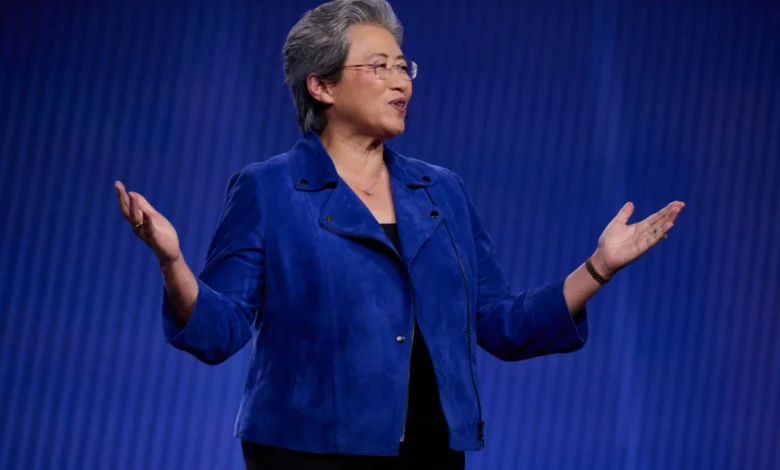
At a packed Advancing AI conference in San Francisco, chipmaker AMD unveiled its ambitious new rack-scale system, codenamed Helios, a direct challenge to competitor Nvidia’s long-standing stronghold in the high-performance computing market for artificial intelligence. The move signals AMD’s aggressive push to capture a significant share of the burgeoning AI infrastructure sector, which is projected to experience explosive growth in the coming years.
The Advancing AI conference, held on Thursday, served as the global stage for AMD Chair and CEO Dr. Lisa Su to present Helios, a system designed to meet the immense computational demands of the world’s leading AI laboratories. The event, which saw all available tickets sold out, underscored the intense industry interest in AMD’s latest offerings. Dr. Su highlighted the growing roster of high-profile customers already committed to adopting Helios, including tech giant Microsoft, with the system slated for shipment later this year. Beyond the Helios system, Su also introduced AMD’s newest generation of chips, engineered to fuel the insatiable appetite of the AI industry for processing power.
Understanding Rack Systems and Their Significance in AI
Rack systems represent a critical evolution in data center architecture, consolidating numerous high-performance processors into a single, powerful unit. These integrated solutions are specifically architected for data centers, the foundational environments where AI models are trained and deployed, and other computationally intensive workloads are executed. The concentration of processing power within a rack system is crucial for the complex calculations and vast datasets involved in modern AI development, from training large language models to running sophisticated simulations.
Dr. Su positioned Helios as the technology industry’s "highest-performance AI rack," emphasizing its capability to "train and run the most demanding frontier models in the world at massive scale." The company announced that Helios will be deployed by leading AI entities at a gigawatt-scale, indicating the sheer magnitude of its intended application. This scale suggests that Helios is not merely an incremental upgrade but a foundational component for the next generation of AI development, capable of powering initiatives that require unprecedented levels of computational throughput.
The Competitive Landscape: AMD vs. Nvidia
Historically, Nvidia has maintained a dominant position in the AI rack system market with its established offerings, such as the Vera Rubin and Grace Blackwell systems. AMD’s entry with Helios is a clear and direct attempt to disrupt this established order and capture a substantial portion of this lucrative market. Early performance metrics for Helios, as reported by The Register, appear to bolster AMD’s competitive claims, suggesting it may outperform Nvidia’s Vera Rubin across several key benchmarks. This competitive positioning is crucial for AMD as it seeks to gain traction against a well-entrenched incumbent.
The unveiling of Helios is not entirely new; the system was initially revealed in 2025 and showcased on stage at CES 2026. However, the Advancing AI conference marked a significant milestone with the confirmation of its production timeline and the announcement of its early customer base. The list of prominent clients already committed to deploying Helios includes industry titans such as OpenAI, Meta, Oracle, Anthropic, and Microsoft. This broad adoption by leading AI innovators underscores the perceived value and performance of AMD’s offering.
Microsoft CEO Satya Nadella confirmed on Monday that the company intends to expand its Azure cloud infrastructure by integrating Helios. This strategic decision by Microsoft, a major cloud provider and AI developer, is a significant endorsement of AMD’s capabilities. Simultaneously, Anthropic and AMD announced a strategic partnership on Wednesday, which will involve the deployment of up to two gigawatts of AMD Instinct MI450-series GPUs through the new Helios rack system. This collaboration signifies a substantial commitment to AMD’s hardware for cutting-edge AI research and development.
Expanding the AI Compute Portfolio: Venice-X CPU
In addition to the Helios rack system, AMD also introduced its Venice-X CPU on Thursday. This new processor is specifically designed for data centers and is engineered to handle exceptionally high-computing workloads. The Venice-X is anticipated to launch in 2027, further strengthening AMD’s portfolio of data center solutions aimed at the AI revolution. The introduction of a new, high-performance CPU designed for demanding AI tasks complements the GPU-centric Helios system, offering a more comprehensive hardware ecosystem for AI development.
The Future of AI Compute: Market Projections and AMD’s Vision
During her keynote address, Dr. Su articulated a compelling vision for the trajectory of the chip industry, asserting that AI-powering chips will constitute a colossal segment of the overall computing market by the year 2030. This forecast is driven by what she described as a "step change in compute demand," a phenomenon largely attributable to the rapid advancements and increasing sophistication of agentic AI.
"When you ask the agent to do something, it actually has dozens of steps, and it has to reason, and it has to call tools, and it has to access data, and it has to keep doing it over and over until it solves the problem, and so you need lots of GPUs to do all that," Dr. Su explained, illustrating the intricate computational processes inherent in agentic AI that necessitate significant processing power.
The AMD CEO provided a striking market projection: "We do expect that by 2030, the AI accelerator market is going to reach about $1.4 trillion. What that means is, by the end of the decade, the AI accelerator market is going to approach the size of the entire semiconductor market today." This projection suggests a paradigm shift in the semiconductor industry, with AI accelerators becoming a dominant force.
Further elaborating on the architectural preferences for this burgeoning market, Dr. Su stated, "We do expect that GPUs are going to make up the vast majority of that market because the algorithms are still very much in their infancy, and we’re still continuing to see the workloads change, and that favors programmability in the overall silicon ecosystem." This indicates AMD’s strategic focus on GPUs as the primary enabler of future AI advancements, while also acknowledging the ongoing evolution of AI algorithms and the need for flexible, programmable hardware solutions.
Implications and Broader Impact
AMD’s aggressive push into the AI rack system market with Helios signifies a major shift in the competitive dynamics of the semiconductor industry. By directly challenging Nvidia’s established dominance, AMD is not only seeking to diversify its revenue streams but also to position itself as a key player in one of the most transformative technological waves of our time. The company’s strategic investments in high-performance GPUs and CPUs, coupled with its focus on integrated rack-scale solutions, indicate a comprehensive approach to capturing the escalating demand for AI infrastructure.
The endorsement and early adoption by major AI players like Microsoft and OpenAI lend significant credibility to AMD’s offerings. These partnerships not only provide crucial revenue streams but also offer valuable feedback loops for product development, allowing AMD to refine its hardware and software solutions to meet the evolving needs of the AI ecosystem. The sheer scale of deployment, exemplified by the gigawatt-scale commitments, highlights the massive investment that AI leaders are making in computational resources, underscoring the critical role of companies like AMD and Nvidia in enabling this technological frontier.
The projected growth of the AI accelerator market to $1.4 trillion by 2030 is a testament to the transformative potential of artificial intelligence across various industries. This market expansion presents a substantial opportunity for semiconductor manufacturers capable of delivering the necessary computational power, efficiency, and scalability. AMD’s strategic positioning with products like Helios and Venice-X suggests a deliberate effort to capitalize on this unprecedented market growth.
The emphasis on GPUs as the dominant component within this market reflects the current state of AI algorithm development, which heavily relies on parallel processing capabilities inherent in graphical processing units. As AI research continues to push the boundaries of what is possible, the demand for more powerful, efficient, and programmable hardware will only intensify. AMD’s commitment to these areas positions it to be a significant contributor to the future of AI development, potentially reshaping the competitive landscape and driving innovation in the process. The success of Helios and the broader AI strategy from AMD will be closely watched by industry analysts and competitors alike as the race to build the future of artificial intelligence continues at a breakneck pace.
Related posts: