Data-Driven Insights Reveal the True Path to Landing a Remote Job Amidst Soaring Competition

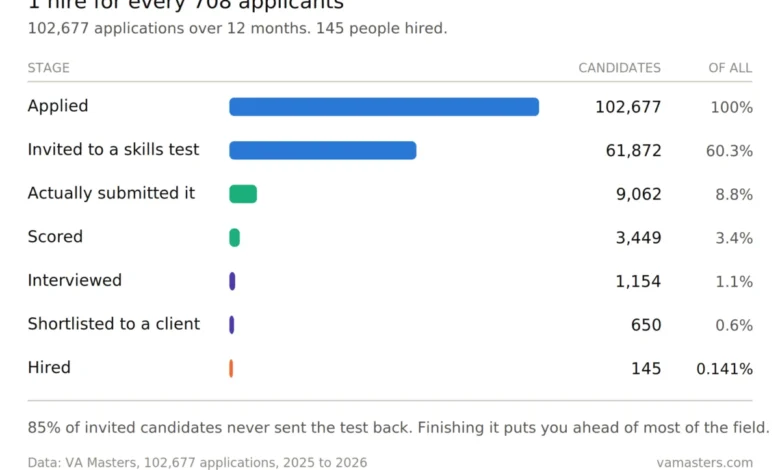
An unprecedented analysis of over 100,000 remote job applications has unveiled a definitive roadmap for success in the fiercely competitive virtual hiring landscape, challenging conventional wisdom and highlighting often-overlooked factors. Alon Pearl, Founder and CEO of VA Masters, a recruitment agency specializing in placing virtual assistants globally, meticulously examined 102,677 applications processed over the past year. From this colossal pool, a mere 145 individuals were ultimately hired, resulting in daunting odds of approximately 1 in 708. However, Pearl’s findings illuminate that the path to securing a remote role is far from random, instead hinging on a predictable set of behaviors and competencies that consistently distinguished successful candidates.
The Remote Work Revolution: A Sea of Applicants and Evolving Hiring Dynamics
The global workforce has undergone a seismic shift, particularly accelerated by the events of recent years. Remote work, once a niche perk, has transitioned into a mainstream expectation and, for many, a necessity. This paradigm shift has opened up unprecedented opportunities, allowing individuals to seek employment globally and companies to tap into diverse talent pools unrestricted by geography. However, this liberation comes with a significant challenge: an explosion in application volume. Employers now face the arduous task of sifting through thousands, sometimes tens of thousands, of resumes for a single remote opening. Traditional hiring metrics, often reliant on in-person interviews and extensive resume vetting, have proven insufficient to navigate this new reality efficiently and effectively.

VA Masters, positioned at the nexus of this remote talent boom, experienced this phenomenon firsthand. Their role in sourcing, vetting, and placing virtual assistants for businesses across the US, UK, Canada, Australia, and Europe provided them with a unique, data-rich vantage point. The sheer volume of applications they managed – averaging one every five minutes, around the clock, for a year – offers an unparalleled dataset to dissect the mechanics of remote hiring success from the recruiter’s perspective, rather than the job seeker’s. Pearl’s insights, therefore, offer a rare glimpse behind the curtain, revealing the signals that truly resonate with hiring managers in a digital-first recruitment process.
Beyond the Resume: Five Pillars of Remote Hiring Success
Pearl’s analysis distilled the complex hiring funnel into five critical factors that consistently differentiated the successful 145 hires from the overwhelming majority of applicants. These insights underscore a fundamental shift in what truly matters in remote talent acquisition, moving beyond superficial credentials to demonstrated commitment and capability.
1. The Urgency Factor: Speed as a Signal of Engagement
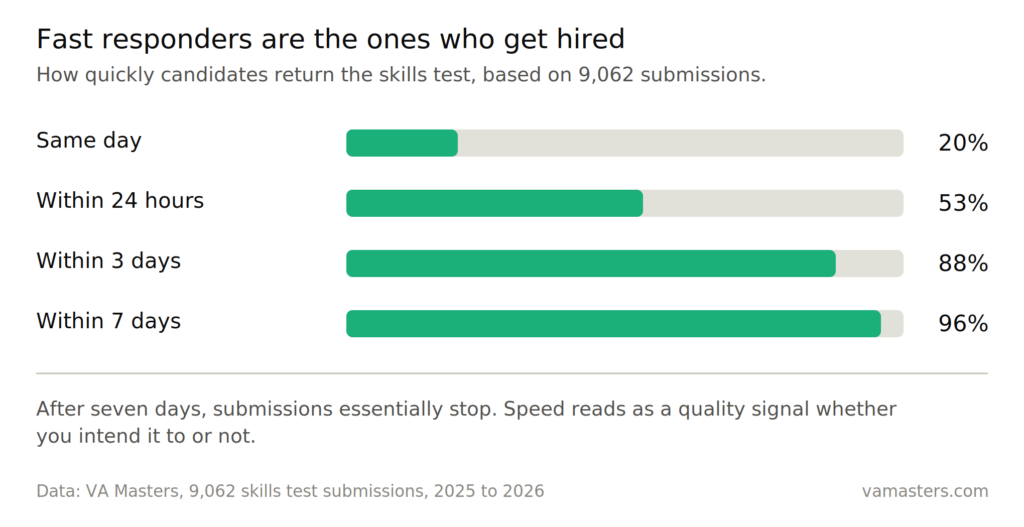
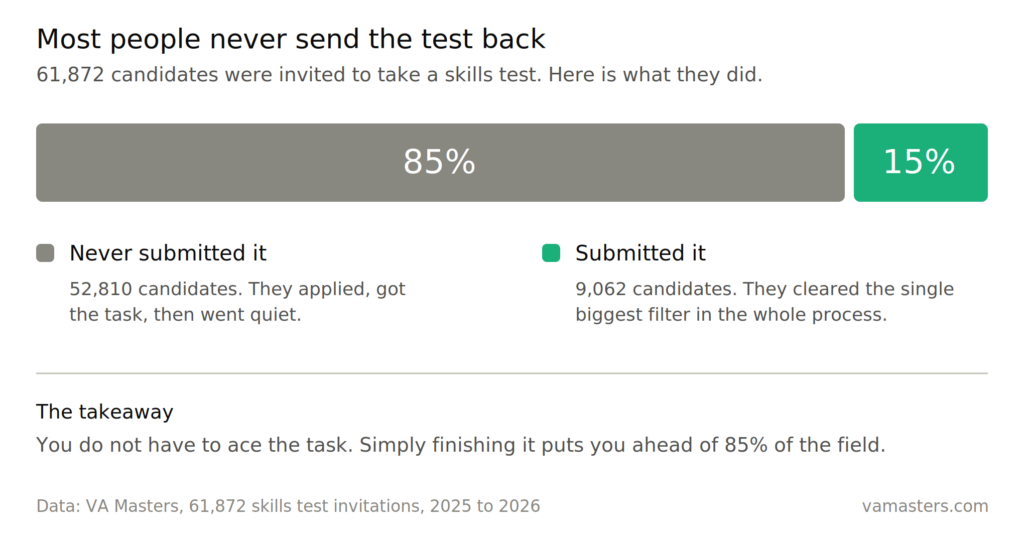
One of the most striking findings concerned the critical role of responsiveness. When candidates were invited to undertake a skills test – a standard evaluative step in VA Masters’ process – a staggering 85% simply disappeared. They applied, expressed interest, but failed to complete the requested task. Among the 15% who did engage, timing proved to be a powerful indicator. Over half (53%) submitted their tests within 24 hours, and nearly all successful submissions (96%) arrived within a week. After seven days, the submission rate effectively flatlined.
This rapid response is not merely about eagerness; it functions as a potent quality signal. In a remote environment, where direct supervision is limited, a candidate’s proactive approach and ability to meet deadlines are paramount. Recruiters interpret swift action as an indicator of organization, dedication, and genuine interest. Conversely, a prolonged delay suggests a lack of prioritization, poor time management, or waning interest, all of which are red flags for roles requiring self-discipline and initiative. For job seekers, this implies that when a genuine opportunity arises, treating it with immediate attention and delivering promptly, without sacrificing quality, can significantly elevate their candidacy above the vast majority.
2. The Power of Completion: Follow-Through Outweighs Initial Impressions
The 85% drop-off rate on skills tests is perhaps the most profound revelation. These were applicants who cleared the initial resume screen, signaling some level of qualification, yet failed at the next crucial hurdle. This phenomenon, often referred to as "applicant ghosting" in the online recruitment space, highlights a critical deficiency in many job seekers’ strategies: a lack of follow-through.
Pearl emphasizes that merely completing the assigned task, regardless of its brilliance, places a candidate far ahead of the competition. A well-crafted resume and an impressive cover letter may open the door, but it is the demonstrated ability to commit to and execute a simple task that truly predicts success in the actual job. For remote roles, where autonomy and accountability are key, a candidate’s reliability in completing small, initial tasks serves as the most accurate predictor of their ability to handle larger responsibilities. This insight suggests that job seekers should prioritize completing every step of the application process with diligence, as this commitment often outweighs the perceived perfection of earlier application stages.
3. Demonstrated Competence: What You Can Do Trumps What You Have Done
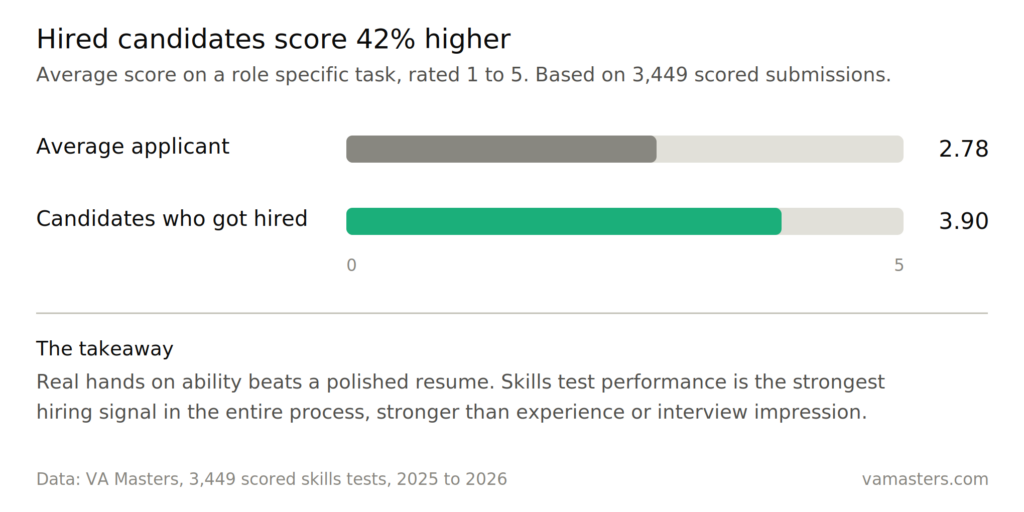
The analysis further underscored the supremacy of practical skills over historical credentials. VA Masters scores every skills test on a 1-to-5 scale, with these tests designed to mirror the actual tasks of the job – whether reconciling accounts, designing to a brief, or building automation. The data revealed a significant gap between average applicants and successful hires: the average applicant scored 2.78, while hired candidates averaged 3.90 – a remarkable 42% difference.
This skills test score was identified as the single strongest predictor of success in the entire hiring process, surpassing even years of experience, polished resumes, or smooth interview performances. This finding is particularly encouraging for early-career professionals or those looking to pivot into new industries. It suggests that demonstrable competence, honed through genuine skill development, can effectively level the playing field against candidates with more extensive (but perhaps less relevant or outdated) experience. The remote work environment, with its emphasis on deliverables and measurable outcomes, naturally gravitates towards verifiable abilities. Companies are increasingly seeking proof of performance rather than just promises of potential.
4. The Specialist’s Advantage: Niche Expertise in a Generalist World
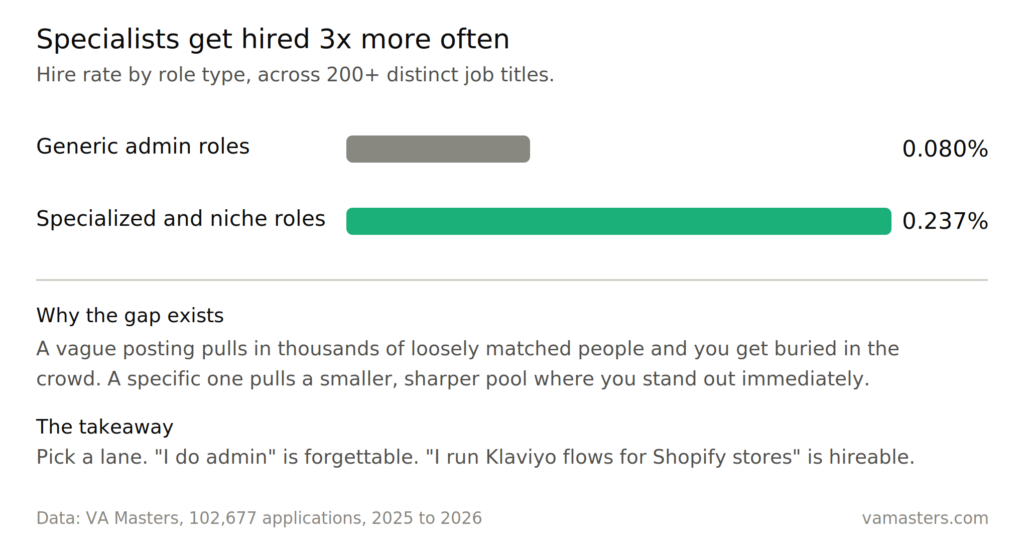
Counter-intuitively, generalist roles like "virtual assistant" or "admin support" proved to be the hardest to land. When Pearl categorized roles, generic administrative postings had the lowest hire rate at 0.08%. In stark contrast, specialized roles – those requiring proficiency in a specific tool (e.g., Klaviyo, Salesforce) or expertise within a particular industry (e.g., e-commerce, real estate) – boasted a hire rate of 0.24%, three times higher than generalist positions.
The reason is simple: a broad job description attracts a massive, often loosely qualified, applicant pool, making it incredibly difficult for any single candidate to stand out. A specialized posting, however, draws a smaller, more targeted group of candidates who possess the precise skills required. In the global marketplace of remote talent, companies can afford to be highly specific in their needs, bypassing generalists for individuals who can immediately add value in a defined capacity. This insight strongly advises job seekers to cultivate and articulate niche skills. Instead of presenting themselves as "general admin," demonstrating expertise in "running Klaviyo email flows for Shopify stores" creates a much clearer, more compelling value proposition for potential employers.
5. Dispelling Myths: Age and Timing’s Subtle Influence
Finally, Pearl’s data debunked persistent myths and offered tactical advice regarding the application process itself.
Age: The notion that remote work is exclusively a "young person’s game" was definitively disproven. The median age of successful hires (29) was identical to the median age of the overall applicant pool (29). This indicates that candidates in their forties, fifties, and beyond achieved success at the same rate as those in their twenties. Experience, particularly when aligned with specialized skills, remains a significant asset. The focus is on capability and follow-through, not the birth year. This is a vital reassurance for experienced professionals looking to transition into remote roles.
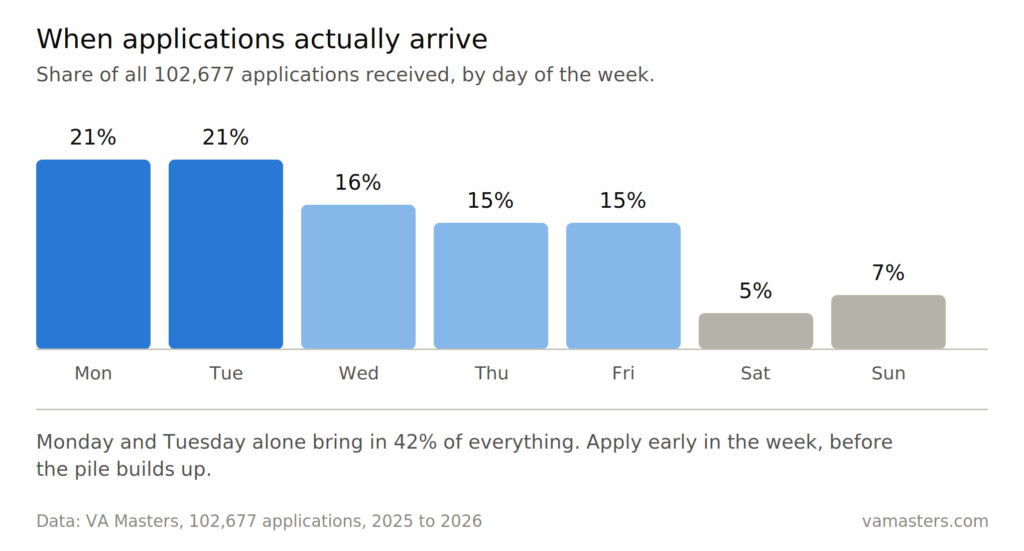
Timing: While a smaller factor, the timing of an application was found to offer a subtle edge. A disproportionate 42% of applications were received on Mondays and Tuesdays, with weekends seeing significantly lower volumes. Applying earlier in the week means a candidate’s application is more likely to land when recruiters are fresh, and the queue of new submissions is shorter. In a high-volume environment where odds are 1 in 708, any minor advantage, such as being among the first few applications reviewed rather than buried at the bottom of a Monday deluge, can collectively make a difference.
Agency vs. Independent: Navigating the Remote Work Spectrum
The article also delves into a perennial question for aspiring remote workers: whether to pursue opportunities independently or through a recruitment agency. Pearl offers a balanced, non-sales-driven perspective, highlighting that neither path is inherently "better"; rather, the optimal choice depends on individual goals and risk tolerance.
Going Solo: This path offers complete autonomy. Independent contractors choose their clients, set their rates, retain all earnings, and operate without external oversight. The trade-off, however, involves significant self-management. This includes the constant effort of client acquisition, pitching services, managing invoicing, and enduring potential "dry stretches" between gigs. This model suits entrepreneurial individuals who thrive on independence and are comfortable with inherent instability.
Working Through an Agency: Partnering with an agency, such as VA Masters, means undergoing a rigorous vetting process (precisely the filter outlined in the five points above). Once accepted, however, many of the administrative burdens and uncertainties disappear. Agencies handle client-finding, contract negotiation, HR issues, and often provide a more consistent flow of work. This stability comes at the cost of some independence and a share of the earning potential, making it ideal for those who prefer to focus solely on their work rather than the business of finding work.
Crucially, Pearl emphasizes that regardless of the chosen path, the five success factors remain constant. The filter for identifying capable remote talent – speed, follow-through, demonstrated skill, specialization, and strategic timing – is universal. The person or entity managing that filter may change, but the underlying principles of success do not. Many professionals may even begin independently to build a portfolio and reputation, later transitioning to an agency for greater stability and reduced administrative overhead.
Implications for the Remote Workforce and Hiring Managers
The insights from VA Masters’ extensive data carry profound implications for both job seekers and organizations operating in the remote economy.
For Job Seekers: The takeaway is clear: success in remote hiring is not a lottery. It demands a strategic and disciplined approach. Candidates must:
- Be hyper-responsive: Treat every communication and task request with urgency.
- Prioritize completion: See every step of the application process through to the end, recognizing that follow-through is a primary indicator of reliability.
- Demonstrate skills: Invest in developing measurable, practical skills relevant to their desired roles and be prepared to prove them through assessments. Credentials alone are insufficient.
- Specialize: Cultivate niche expertise in tools, industries, or specific job functions to stand out in crowded applicant pools. Generic applications yield generic results.
- Strategize timing: While minor, applying early in the week can provide a subtle advantage in visibility.
For Companies and Hiring Managers: The data offers a blueprint for optimizing remote hiring funnels:

- Embrace skills-based assessments: Move beyond traditional resume reviews and interviews to implement practical tasks that directly measure job-relevant competencies.
- Recognize behavioral signals: Understand that responsiveness and completion rates are powerful predictors of candidate engagement and future performance in a remote setting.
- Define specific needs: Clearly articulate specialized skill requirements in job descriptions to attract a more targeted and qualified applicant pool, reducing overall screening volume.
- Challenge assumptions: Dispel myths about age or other non-performance-related factors, focusing instead on demonstrated ability and commitment.
The Future of Remote Talent Acquisition
Pearl’s comprehensive analysis underscores a fundamental evolution in remote talent acquisition. As the global remote workforce continues to expand, the emphasis will increasingly shift from proxies of ability (like years of experience or academic qualifications) to direct evidence of competence and a robust work ethic. Data-driven insights will continue to refine hiring processes, making them more efficient for employers and more meritocratic for job seekers.
The competitive landscape of remote work may appear daunting from the outside, with odds of 1 in 708 seeming insurmountable. However, Alon Pearl’s work reveals that this challenge is far more beatable than it appears. By understanding and consistently applying these five simple, yet powerful, principles – speed, follow-through, demonstrable skill, specialization, and strategic timing – job seekers can dramatically improve their chances of not just navigating, but conquering, the remote hiring funnel. The secret, it turns out, lies not in complex strategies, but in disciplined execution of foundational principles that resonate universally with those on the other side of the desk.
Related posts: