The landscape of modern motion control is undergoing a significant shift as engineers move away from the traditional, component-heavy "stack" approach toward highly compact, integrated solutions. Traditionally, a standard motion control system requires a disparate collection of hardware: a motor (stepper or brushless DC), an external driver board, a motion controller, and a rotary encoder to ensure position accuracy. Connecting these components necessitates a complex web of wiring, which often leads to signal degradation, increased assembly time, and difficult troubleshooting when a fault occurs. The integrated servomotor—a device that houses the motor, driver, controller, and encoder within a single, unified enclosure—represents a fundamental consolidation of these elements.
The Evolution of Motion Control Architecture
For decades, the standard for small-to-medium scale automation was the open-loop stepper motor. In these systems, a controller sends pulses to a driver, which then commands the motor to move. The inherent flaw in this configuration is the lack of feedback; the controller assumes the motor has reached its target position based on the number of pulses sent. If the motor experiences a physical snag or is driven too quickly for its torque curve, it may lose steps, leading to cumulative positional errors that the system cannot detect.

The emergence of integrated servomotors addresses this limitation by closing the loop. By incorporating an encoder directly into the motor housing, the integrated unit can constantly monitor its actual position and make real-time corrections. This transition from "blind" open-loop systems to intelligent, self-correcting units has been facilitated by advancements in power electronics and the miniaturization of microcontrollers.
Comparative Analysis: The Traditional Stack vs. Integrated Units
The primary driver for the adoption of integrated units is the radical simplification of system architecture. In a traditional setup involving a six-axis machine, the wiring requirements are substantial. Each axis requires dedicated cabling for STEP/DIR signals, power, and encoder feedback, resulting in a dense, failure-prone "loom" of wires.
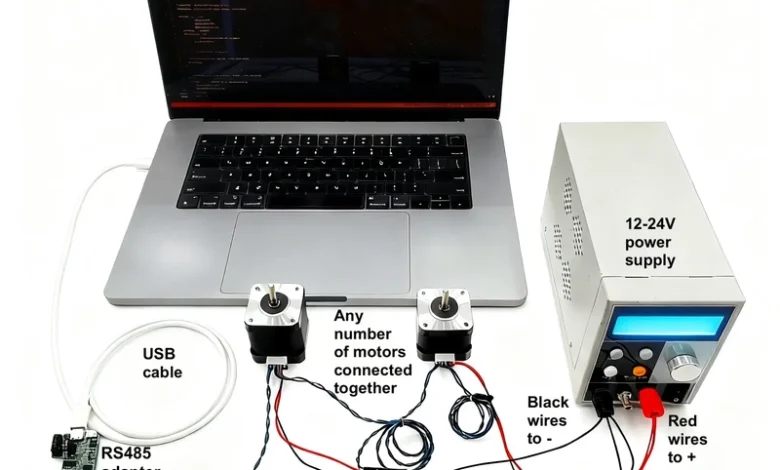
In contrast, an integrated unit typically utilizes a multi-drop communication bus, such as RS-485. This allows a single controller to communicate with every motor in a system via a daisy-chained twisted pair. Each motor is assigned a unique address on the bus, allowing the central controller to send discrete commands to individual axes through one port.

| Feature | Traditional Stack | Integrated Unit |
|---|---|---|
| Component Count | Motor, Driver, Controller, Encoder | Single Integrated Housing |
| Wiring Complexity | High (Discrete lines per axis) | Low (Daisy-chained bus) |
| Configuration | Manual Tuning (Current/Microsteps) | Factory-Calibrated |
| Maintenance | Complex (Multi-vendor failure) | Simple (Unit replacement) |
Technical Chronology and Market Context
The integration trend gained significant momentum as the open-source hardware movement began to demand more sophisticated control for 3D printers, CNC machines, and custom robotic arms. Previously, high-performance servo systems were prohibitively expensive and locked behind proprietary industrial protocols. The entry of accessible, open-source integrated servomotors—such as the M17 family—marks a shift where sophisticated feedback control is becoming available to individual developers and small-scale manufacturers.
The M17 series, for example, illustrates the current state of the art for this category. By utilizing an RS-485 architecture and providing native libraries for environments like Python and Arduino, the system bridges the gap between industrial-grade reliability and maker-friendly accessibility. The integration of a Model Context Protocol (MCP) server further suggests a future where motion control is managed by AI agents capable of interpreting natural language instructions, potentially reducing the barrier to entry for complex automation tasks.
Practical Considerations and Trade-offs
Despite the obvious advantages in wiring and space, integrated servomotors are not a universal panacea. Engineering decisions must account for several critical trade-offs:

- Thermal Management: Because the driver and controller electronics are housed within the motor casing, heat dissipation becomes a constraint. These units are generally limited in power output compared to modular systems where the driver can be mounted on a large heat sink in a ventilated cabinet.
- Environmental Robustness: Many integrated units are rated at IP20, meaning they lack significant protection against dust and moisture. Industrial applications requiring IP65 or higher protection often necessitate traditional, remote-mounted drive electronics.
- Power Limitations: Integrated units are currently optimized for low-to-medium power applications. For high-torque or high-speed industrial robotics, the physical size required to house the integrated electronics would lead to excessive inertia, making traditional remote drivers a more efficient choice.
- Repairability: A distinct disadvantage of the integrated approach is the "all-or-nothing" repair scenario. In a modular system, a failed driver can be swapped out for a nominal cost. If an integrated unit suffers a failure of the internal driver, the entire motor assembly must be replaced, which may be more expensive in the long term.
Implications for the Industry
The shift toward integrated motion control is symptomatic of a broader trend in mechatronics: the move toward "smart" peripherals. As hardware becomes more modular and "intelligent," the role of the system integrator changes. Engineers are spending less time soldering and troubleshooting signal noise in long cable runs, and more time developing high-level logic and control algorithms.
Industry analysts observe that as AI-driven automation continues to permeate manufacturing, the demand for standardized, easily addressable motion control components will likely grow. The ability to control a complex multi-axis system via a single bus cable—integrated with modern software interfaces like MCP—allows for more rapid prototyping and faster time-to-market for robotic innovations.
Looking Ahead: The Open-Source Frontier
The transparency of open-source hardware, firmware, and software is playing a pivotal role in the adoption of these technologies. By providing full access to the source code, manufacturers allow developers to customize the control loops for specific mechanical requirements, such as resonance dampening or non-linear load handling.

For the M17 series and similar initiatives, the roadmap focuses on lowering the barrier for integration with Large Language Models (LLMs). By enabling AI agents to query the state of a motor directly—such as asking for torque load, temperature, or position—the industry is moving toward a paradigm where the machine hardware is a first-class citizen in the software ecosystem.
While integrated servomotors will not replace high-power industrial drives in the near future, their utility in precision automation, desktop manufacturing, and research robotics is well-established. As power density increases and component costs continue to decline, the "motor + driver + controller" stack is likely to become an increasingly rare sight in modern engineering designs, replaced by the streamlined, "plug-and-play" efficiency of integrated servo technology. For the modern engineer, the decision to use an integrated unit now hinges on a balance of spatial constraints, environmental requirements, and the necessity for simplified, daisy-chained system architecture.