The Hidden Costs of the Hater-Leader Mentality in Modern Corporate Governance

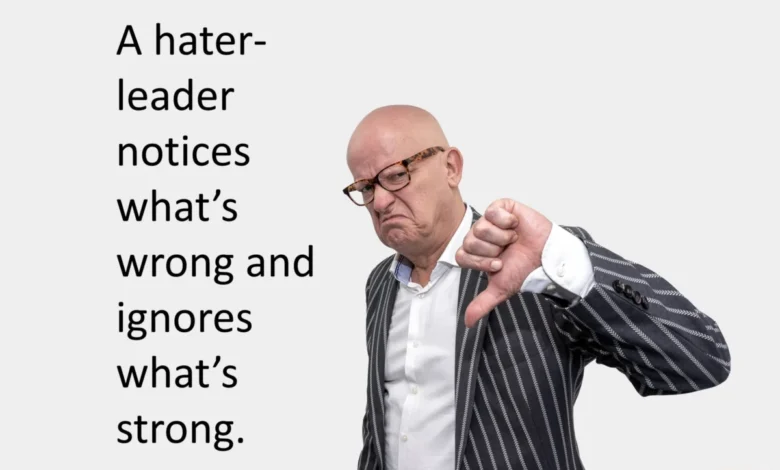
The phenomenon of the "hater-leader"—a management style characterized by a disproportionate focus on employee deficiencies—has become a subject of increasing scrutiny within organizational psychology and human resources management. While few executives would intentionally identify as a "hater," professional conduct that prioritizes error-correction over developmental support frequently produces the same psychological fallout as overt hostility. This management approach, which favors a "fix-it" mentality, often results in decreased employee retention, stifled innovation, and a toxic workplace culture that inhibits professional growth.
The Anatomy of Deficit-Based Leadership
At its core, the hater-leader operates from a framework of persistent dissatisfaction. Rather than viewing staff members as assets to be cultivated, this leadership style treats individuals as "defects" to be repaired. Research in behavioral management suggests that this perspective is not merely a personality quirk but a strategic failure. When a manager focuses exclusively on what is wrong, they effectively ignore what is strong, leading to a phenomenon known as "negativity bias" within the workplace.
The evolution of this behavior often begins subtly. A leader may start with a desire for high standards and operational precision. However, when these goals are pursued through constant criticism and the highlighting of failures, the leader inadvertently shifts into a pattern of nagging. Over time, this transforms the organizational atmosphere into one defined by fear rather than aspiration. Employees subjected to this environment often report that they feel rejected by their leadership, and in the human psyche, the sensation of professional rejection is processed similarly to the experience of personal hate.
Chronology of Management Shifts
Historically, the industrial era emphasized a "command and control" structure where fixing flaws in production was the primary directive. This model was highly effective for assembly lines but has proved detrimental in the modern knowledge economy.

- 1990s–2000s: The rise of performance-improvement plans (PIPs) became a standard corporate tool. While intended for accountability, these tools were often weaponized, leading to a rise in the "hater" dynamic where managers used PIPs as a precursor to termination rather than a tool for growth.
- 2010s: The "Strengths-Based Leadership" movement, popularized by organizations like Gallup, began to challenge the deficit-based model. Data began to emerge showing that leaders who focused on employee strengths saw significantly higher levels of engagement.
- 2020s–Present: The post-pandemic shift toward remote and hybrid work has exacerbated the visibility of hater-leaders. Without the nuance of face-to-face interaction, a focus on "what is wrong" is often conveyed via digital channels, where it is stripped of context, making the criticism feel more personal and abrasive to the recipient.
Supporting Data and Psychological Impact
Quantitative data on organizational health provides a stark contrast between deficit-focused leadership and growth-focused leadership. According to recent surveys by the Society for Human Resource Management (SHRM), toxic workplace culture is the primary driver of the "Great Resignation" and the subsequent "Quiet Quitting" phenomenon.
Studies indicate that for every one positive interaction in a professional setting, a hater-leader’s habit of pointing out three or more negatives can effectively neutralize the employee’s internal motivation. This is supported by the "Losada Line," a concept in social psychology that suggests a specific ratio of positive to negative feedback is required to maintain a high-functioning team. When leaders drop below this ratio, productivity drops by an average of 20% to 30% within six months.
Furthermore, neuroscientific research shows that constant negative feedback triggers the amygdala—the brain’s "fight or flight" center. When an employee is in a state of chronic stress caused by a supervisor’s relentless focus on their weaknesses, the prefrontal cortex—the area responsible for creative problem-solving and strategic thinking—is physically compromised. In short, the hater-leader effectively makes their team less capable of doing the very work they are being criticized for failing to complete.
The Distinction Between Fixing and Developing
Industry experts differentiate between two distinct management philosophies: "Fixing" and "Developing."
Fixing assumes that the employee is a broken mechanism that requires a manager’s intervention to reach baseline efficiency. This is a top-down, authoritarian approach that strips the employee of agency. Conversely, development assumes that the employee is an asset with untapped potential that requires guidance to flourish.

Developmental leadership requires a fundamental shift in perception. It requires the leader to:
- Acknowledge Strengths First: Before addressing a failure, the leader must acknowledge the employee’s existing competencies to create a psychological baseline of security.
- Contextualize Feedback: Framing a problem as a learning opportunity rather than a character flaw.
- Encourage Autonomy: Allowing the individual to lead the process of their own improvement.
Broader Organizational Implications
The presence of a hater-leader in middle management can have a cascading effect on a company’s bottom line. The costs associated with employee turnover—including recruitment, onboarding, and lost institutional knowledge—are estimated to range from 50% to 200% of an employee’s annual salary. Beyond these hard costs, the loss of morale leads to "cultural erosion," where the best talent leaves first, leaving behind a team that is either too demoralized to innovate or too fearful to speak up.
In many cases, the hater-leader is actually a product of their own environment. Executives who are under extreme pressure to meet quarterly targets often pass that pressure down to their direct reports in the form of increased criticism. This systemic issue suggests that the "hater" behavior is often a symptom of poor leadership training at the senior level.
Addressing the Hater-Leader Phenomenon
To mitigate the influence of this management style, organizations must prioritize "management-as-coaching" training programs. These programs shift the focus from performance auditing to talent development.
One effective intervention is the "360-degree feedback" model, which allows employees to anonymously report on their manager’s leadership style. When a pattern of deficit-focus emerges, the manager is typically assigned a leadership coach to help reframe their perspective.

Additionally, experts suggest that organizations implement a "strengths-first" performance review policy. By requiring that managers highlight three areas of excellence for every one area of improvement, the company forces the manager to change their focus. As the adage goes, "you find what you seek, and you go where you look." If a leader is tasked with looking for success, they will eventually find it, even in their most struggling employees.
Conclusion
The transition from a hater-leader to an effective coach requires a fundamental shift in mindset. It necessitates the realization that respect is the primary currency of leadership. When an employee feels respected, they are significantly more likely to accept constructive criticism and pursue self-improvement. When they feel rejected, they withdraw, leading to the exact failures the leader was trying to avoid.
Ultimately, the goal of leadership is to increase the capacity of the team. Leaders who spend their time "fixing" people are merely managing the present; leaders who spend their time "developing" people are building the future. The data is clear: the most sustainable path to organizational excellence lies in the ability to identify, nurture, and leverage the strengths that already exist within the workforce, rather than focusing on the perceived deficits that lead to professional alienation.