NVIDIA and Salesforce Unveil Koa: The Next Evolution of Enterprise CRM Reasoning Models at Dreamforce

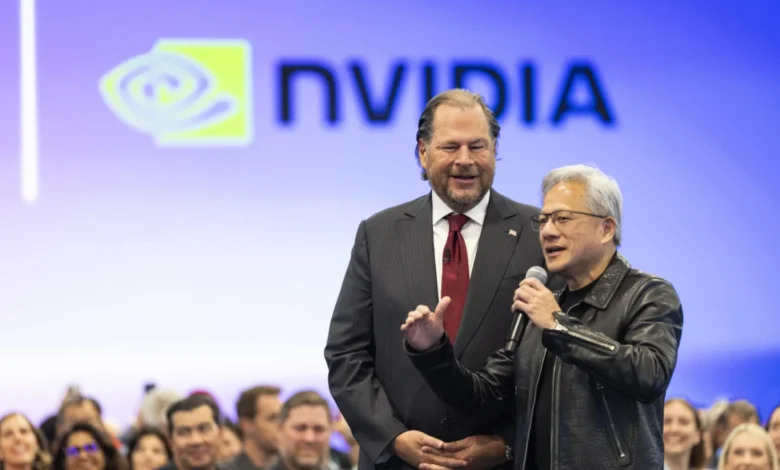
The intersection of artificial intelligence and enterprise software reached a new milestone at the Salesforce Dreamforce conference in San Francisco, where NVIDIA founder and CEO Jensen Huang joined Salesforce CEO Marc Benioff to unveil a transformative collaboration. The centerpiece of the announcement was the introduction of Koa, Salesforce’s first dedicated Customer Relationship Management (CRM) reasoning model. Built upon the architecture of NVIDIA Nemotron 3 Super, Koa represents a fundamental shift in how enterprises process, analyze, and act upon complex data streams across global business environments.
The event, held at the sprawling Moscone Center, combined theatrical flair with profound technological assertions. Huang departed from traditional keynote protocols by stepping off the stage and walking directly into the audience, microphone in hand, accompanied by Benioff. This symbolic gesture underscored the central theme of their joint presentation: the democratization and ubiquitous integration of artificial intelligence into daily enterprise workflows.
Tracing the historical trajectory of technological revolutions, Huang contextualized the current AI boom within a broader developmental framework. Drawing parallels to the advent of electrical grids and the commercialization of the internet, Huang articulated a vision of artificial intelligence as a foundational planetary infrastructure layer. "With electricity, we could power everything," Huang told the packed auditorium. "With the internet, you can find anything. And now, with artificial intelligence as an infrastructure layer across the planet, we can know everything and do anything."
The Engineering Behind Koa: Architecture and Training
The development of Koa addresses a longstanding challenge in enterprise software: adapting generalized large language models to the highly specific, nuanced, and structurally rigid requirements of customer relationship management. To achieve this, Salesforce post-trained the NVIDIA Nemotron 3 Super model utilizing a proprietary synthetic dataset. This dataset was meticulously curated from nearly three decades of accumulated enterprise CRM deployments, capturing the intricate workflows, terminology, and operational logic characteristic of modern corporate environments.
The technical execution of Koa leveraged advanced machine learning frameworks, including supervised fine-tuning and reinforcement learning protocols powered by NVIDIA NeMo RL, NeMo Gym, and NeMo AutoModel. The training corpus was designed to reflect diverse operational realities, encompassing synthetic enterprise scenarios spanning more than 14 major industries, including manufacturing, financial services, healthcare, and travel.
Performance evaluations underscore the efficacy of this specialized training regimen. In Salesforce’s proprietary CRM Bench—a comprehensive model benchmark suite designed to evaluate real-world tasks such as updating sales opportunities, routing customer support cases, and scheduling administrative follow-ups—Koa demonstrated exceptional capability. The model consistently matches or exceeds the performance of leading generalized AI models on CRM-specific actions while achieving these results with threefold fewer errors.
Data Sovereignty, Privacy, and Open Infrastructure
A critical dimension of the Koa rollout is its structural alignment with stringent corporate data privacy and security mandates. Because the foundational NVIDIA Nemotron architecture is open, Salesforce was able to fine-tune and execute the model entirely within its proprietary infrastructure.
This configuration ensures that Salesforce retains complete control over the model weights and execution environment. Crucially, Rohan Kumar, Salesforce’s president of platform and engineering, emphasized that no customer data was utilized during the training or inference phases of the model’s development. "Not a single byte of customer data was used," Kumar stated prior to Huang’s stage appearance. This architecture provides enterprise clients with the assurance that their proprietary customer records remain sequestered and secure, mitigating regulatory and privacy concerns that have historically hindered AI adoption in sensitive sectors like healthcare and finance.
Huang expanded on the broader industry trend toward open models, noting a significant market shift. While open models accounted for approximately 30 percent of the market at the beginning of the preceding year, they have since expanded to capture roughly 70 percent of adoption metrics. "People are both adopting closed models at exponential rates, but also building their own custom AIs," Huang observed, reinforcing the perspective that every contemporary software company must evolve into an AI-driven enterprise.
Addressing Industry Anxiety: AI Safety, Employment, and the Agentic Enterprise
Amid the rapid commercialization of generative artificial intelligence, concerns regarding systemic safety, regulatory oversight, and workforce displacement remain prevalent across corporate boardrooms. When queried by Benioff regarding the imperative of AI safety, Huang offered a pragmatic, engineering-focused perspective.
"Safety is paramount in a lot of ways. It’s job one," Huang stated. However, he demystified the concept of AI safety, framing it not as an intractable philosophical dilemma, but as a standard engineering challenge. "If you build a product or a service and you’re not confident in its functionality, capability, or safety, then don’t release it."
Huang explicitly rejected the notion that developers must choose between velocity and security, characterizing the perceived dichotomy as a false choice. "Innovation, speed, and safe products—it’s a false choice," he asserted. "You could definitely have both at the same time. So run as fast as you can. But if you feel at any given point in time the company’s out of control, or the product’s not going to be safe, take a pause and make sure you get it right."
Furthermore, Huang pushed back against prevailing anxieties concerning widespread job displacement driven by automation. Instead, he articulated an optimistic vision centered on human-AI collaboration and elevated productivity standards. "As a result of our ambition, and with the productivity boost we get from AI, the sky’s the limit," Huang stated, urging industry stakeholders to actively engage with the technology rather than risk obsolescence. "Engage AI. Don’t get left behind."
Benioff echoed this sentiment, highlighting the empowering potential of the technology for the Salesforce Trailblazer community of developers and administrators. "The sky is especially the limit for our Trailblazers," Benioff noted. "I think this technology, the way it empowers people… the technology can partner with them to do this in incredible new ways."
Huang summarized the ultimate corporate destination for this technological wave, coining a framework that has rapidly gained traction across the technology sector: "Every company, every enterprise, every country would become an AI company. It’s going to be an agentic enterprise."
Integration Timeline and Deployment Roadmap
The deployment of Koa is structured across a phased rollout designed to transition the model from internal validation to broad commercial availability. The system is already operational within Salesforce’s internal ecosystem, powering an advanced employee agent deployed within Slack.
The commercialization timeline moves next to a targeted customer pilot phase scheduled for October. During this phase, Koa will be introduced as a customer-selectable model within Agentforce, Salesforce’s autonomous agent suite. Initial pilot participants include prominent global entities such as Formula 1, UChicago Medicine, Baxter Credit Union, 1-800Accountant, Engine, and Xero.
Following the completion of the pilot phase and subsequent performance optimizations, general availability for Koa is officially projected for winter 2026 across U.S. regional deployments. This measured deployment schedule reflects both the rigorous validation standards required for enterprise-grade autonomous systems and the accelerating demand for domain-specific reasoning engines capable of autonomous execution in complex operational environments.