Breaking the Cycle of Cognitive Debt: Why Corporate and Academic Institutions Must Move Beyond AI Abstinence and Ungoverned Adoption

Across corporate boardrooms and university lecture halls alike, leaders are grappling with an unprecedented technological shift, yet both sectors have fallen into opposing traps of avoidance and unchecked integration. In higher education, the dominant reflex has been strict prohibition: universities deploy advanced AI detection software, rewrite honor codes, and engineer assignments explicitly designed to render machine assistance impossible or easily penalized. Conversely, corporate America has sprinted toward the opposite extreme, prioritizing rapid deployment targets, organizational adoption dashboards, and aggressive AI fluency training aimed at maximizing speed and output.
Yet, emerging behavioral research and empirical neuroscience suggest that both extremes share a fundamental design flaw. Neither institutional approach asks the critical question governing modern human-computer interaction: What is the human supposed to be doing while artificial intelligence is in the room?
This shared policy failure carries profound consequences. Rather than protecting academic integrity or corporate data security, prohibition drives user behavior underground into poorly governed environments. Meanwhile, unsequenced corporate adoption metrics measure how often tools are used without tracking whether that usage builds human capability or slowly erodes it. To bridge this divide, educators and organizational development leaders are increasingly turning to a structured, repeatable framework known as the Bot Check Method—a deliberate sequence that transitions institutions from passive abstinence or chaotic adoption toward active human agency.
The Neuroscience of Cognitive Debt: What the MIT Media Lab Uncovered
The argument against unsequenced artificial intelligence integration is no longer merely philosophical; it is neurological. A landmark study conducted by researchers at the MIT Media Lab, titled Your Brain on ChatGPT: Accumulation of Cognitive Debt when Using an AI Assistant for Essay Writing Task, provided empirical data regarding the physiological cost of premature AI dependency.
Led by researcher Nataliya Kosmyna, the study outfitted 54 university students with electroencephalogram (EEG) caps to measure real-time neural activity as they drafted essays under three distinct conditions: utilizing ChatGPT, relying on a standard search engine, or working entirely unaided. The findings, published in early 2025, revealed stark contrasts in brain function. Students who relied on ChatGPT exhibited the weakest neural connectivity across brain regions associated with active critical thinking, memory consolidation, and deep synthesis. Conversely, participants working without technological assistance demonstrated the strongest and most distributed neural networks.

Most alarmingly, when students from the ChatGPT cohort were subsequently asked to write without AI assistance in a follow-up session, their neural engagement remained severely depressed. Researchers categorized this persistent state as underengagement, noting that the habit of cognitive outsourcing appeared to fundamentally alter short-term patterns of neural activation. The MIT team coined the term cognitive debt to describe this cumulative neurological toll.
Furthermore, behavioral metrics mirrored the neurological data. Self-reported ownership of the written essays was lowest among the generative AI group and highest among the unaided control group. AI users frequently struggled to accurately recall or quote their own submitted text, signaling a profound loss of intellectual ownership alongside reduced cognitive effort. While researchers emphasize that generative tools hold immense utility, the data serves as a clear warning regarding the timing and methodology of their introduction into learning workflows.
The Flaws of Prohibition and Ungoverned Adoption
The institutional insistence on abstinence-only policies mirrors historical precedents in public health and education, where blanket prohibitions consistently fail to eliminate targeted behaviors, instead driving them into unmonitored spaces.
In academia, stringent anti-AI policies have failed to stop students from using large language models. Instead, detection software often creates an adversarial dynamic, forcing students to use AI secretly as a total substitute for original thought rather than an intellectual sparring partner. Pedagogical scaffolding is stripped away, leaving learners vulnerable to the exact cognitive underengagement documented by MIT researchers.
In corporate environments, the abstinence error manifests as shadow AI. When enterprises place blanket bans on consumer-grade artificial intelligence without supplying secure, sanctioned alternatives, employees routinely bypass corporate firewalls. Sensitive proprietary information—including client datasets, internal strategic planning documents, financial projections, and human resources files—routinely finds its way into external AI platforms via personal mobile devices and home networks. Prohibition does not secure corporate data; it simply blinds security teams to where that data is traveling.
Conversely, organizations that enforce unsequenced, wide-open adoption face a parallel crisis. Without clear operational frameworks, metrics gauge only the frequency of AI utilization rather than the quality of human output or critical oversight. Accountability blurs, and employees increasingly accept automated outputs as authoritative without exercising independent judgment.
Structuring Co-Intelligence: The Bot Check Method and the Community of Inquiry
To resolve these systemic shortcomings, learning architects are advocating for a third framework anchored in human agency. Agency in this context is defined as the practiced capacity to think independently before consulting AI, to evaluate machine outputs critically, and to synthesize multiple perspectives into a final product that bears genuine intellectual ownership.
This methodology relies on foundational learning theories, notably the Community of Inquiry (CoI) framework developed by researchers D. Randy Garrison, Terry Anderson, and Walter Archer. The CoI model dictates that cognitive presence—the construction of deep meaning through sustained reflection and discourse—requires a distinct sequence of four cognitive events: a triggering event, exploration, integration, and resolution. When artificial intelligence is introduced too early in a task, it short-circuits the triggering and exploration phases, robbing the human of the struggle required to build lasting neural pathways.
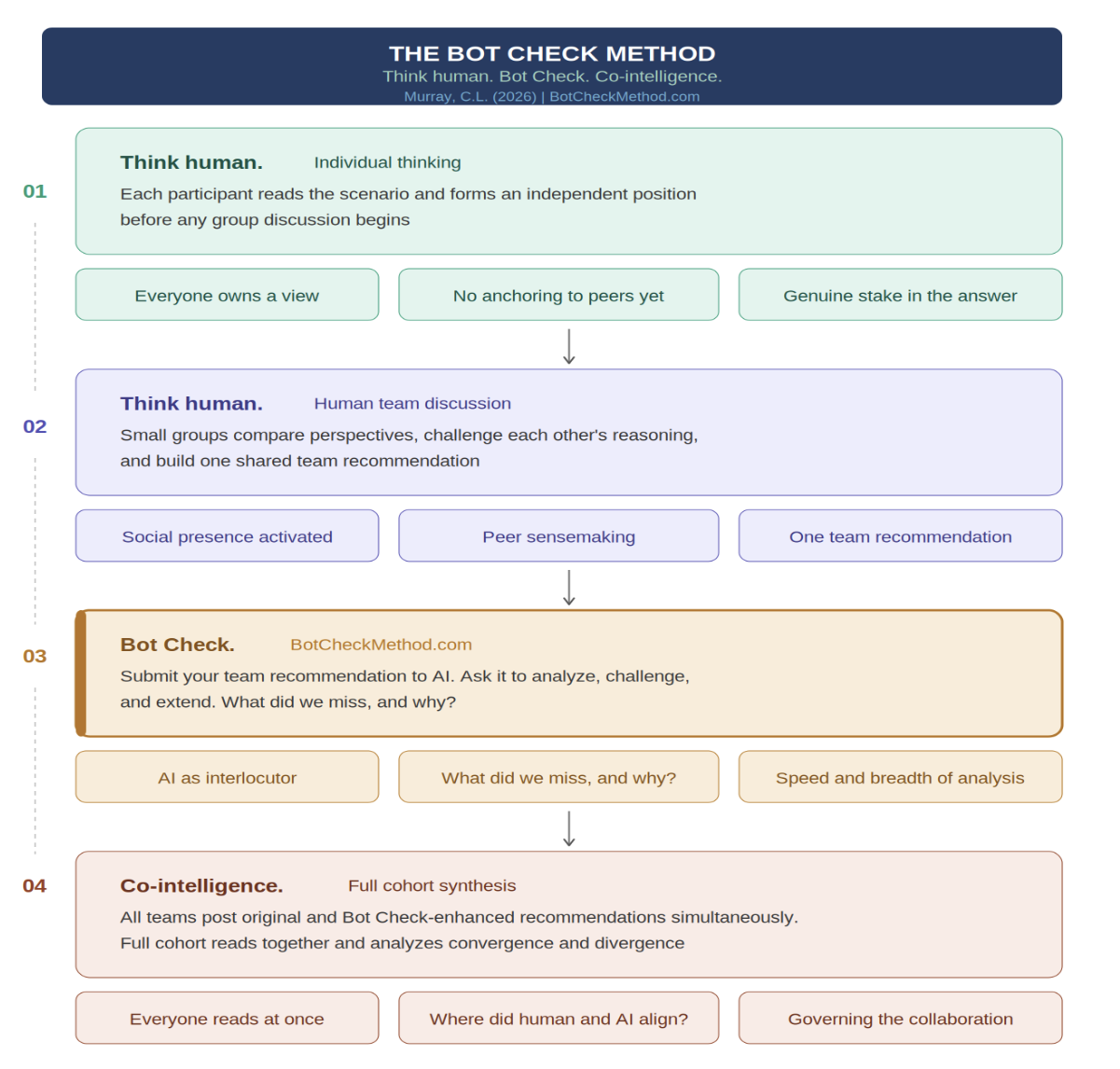
Addressing this vulnerability, the Bot Check Method provides a four-phase, governed sequence designed to protect human cognitive engagement while leveraging machine capabilities:
- Think Human: Participants confront a problem independently, formulating their own initial diagnosis and establishing a personal intellectual stake before engaging with peers or technology.
- Think Human Together: Individuals assemble into small collaborative groups to share perspectives, challenge assumptions, and debate hypotheses, thereby building a foundational social and cognitive presence.
- Bot Check: Once a cohesive human position is established, teams submit their working draft to an artificial intelligence tool, explicitly tasking the model to challenge assumptions, expose blind spots, and test the rigor of the argument. AI functions strictly as an interlocutor rather than an author.
- Co-intelligence: Teams compare their original human insights with the AI-enhanced revisions within a shared group setting, analyzing points of convergence and divergence to generate a final, highly synthesized output.
Scaling Governance Through the SHINE Framework
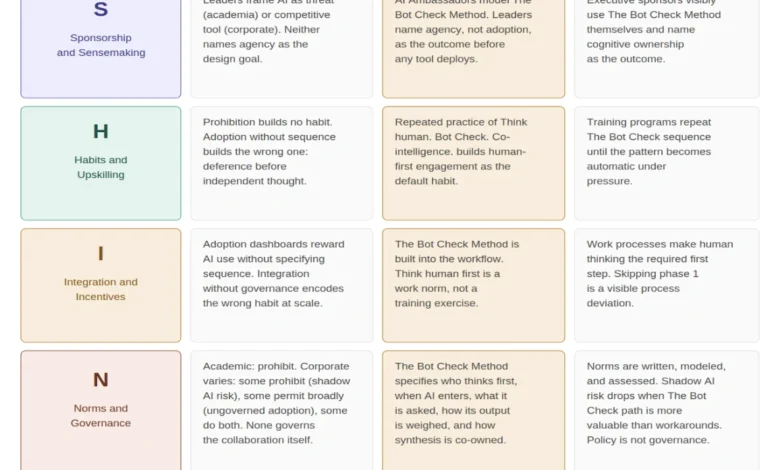
Translating session-level pedagogical methods into enterprise-wide capabilities requires robust organizational governance. Industry leaders increasingly map these practices onto the SHINE framework, an operational architecture designed to guide large-scale technological transformations:
- Sponsorship and Sensemaking: Executive leaders and designated AI ambassadors must model the Bot Check sequence publicly, demonstrating that purposeful AI engagement prioritizes human critical thinking over sheer speed.
- Habits and Upskilling: Training programs must pivot away from basic tool proficiency toward behavioral conditioning, embedding human-first analytical habits into daily operational workflows.
- Integration and Incentives: Workflow design must mandate individual human reflection as a prerequisite before any generative AI consultation is permitted, aligning corporate incentives with cognitive rigor.
- Norms and Governance: Organizations must replace reactive prohibition policies with structured operational guardrails that dictate how humans and machines collaborate safely and transparently.
- Evidence and Expansion: Enterprise learning programs must continuously audit the outcomes of human-AI collaboration, utilizing convergence and divergence metrics to refine governance strategies over time.
Implications for the Future of Work and Education
As generative artificial intelligence continues to mature, the debate surrounding its integration has reached an inflection point. The converging evidence from neuroscience, organizational psychology, and educational research indicates that neither total restriction nor uncritical adoption is sustainable.
For chief learning officers and academic administrators alike, the mandate moving forward is clear. Fostering future-ready professionals requires an intentional shift from passive technology consumption to active cognitive agency. By implementing structured methodologies that place independent human reasoning at the center of the workflow, institutions can harness the vast analytical power of artificial intelligence without sacrificing the intellectual vitality of the human workforce.