Revolutionizing Large Language Model Deployment with the New Amazon SageMaker HyperPod Inference Gateway

The landscape of generative artificial intelligence is shifting from model development to high-efficiency deployment, and the primary bottleneck for enterprises has become the sheer cost and inefficiency of GPU utilization. Amazon Web Services (AWS) has officially unveiled the Amazon SageMaker HyperPod Inference Gateway, a Kubernetes-native solution designed to eliminate the systemic waste inherent in traditional load-balancing techniques. By integrating a sophisticated, GPU-aware routing system directly into existing Elastic Kubernetes Service (EKS) clusters, the gateway promises to reduce first-token latency by up to 82% without requiring developers to modify their existing application code.
The Problem: The Inefficiency of Conventional Routing
For years, organizations deploying Large Language Models (LLMs) at scale have relied on standard Kubernetes load balancers. These conventional systems typically utilize round-robin or least-connections algorithms, both of which operate in a state of "infrastructure blindness." These routers treat GPU-backed pods as interchangeable commodity compute units, failing to account for the complex state of an LLM inference task.
In modern production environments, an inference pod is rarely a blank slate. Some pods may have their Key-Value (KV) caches saturated by long-context sessions, while others may be mid-generation. Furthermore, in environments utilizing LoRA (Low-Rank Adaptation) adapters for fine-tuned responses, specific pods hold distinct memory states that are vital to the efficiency of the request. When a naive load balancer sends a request to a busy pod, the request queues behind ongoing computations, causing first-token latency—the most critical metric for user-perceived performance—to spike. Historically, this has forced engineering teams to over-provision GPU clusters to buffer against these latency spikes, leading to significant financial waste and underutilized high-performance hardware.
A New Architectural Approach: The Two-Tier Inference Gateway
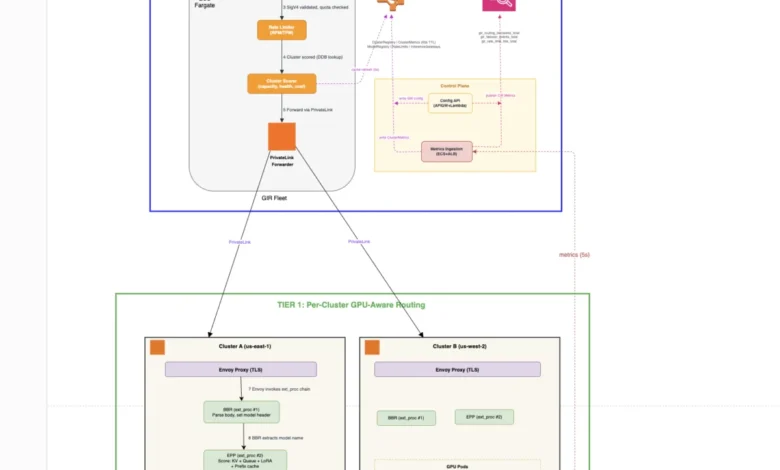
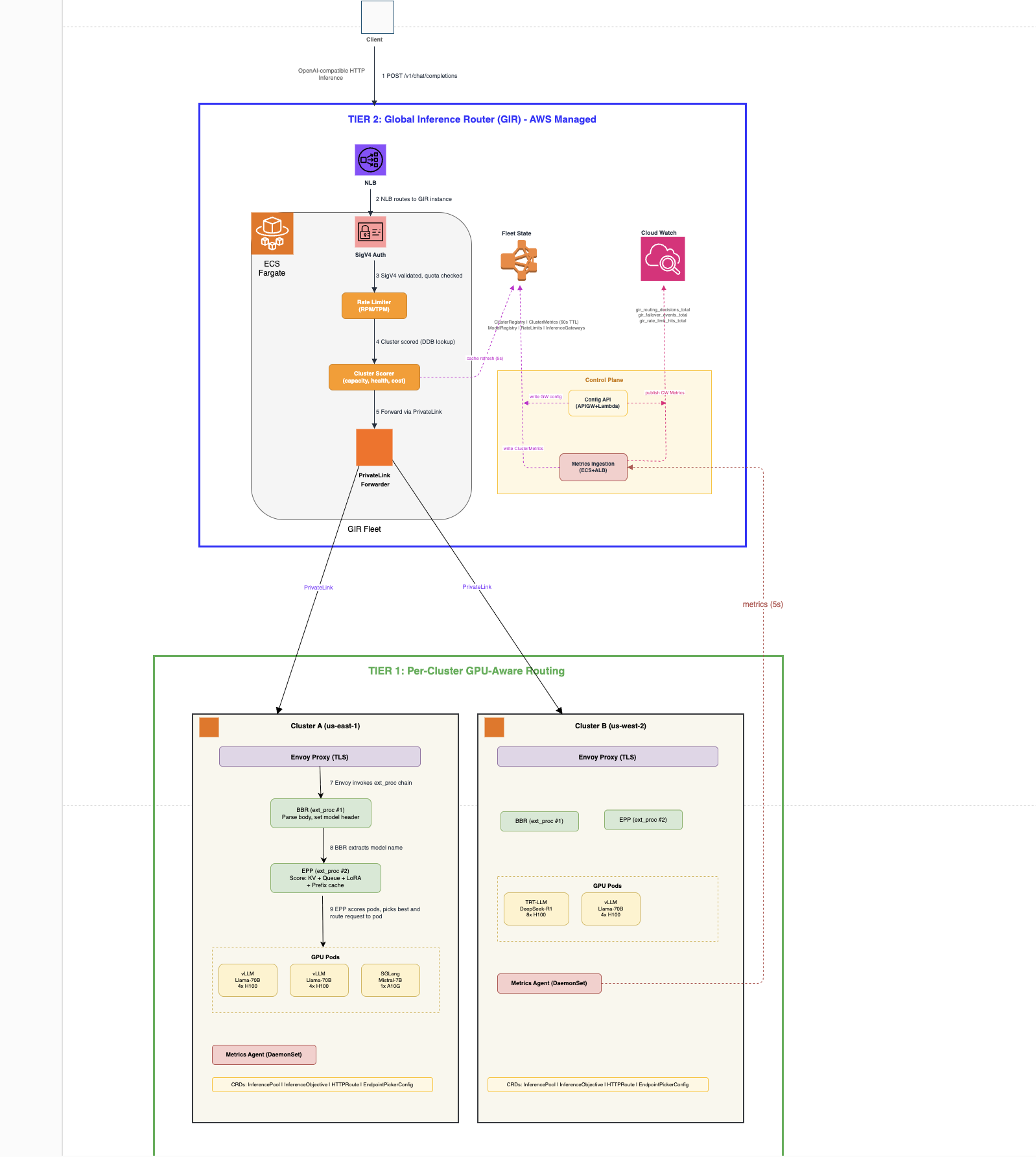
The introduction of the SageMaker HyperPod Inference Gateway marks a shift toward intent-based infrastructure. Deployed as a managed EKS addon, the gateway operates via a two-tier architecture. The first tier, currently available, handles per-cluster intelligent routing. It utilizes the open-source Gateway API Inference Extension to intercept traffic and apply logic before the request reaches the model server.
The system is comprised of three primary pillars:
- Envoy Gateway: Acting as the high-performance Layer 7 proxy, it manages secure HTTPS traffic termination.
- Body-Based Router (BBR): This component inspects the metadata within the OpenAI-compatible request body. By parsing the model identifier, it directs traffic to the specific pool of pods configured for that workload, enabling multi-model hosting on a single cluster.
- Endpoint Picker (EPP): This is the core "intelligence" layer. Unlike standard routers that look at network metrics, the EPP consumes real-time Prometheus telemetry from the GPU pods. It evaluates variables such as KV cache saturation, LoRA adapter residency, and current compute load, applying a weighted scoring algorithm to ensure the request is routed to the optimal destination.
Looking ahead, AWS has signaled the development of a second tier: the Global Inference Router (GIR). This upcoming feature will provide fleet-wide orchestration, enabling cross-cluster failover and regional traffic shaping, effectively turning fragmented GPU clusters into a cohesive, global inference fabric.
Chronology of Infrastructure Evolution
The development of this gateway is the culmination of years of iterative work in the Kubernetes ecosystem. In the early stages of generative AI adoption, developers were forced to build custom sidecars and complex service meshes to manage inference traffic. These solutions often introduced latency overhead and added significant maintenance burdens. By 2024, as model sizes expanded and the prevalence of LoRA adapters grew, the limitations of these bespoke implementations became a significant barrier to enterprise scaling. The release of the SageMaker HyperPod Inference Gateway represents a transition from "do-it-yourself" infrastructure to standardized, managed primitives within the EKS environment.
Quantifying the Gains: Empirical Performance Benchmarking
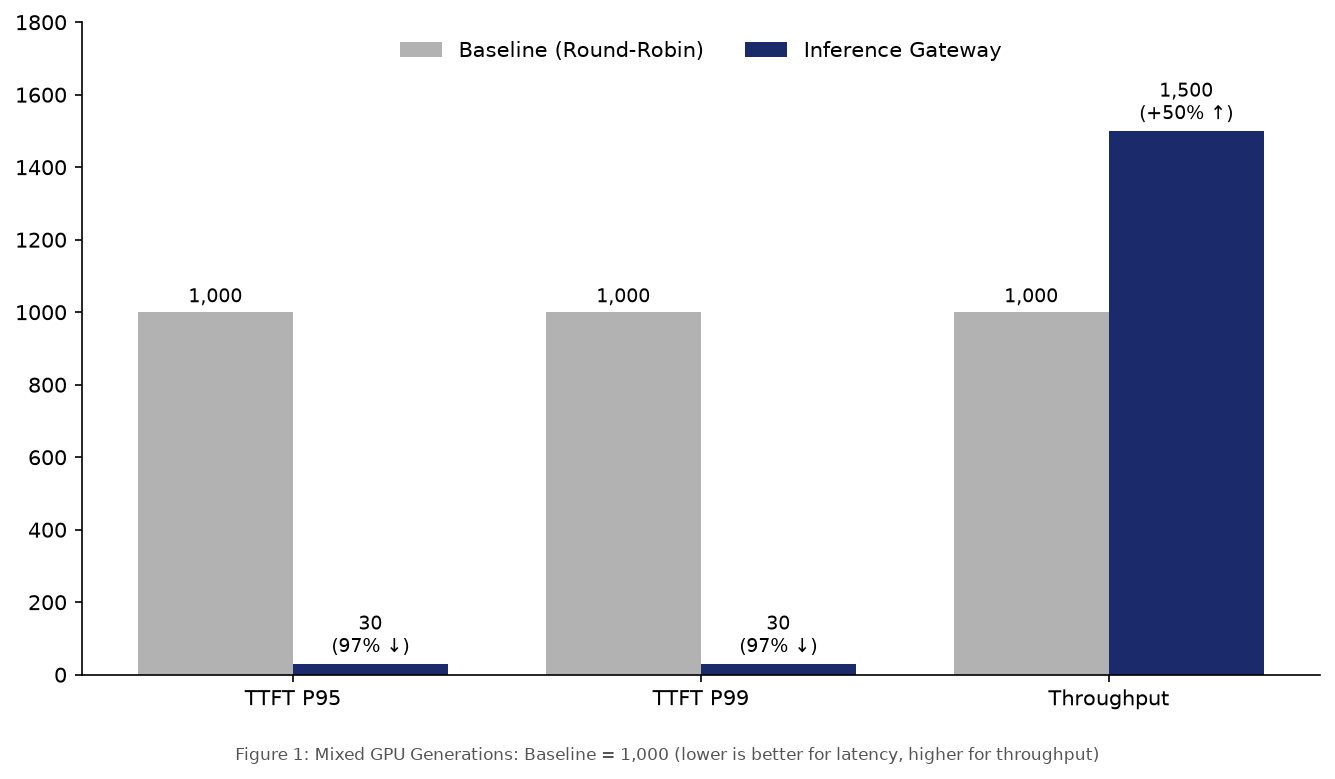
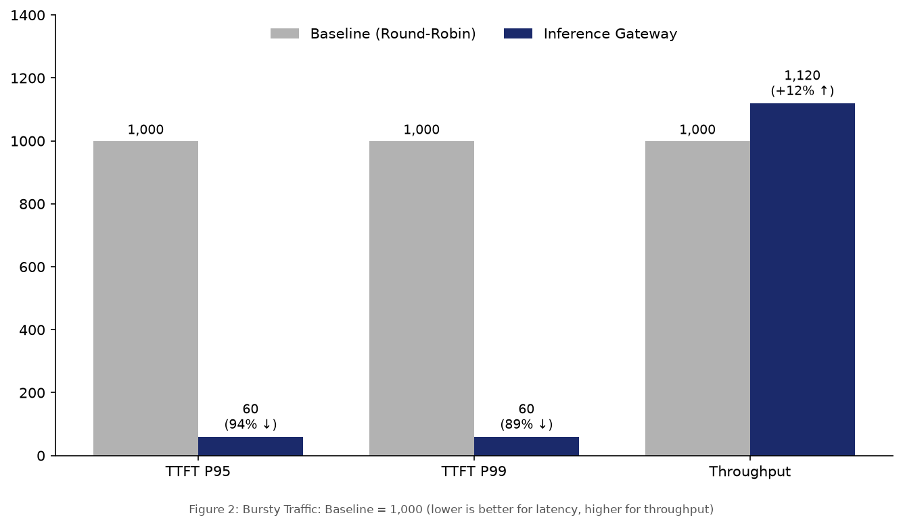
To demonstrate the impact of GPU-aware routing, AWS conducted extensive benchmarks across various hardware profiles, including p5.48xlarge (NVIDIA H100) and g5 (NVIDIA A10G) instances. The testing scenarios focused on the most common pain points in modern LLM production: mixed hardware generations, bursty traffic, and shared prompt prefix scenarios.
The results are stark. In scenarios involving mixed GPU generations, the gateway achieved a 98% reduction in P99 first-token latency for Qwen3-32B models, while simultaneously increasing throughput by 50%. Even under severe bursty traffic—a condition that usually results in massive latency degradation—the gateway maintained stability, showing a 98% improvement in P99 first-token latency for Llama-3.1-70B models compared to the round-robin baseline.
Perhaps most significantly, the system excels in "shared prompt" scenarios. By using the Prefix Cache Hit Rate scorer, the gateway identifies requests that share common context, routing them to pods where that context is already resident in memory. This eliminates the redundant computational cycles usually spent re-processing the same prompt prefixes, thereby accelerating responses for multi-turn conversations and document analysis workflows.
Operational Implications and Ease of Deployment
The primary value proposition for enterprise users is the "zero-change" integration model. Because the gateway exposes an OpenAI-compatible endpoint, organizations can redirect their existing client applications to the new gateway URL without altering a single line of SDK or application code.
Deployment follows a four-step process:
- Installation: A simple
aws eks create-addoncommand initiates the deployment of the Inference Gateway. - Labeling: Administrators apply standard Kubernetes labels to existing model pods, allowing the gateway to discover and categorize them.
- Configuration: Through a declarative
InferenceGatewayConfigcustom resource, teams define their routing policies, such as specific model-to-pod mappings. - Execution: The application begins sending traffic to the gateway, which immediately assumes control of intelligent load balancing.
This approach effectively decouples the complexity of GPU orchestration from the application logic. Developers can focus on model performance and application features, while the infrastructure layer manages the high-stakes balancing act of memory utilization and request distribution.
The Future of GPU Utilization
Industry analysts have noted that the "cloud-native" approach to AI is finally maturing. The integration of inference routing into the infrastructure layer is a response to the maturation of the LLM market, where efficiency has replaced novelty as the primary driver of adoption.
By moving away from static routing, enterprises can now effectively consolidate workloads. A single cluster can host multiple models and various LoRA adapters without the "noisy neighbor" effect that typically degrades performance in multi-tenant environments. The LoRA Affinity Scorer, in particular, solves a persistent headache for AI engineers: the "swap latency" that occurs when an adapter must be loaded into GPU memory. By ensuring that requests requiring specific adapters are routed to pods where those adapters are already cached, the gateway transforms what was once an expensive, time-consuming operation into a near-instantaneous process.
As AWS continues to refine the HyperPod ecosystem, the upcoming Global Inference Router promises to address the final frontier of large-scale deployment: multi-region resiliency. With the ability to automatically fail over to a healthy region in the event of a local cluster outage, the Inference Gateway provides a level of reliability that has historically been difficult to achieve for high-concurrency LLM services.
In summary, the SageMaker HyperPod Inference Gateway provides a clear roadmap for organizations looking to optimize their cloud spend. By reducing the reliance on over-provisioning and solving the fundamental inefficiencies of standard load balancing, it allows businesses to maximize the performance of their existing GPU fleets. For the modern enterprise, this transition from naive to intelligent routing is no longer an optional upgrade; it is a fundamental requirement for scaling generative AI in a cost-effective, high-performance manner.