AI Workflows Versus AI Agents: A Technical Framework for Strategic Implementation

In the rapidly evolving landscape of artificial intelligence, the distinction between structured workflows and autonomous agents has become a focal point for software architects and enterprise decision-makers. As organizations move beyond initial experimentation with Large Language Models (LLMs), the industry is grappling with a nomenclature crisis where the term "agent" is frequently misapplied to simple, linear automated tasks. Understanding the structural differences between these two methodologies is critical, as the wrong choice can lead to significant technical debt, inflated operational costs, and diminished system reliability.
Defining the Architectural Divide
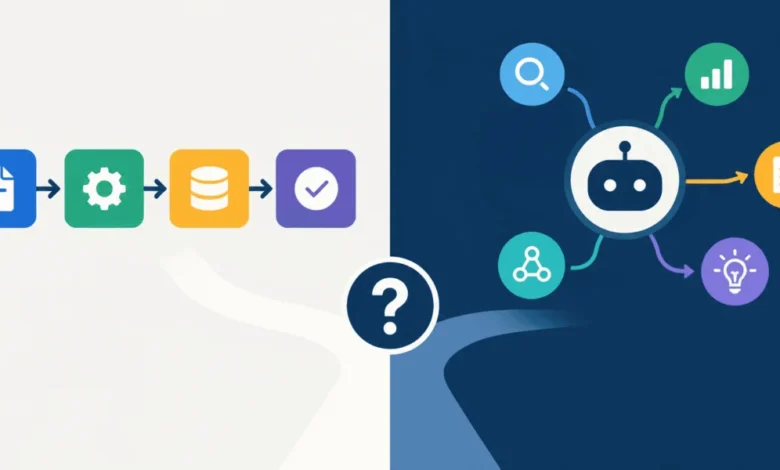
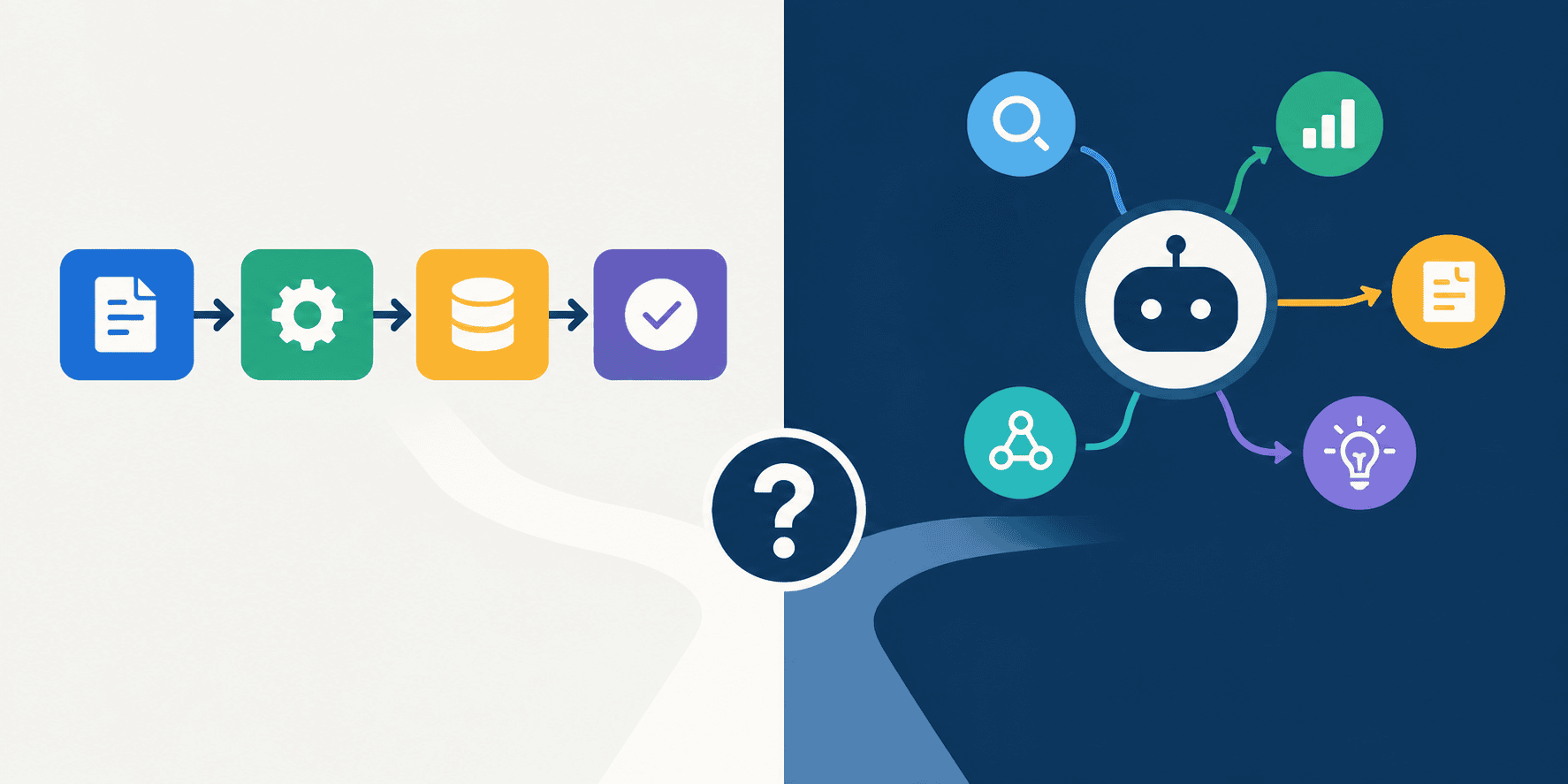
At the core of the current debate is the mechanism of control. A workflow, often referred to as a pipeline or a chain, is defined by deterministic logic established during the design phase. Regardless of the complexity of the internal components—which may include multiple LLM calls, external API integrations, or retrieval-augmented generation (RAG) processes—the sequence of operations is fixed. The developer explicitly defines the branching logic, the stop conditions, and the data transformation steps before the system is ever deployed.
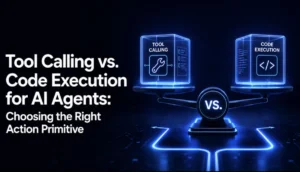
Conversely, an agentic system delegates the control flow to the model at runtime. In this architecture, the LLM is provided with a defined goal and a set of available tools, such as database access, search engines, or calculation modules. The model then evaluates the current state, selects the appropriate tool, executes the action, and interprets the result to determine the subsequent step. This iterative loop—observe, plan, act—allows for dynamic pathfinding that is not possible within a static pipeline.
The Evolution of Automation: A Chronology of Complexity
The shift from simple automation to agentic systems mirrors the broader history of software development. Early AI integration typically involved "bolt-on" LLM calls where a model acted as a static classifier or summarizer within a traditional procedural application. This era, spanning roughly 2022 to early 2023, focused on refining prompt engineering to ensure consistent outputs in predictable environments.
By late 2023, the emergence of frameworks like LangChain and AutoGPT accelerated the development of agentic architectures. Developers began experimenting with models that could chain together multiple tool calls. However, this period also introduced "hype-driven development," where organizations attempted to deploy autonomous agents for tasks better suited for simple scripts.
Industry data suggests a clear trend in implementation efficiency. According to recent performance benchmarking in enterprise software, systems utilizing static workflows for high-volume tasks achieve an average of 99.8% reliability, compared to approximately 82% for autonomous agents in equivalent complex scenarios. The divergence is primarily attributed to the "hallucination" and "looping" risks inherent in autonomous decision-making models.
The Practical Test: Validating System Requirements
Before a single line of code is committed to a repository, architects are advised to perform a simple diagnostic: the flowchart test. If a project lead can map out the entire process on a whiteboard—including every conditional branch, error-handling step, and data validation point—the system is inherently a workflow.
The misconception that workflows represent "simple" technology while agents represent "sophisticated" technology is a persistent myth in the developer community. In reality, a high-performance workflow can be incredibly sophisticated, incorporating human-in-the-loop approvals, multi-stage data validation, and complex retry logic. Conversely, a simple agent may be unnecessarily fragile, prone to excessive token consumption and unpredictable behavior when faced with edge cases.
Strategic Considerations for Enterprise Deployment
When determining whether to pursue a workflow or an agent, organizations should evaluate their needs across four primary dimensions:
1. Predictability and Auditability
In highly regulated sectors such as finance, healthcare, and legal services, deterministic execution is not just a preference but a compliance requirement. If an application must demonstrate an identical sequence of actions for every audit, a workflow is the only viable path. Agents, by their nature, may choose different paths to reach the same conclusion, making forensic analysis of their decision-making process significantly more complex.
2. Resource Allocation and Cost Efficiency
Agents operate on a "reasoning-heavy" paradigm. Because they must constantly re-evaluate the next step based on the previous output, they consume a higher volume of tokens per request. In high-volume environments, such as customer-facing support bots or real-time data processing, the cumulative cost of agentic reasoning can become prohibitive. Workflows allow for targeted LLM usage, applying the model only where reasoning is actually required, thereby optimizing for cost and latency.
3. Input Variability
The strongest case for an agentic architecture is found in tasks with high input variability. If the system is designed to handle "unusual" or "unpredictable" requests—such as an IT incident response system that must navigate disparate error logs, network topologies, and historical documentation—an agent can discover solutions that a static decision tree might miss. If the inputs are narrow and well-defined, the overhead of an agent provides no tangible benefit.
4. The "Hybrid" Approach
Increasingly, the most successful implementations are hybrid systems. These architectures utilize a workflow as the primary control mechanism, while embedding "agentic islands"—specific steps where an LLM is given the autonomy to make a choice or interpret complex data. This provides the predictability of a pipeline with the flexibility of intelligent decision-making where it is most needed.
Expert Perspective and Industry Consensus
Lead developers and AI researchers increasingly emphasize that autonomous agents should be viewed as "specialized tools" rather than a replacement for structured software engineering. A common refrain among architectural leads is to "start with the constraint." By building a rigid workflow first, developers gain a deep understanding of the problem domain. If the workflow hits a wall—where the number of branches becomes unmanageable or the logic becomes too complex to maintain—that is the moment to introduce agentic capabilities for that specific segment.
Implications for Future Software Development
The transition from the current "hype" phase to a period of pragmatic implementation will likely see a reduction in the number of "general-purpose" agents. Instead, the industry is moving toward highly structured, modular systems where agents are scoped to bounded, well-defined tasks.
For developers, the implication is clear: the mastery of software engineering fundamentals—flow control, state management, and clear documentation—remains just as important as the mastery of LLM prompting. As AI tools become more integrated into the enterprise tech stack, the ability to discern when to relinquish control to a model and when to retain it through traditional design will be the defining skill of the next generation of software architects.
In conclusion, while the allure of fully autonomous agents is strong, the most reliable and scalable systems are those that prioritize clear, intentional design. By applying the flowchart test and adhering to the principles of predictability and cost-effectiveness, organizations can leverage the power of AI without sacrificing the stability of their core infrastructure.