Orchestrating Complex Multi-Agent Workflows with Amazon Bedrock AgentCore Runtime Instances

As the landscape of generative artificial intelligence pivots from simple, single-purpose chatbots toward sophisticated, multi-agent systems, the underlying infrastructure must evolve to meet the demands of collaborative, long-running processes. The traditional serverless model, characterized by ephemeral execution environments and limited session durations, has long been the gold standard for stateless tasks. However, when complex workflows—such as creative production, scientific simulation, or high-fidelity media rendering—require agents to share deep context, persistent file systems, and hardware acceleration over several days, this serverless paradigm encounters significant friction. Amazon Bedrock AgentCore has introduced Runtime Instances to bridge this gap, providing a robust solution for developers managing complex, multi-agent pipelines.
The emergence of these systems represents a structural shift in how organizations deploy AI. Previously, "agentic" workflows were often bottlenecked by cold-start latency and the inability to maintain state across disparate tasks. By moving from isolated MicroVMs to persistent Runtime Instances, organizations can now host multiple agents on a single EC2-backed infrastructure. This shift not only optimizes cost by leveraging existing AWS Savings Plans and On-Demand Capacity Reservations (ODCRs) but also enables high-bandwidth collaboration through shared Amazon EBS volumes and GPU acceleration.
The Evolution of Agentic Infrastructure
The architectural transition from MicroVMs to Runtime Instances addresses a fundamental challenge: the "context gap." In a typical MicroVM environment, agents operate in silos. If a task requires an agent to generate a large artifact, pass it to a second agent for quality assurance, and then have a third agent perform compliance checks, the lack of shared storage makes this orchestration difficult.
Runtime Instances solve this by allowing multiple agents to occupy the same physical compute resource. This enables them to share local memory and file systems, drastically reducing the latency associated with inter-agent data transfer. Furthermore, the extension of session durations from a few hours to up to 14 days allows for asynchronous workflows that can pause, resume, and evolve without losing the state of the computation.
A Case Study in Creative Automation: The Three-Agent Pipeline
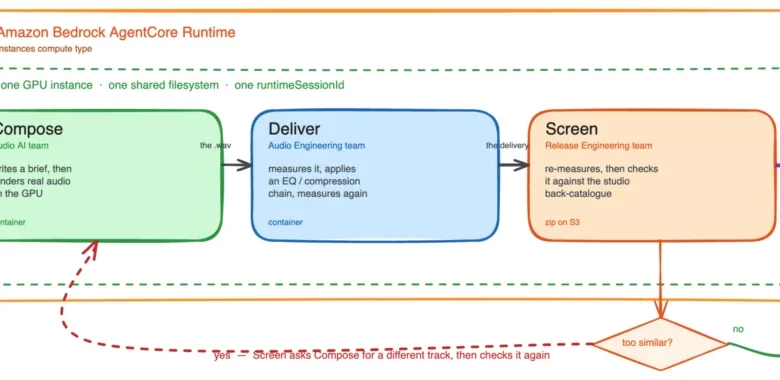
To demonstrate the capabilities of Runtime Instances, developers have implemented a music production pipeline that exemplifies the power of agent-to-agent (A2A) collaboration. The pipeline utilizes three specialized agents—Composition, Delivery, and Compliance—to automate the end-to-end creation of professional-grade audio tracks.
The workflow begins when a producer submits a prompt. The Composition Agent interprets the request and triggers a generative audio model, which runs directly on the instance’s GPU. Once the audio is rendered, the Delivery Agent retrieves the file from a shared volume, performs digital signal processing (DSP) to adjust equalization and loudness targets, and verifies the output against industry standards. Finally, the Compliance Agent conducts an independent audit, comparing the output against a studio’s back catalog to ensure originality. If a conflict is detected, the Compliance Agent initiates a remediation loop with the Composition Agent to refine the track.
This multi-stage process is made possible by the collocation of these agents on a single g6.xlarge instance. By sharing a filesystem, the agents avoid the overhead of constant S3 bucket synchronization, turning a potentially sluggish, multi-step process into a streamlined production cycle.
Comparative Analysis of Compute Models
The choice between MicroVMs and Runtime Instances is dictated by the specific needs of the workload. MicroVMs remain the optimal choice for event-driven, high-concurrency tasks where rapid scaling and strict session isolation are paramount. They are entirely managed by AWS, offering a consumption-based pricing model that eliminates the need for capacity planning.
Conversely, Runtime Instances provide the necessary infrastructure for heavy-lifting, resource-intensive tasks. The following table highlights the technical differences between these two deployment options:
| Feature | MicroVM (Serverless) | Runtime Instances |
|---|---|---|
| Compute Model | Fully AWS Managed | Managed EC2 Instances |
| Max Session Length | 8 Hours | 14 Days |
| Agent Density | 1:1 (Agent-to-VM) | 1:N (Agent-to-Instance) |
| GPU Support | No | Yes (Supported Families) |
| Persistence | Session-Scoped | EBS-backed Volumes |
| Scaling | On-Demand | Capacity Provider Managed |
For teams operating at scale, the ability to pin agents to specific hardware—such as NVIDIA L4 GPUs—is a game-changer. This configuration ensures that resource-heavy models, which would fail to execute in a standard serverless container, can run effectively within the AgentCore ecosystem.
Implementation and Operational Best Practices
Successful deployment of Runtime Instances requires careful attention to the lifecycle of the session. Developers must ensure that their agent code is architected to handle session-based context. For instance, using a FileSessionManager is essential for persisting history across days, allowing the agent to remember prior decisions or data inputs.
One critical aspect of this architecture is the independent deployment of agents. Because each runtime is defined separately, the Audio AI team can update the Composition Agent’s container image without requiring a redeployment of the Delivery or Compliance agents. This modularity reduces the blast radius of potential bugs and allows teams to operate with a higher degree of autonomy.
Furthermore, capacity management is handled via "Capacity Providers." By configuring these providers with specific instance requirements, VPC placement, and storage volumes, organizations can guarantee that their agents land in the appropriate availability zones. The use of AZ-pinned ODCRs is recommended for production environments to ensure that in the event of an instance restart, the volume can reattach, and the session can resume seamlessly.
Strategic Implications for Industry
The industry trend toward "agentic" workflows is not merely a software update; it is a fundamental shift in business operations. As these systems become more autonomous, the reliance on persistent, high-performance infrastructure will grow. By providing a managed path to EC2-backed agent hosting, Amazon is signaling that the next phase of AI development will be defined by "agent teams"—coordinated groups of AI entities working in concert rather than isolated bots.
Industry analysts observe that this capability significantly lowers the barrier to entry for complex AI applications. Previously, a company looking to build an automated music or video studio would have needed to engineer a complex orchestration layer to manage GPUs, persistent storage, and inter-agent communication. Now, that plumbing is provided as a native feature of the Bedrock AgentCore runtime.
Future-Proofing the Agentic Stack
The flexibility of the Amazon Bedrock AgentCore architecture suggests that its utility extends well beyond creative media. Simulation environments, 3D rendering farms, and real-time financial modeling are all potential beneficiaries of this infrastructure. As the ecosystem of frameworks like CrewAI, LangGraph, and Strands Agents continues to mature, the ability to deploy these frameworks on persistent, GPU-backed instances will likely become a requirement for enterprise-grade AI adoption.
For organizations looking to implement these systems, the recommendation is clear: start by defining the smallest viable unit of the workflow, establish the shared storage requirements, and then scale by adding specialized agents as the complexity of the task demands. By leveraging the granular control offered by Runtime Instances, businesses can transition from "chatting with AI" to "tasking AI teams," effectively offloading complex, multi-day cognitive workflows to a reliable, managed infrastructure.
In summary, the transition toward multi-agent systems requires a departure from the "fire-and-forget" serverless mindset. Through tools like Amazon Bedrock AgentCore, developers now have the necessary primitives to build persistent, collaborative, and resource-aware agent architectures that are capable of handling the most demanding professional workflows. As this technology continues to evolve, the capacity to orchestrate these teams of agents will likely become a defining competitive advantage in the digital economy.