Greg Brown Named 2026 CEO of the Year for Architecting the Extraordinary Renaissance of Motorola Solutions

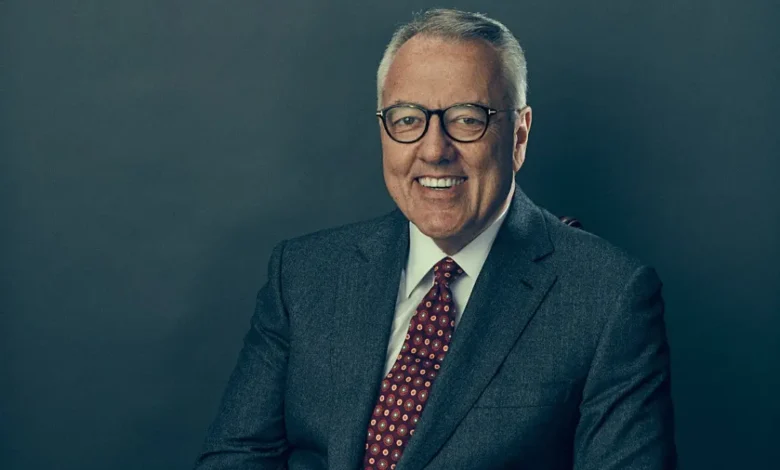
In the pantheon of modern American corporate turnarounds, few stories possess the structural complexity and ultimate success of Greg Brown’s tenure at Motorola. Nearly two decades after the company faced an existential crisis that threatened to dissolve one of the most storied names in industrial history, Brown has been named the 2026 CEO of the Year. The award, bestowed by a committee of distinguished industry peers and former laureates, recognizes a strategic transformation that shifted Motorola from a struggling, multi-industry conglomerate into the global bedrock of mission-critical public safety and enterprise security.
The Crucible of 2008: A Company on the Brink
To understand the magnitude of Brown’s achievement, one must examine the precarious state of Motorola in 2008. The company, which had been the vanguard of the mobile age since introducing the first portable cellular phone in 1973, found itself trapped in a cycle of innovation decay. By the time Brown ascended to the CEO role, the handset division—the company’s traditional "crown jewel"—was hemorrhaging more than $1 billion annually. The arrival of the iPhone in 2007 had fundamentally altered the competitive landscape, rendering Motorola’s legacy portfolio obsolete while the firm struggled to pivot toward 3G technology.
The internal pressure was immense. Brown, who had lost 40 pounds under the strain of the transition, faced a board of directors that was deeply skeptical of his radical ideas, alongside the aggressive presence of activist investor Carl Icahn. The company was characterized by a bloated cost structure, a massive inventory backlog, and a rigid, tradition-bound culture that prioritized long-tenured staff over agile, performance-driven outcomes.
A Chronology of Transformation
The metamorphosis of Motorola occurred in distinct, decisive phases under Brown’s leadership:
- 2008: The Strategic Pivot: Within his first quarter as CEO, Brown initiated a series of aggressive measures, including a public commitment to evaluate strategic alternatives for the handset business and a controversial settlement with Carl Icahn to prevent a destabilizing proxy battle.
- 2009–2010: Structural Bifurcation: Brown implemented a rigorous cost-cutting program, including significant workforce reductions and pension freezes. He brought in industry veteran Sanjay Jha to stabilize the mobile handset business, allowing the parent company to focus on its "afterthought" division: commercial, government, and industrial solutions.
- 2011: The Birth of Motorola Solutions: The company successfully spun off Motorola Mobility, which was subsequently acquired by Google for $12.5 billion. The remaining entity, Motorola Solutions (MSI), began its journey as a focused mission-critical communications firm.
- 2014–2015: The Cultural Reset: Facing internal skepticism, Brown famously challenged his leadership team to "commit or quit," offering historic severance packages to those who did not align with the new focus on total shareholder return (TSR).
- 2016–Present: The Era of the Compounder: Through over 60 strategic acquisitions—including Avigilon, Airwave, and Silvus Technologies—Brown evolved the firm into a software-driven security leader, focused on AI, video analytics, and integrated response systems.
Data-Driven Performance and Market Impact
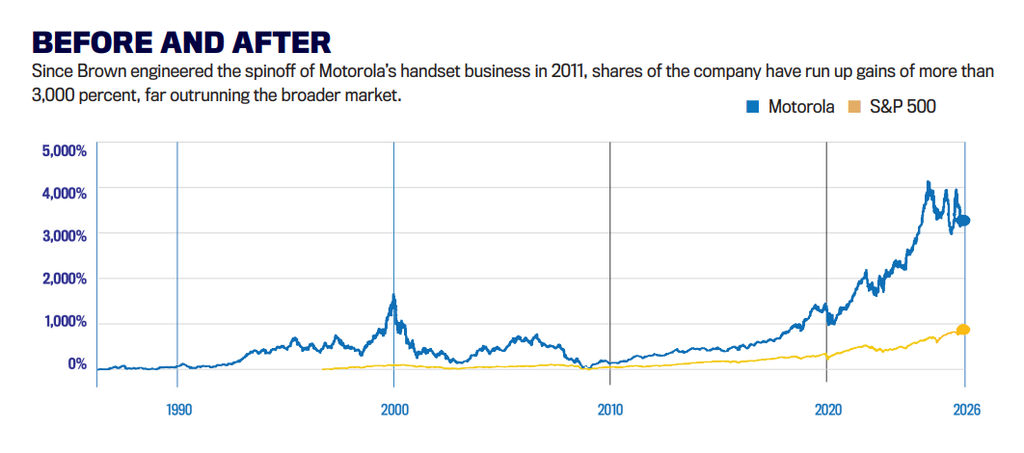
The financial results of this transformation are stark. Since the 2011 spin-off, Motorola Solutions has generated a total shareholder return exceeding 1,500 percent, vastly outperforming the S&P 500’s roughly 400 percent return over the same period. With a market capitalization currently sitting at approximately $66.5 billion, MSI has become an "elite compounder"—a company that consistently grows revenue, expands margins, and generates significant operating cash flow.
The company’s focus is now "near-monastic": providing the networks that power 911 call centers, the body cameras worn by law enforcement, and the communications systems used by first responders across more than 100 countries. This transition has proven that high switching costs and deep integration with government infrastructure create a "moat" that is far more defensible than the volatile, hyper-competitive consumer electronics market.
Expert Perspectives and Peer Recognition
The selection committee for the CEO of the Year award highlighted Brown’s unique ability to blend technical curiosity with ruthless operational discipline. Marillyn Hewson, former chair and CEO of Lockheed Martin, noted that Brown’s navigation of a complex, high-stakes environment has redefined the company’s trajectory for the next century.
Dave Ricks, chair and CEO of Eli Lilly, emphasized the importance of Brown’s strategic conviction: "The fact that Motorola now sits at the core of public safety communications—protecting communities across the U.S. and around the world—is a testament to his vision and discipline."
The committee’s decision also weighed the "courageous transformation" cited by Tamara Lundgren, former CEO of Radius Recycling, who praised Brown’s shift toward mission-critical software and rigorous operational excellence as a blueprint for long-term institutional survival.
The Philosophy of "Less Is More"
Central to Brown’s success is his rejection of the traditional conglomerate model. While many CEOs prioritize "shiny objects" and rapid, uncoordinated growth, Brown has consistently advocated for a "less is more" approach. He argues that being a $15 billion market leader in a niche, essential sector is vastly superior to being a $50 billion firm with diluted focus and lower margins.
This philosophy extends to his approach to capital allocation. Brown asserts that he spends his time on only two things: people and capital. He has cultivated a leadership team composed of both "homegrown" talent and strategic hires from the tech sector, fostering a culture where accountability is non-negotiable. His management style—the "Socratic method"—involves constant, direct communication with employees at all levels, a practice he describes as "density of dots," allowing him to ingest frontline information to make informed, data-backed decisions.
Future Implications: The AI Integration
Looking toward the horizon, Brown is positioning Motorola Solutions to lead in the integration of Artificial Intelligence within public safety. Unlike firms that seek to replace human labor with automation, Brown’s strategy focuses on "human-in-the-loop" augmentation. By utilizing AI for real-time translation during 911 calls, anomaly detection in video security, and automated drone deployment, Motorola is seeking to shave critical seconds off emergency response times.
The implications for the broader technology sector are significant. Brown’s model demonstrates that legacy firms, often dismissed as "dinosaurs," can effectively pivot to high-growth, high-tech sectors if they are willing to divest their legacy burdens and embrace radical transparency. His commitment to "nutrition labels" for AI—transparently communicating the capabilities and limitations of the software—sets a potential standard for corporate ethics in the age of generative AI.
A Legacy of Resilience
At 66 years old, and serving as one of the longest-tenured CEOs in the Fortune 500, Brown displays no signs of slowing down. His perspective on leadership remains grounded in the lessons of his upbringing: the necessity of taking responsibility, the avoidance of excuses, and the importance of lifelong learning.
His journey from a young manager in the telecom sector to the head of a global public safety giant serves as a case study for business schools and boardrooms alike. The 2026 CEO of the Year award is not merely a celebration of past financial metrics; it is a recognition of a leader who looked at a dying empire and had the foresight to dismantle it—not to destroy it, but to save it. By focusing on the essential, defending the critical, and embracing the necessity of change, Greg Brown has secured Motorola’s place in the future of global infrastructure, ensuring that the company’s mission—to help people be their best in the moments that matter—remains the driving force of its existence.