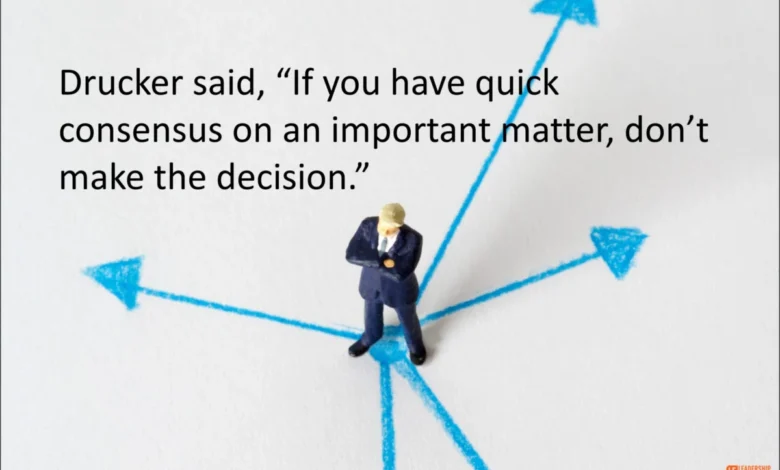
The management philosophy of Peter Drucker, the father of modern business consulting, remains a foundational pillar for organizational success, particularly his assertion that if a leadership team reaches a quick consensus on an important matter, the decision should be delayed. This concept, often debated in boardrooms and academic business circles, posits that the absence of friction in a decision-making process is not a sign of alignment, but rather an indicator of potential groupthink, hidden agendas, or a lack of rigorous analytical depth. When high-stakes decisions are finalized without the crucible of constructive dissent, the likelihood of long-term failure increases significantly, as the organization lacks a buffer against blind spots and unexamined risks.
The Psychology of Groupthink and the Value of Friction
The phenomenon of "groupthink," a term coined by social psychologist Irving Janis in 1972, provides the scientific underpinning for Drucker’s warning. Janis identified that when groups prioritize consensus over the realistic appraisal of alternatives, the quality of decision-making deteriorates. This is often exacerbated in environments where subordinates feel it is unsafe to challenge authority, leading to a phenomenon known as "pluralistic ignorance," where individuals privately disagree with the group’s direction but publicly support it, assuming they are the only ones with reservations.
In the corporate landscape, the absence of dissent is rarely a result of perfect clarity; it is more frequently a byproduct of a culture that rewards compliance over critical inquiry. When a leadership team moves too quickly to reach a decision, they often bypass the "discovery phase," where competing viewpoints would have surfaced underlying operational or strategic flaws. Data from various organizational studies suggest that teams which engage in "cognitive conflict"—disagreement centered on ideas rather than personalities—outperform teams that focus on "affective conflict," which is driven by personal ego and politics.
The Four Pillars of Rigorous Decision Making
To counteract the tendency toward premature consensus, organizational experts have identified four core strategies that leaders must employ to ensure that the decision-making process remains robust and reflective of the organization’s best interests.

1. Prioritizing Radical Transparency Over Corporate Politics
The primary enemy of effective decision-making is the hidden agenda. Politics within an organization often masquerades as efficiency, but in reality, it protects individual power bases at the expense of collective success. Transparency requires that the underlying motivations for a particular stance be brought to the surface. When a leader or stakeholder pushes for more analysis, the group must distinguish between a genuine need for data and a stalling tactic designed to sideline a competitor. A culture of transparency demands that the "why" behind a position is as clear as the "what."
2. Institutionalizing the Right to Challenge
For dissent to be productive, it must be sanctioned from the top down. If employees perceive that challenging a senior executive is a career-limiting move, they will withhold information that could prevent a catastrophe. Leaders must explicitly grant permission for their logic to be questioned. This does not imply a breakdown in authority, but rather the creation of a "safe harbor" where ideas are stress-tested. Organizations like the United States Navy and certain high-reliability organizations in aviation use "devil’s advocacy" protocols, where specific individuals are tasked with finding flaws in the proposed plan, ensuring that all risks are documented before execution.
3. The Necessity of Intellectual Flexibility
The most significant barrier to effective decision-making is the leader’s inability to change their mind. If a leader demonstrates that they are emotionally tethered to their initial premise, they effectively shut down the flow of contradictory evidence. Research on cognitive bias shows that the "confirmation bias"—the tendency to search for information that supports one’s existing beliefs—is most potent in those with high levels of authority. When a leader openly admits when they have been swayed by new data, they signal to the organization that the goal is the correct decision, not the leader’s ego. This creates a psychological environment where team members feel emboldened to contribute their best insights, knowing their feedback is an asset rather than a liability.
4. Engaging Diverse Perspectives Early
The timing of input is as critical as the quality of the input. Many organizations make the mistake of developing a strategy in a vacuum and only presenting it to lower-level staff for "buy-in" once the final details have been cemented. By the time frontline workers are consulted, the decision is already set in stone, and dissent is viewed as a disruption. Engaging those who are closest to the daily operations—the "frontline" staff—at the conceptual phase of a project provides a reality check that high-level strategy often lacks. This practice is supported by the ancient wisdom of thinkers like Ptahhotep, who advocated for taking counsel from all corners of society, recognizing that valuable insights are often found in the most unassuming places.
Historical Context and Modern Implications
The history of corporate failure is littered with examples of organizations that succumbed to the allure of consensus. The collapse of major financial institutions during the 2008 economic crisis, for instance, has been frequently attributed to a culture where dissenting voices were systematically excluded from risk-management committees. Similarly, in the technology sector, companies that have failed to pivot often did so because their internal feedback loops were broken by a "yes-man" culture that ignored market signals until it was too late.

In the current era of rapid digital transformation, the pace of change is unprecedented. However, speed should not be confused with haste. The ability to pause and demand a second, more critical look at a decision is a competitive advantage. Data from the Harvard Business Review indicate that companies that utilize structured decision-making processes, which include formal intervals for critique and review, have a 25% higher success rate in executing strategic initiatives compared to their peers.
The Role of Data in Mitigating Personal Bias
While human intuition is a valuable component of leadership, it is increasingly supplemented by data-driven decision-making. However, data can also be manipulated to support a pre-existing conclusion. Therefore, the challenge for the modern executive is not just to collect data, but to ensure that the data is interrogated by individuals with diverse perspectives. When a project team includes members from marketing, finance, engineering, and customer support, they are inherently more likely to identify the weaknesses in a proposal than a homogenous group of high-level stakeholders.
The goal of this multi-disciplinary approach is to reach a "consensus of the informed" rather than a "consensus of the convenient." The former is built on a foundation of shared understanding and debated trade-offs, while the latter is a fragile agreement that typically dissolves at the first sign of real-world implementation trouble.
Conclusion: Wisdom Over Agreement
Ultimately, the purpose of dissent in the workplace is not to generate conflict for its own sake, but to cultivate wisdom. Wisdom is the result of testing an idea against reality, against historical precedent, and against the collective experience of the team. As organizations navigate an increasingly complex global economy, the ability to foster a culture that values rigorous, transparent, and inclusive debate will distinguish the industry leaders of the next decade from those that remain stagnant.
Leaders who take Drucker’s advice to heart—viewing quick consensus as a red flag rather than a green light—will be better positioned to navigate the volatility of the modern market. By institutionalizing the right to challenge, rejecting the influence of office politics, and remaining intellectually flexible, they can ensure that their organizations are not merely moving forward, but moving in the right direction. True leadership, in this context, is the capacity to steer an organization through the fire of constructive friction, emerging not with the easiest answer, but with the strongest, most resilient path forward.