The Missing Context Layer: Why Most Enterprises Struggle to Extract Transformative Value From Artificial Intelligence Investments


Across the modern global enterprise, an invisible army of artificial intelligence platforms, systems, and advanced tools operates around the clock. From customer-facing conversational assistants and automated workflow engines to complex predictive analytics models, contemporary organizations have deeply integrated rapid-fire digital machinery into their daily operations. Each individual system is mathematically sophisticated, technologically advanced, and engineered to respond in milliseconds. Yet, when these systems are unleashed on real-world business challenges, the outcomes are frequently flawed, fundamentally confused, or disconnected from the strategic realities of the enterprise. This disconnect represents a profound operational hazard, and according to recent industry data, it stands as the primary structural barrier preventing businesses from realizing tangible returns on their massive artificial intelligence investments.
The Scope of the Enterprise AI Disconnect
A comprehensive new research poll conducted by MIT Technology Review Insights reveals a striking paradox at the heart of the current corporate technology boom. While virtually every organization surveyed is actively utilizing artificial intelligence to some degree, fewer than one in five enterprises—precisely 16 percent—are extracting transformative, enterprise-wide value from their deployments.
The empirical breakdown of the survey results highlights a widespread plateau in technological maturity. The largest single cohort of respondents, representing 40 percent of the total, reported seeing only moderate, isolated gains confined to specific tasks or individual teams. Meanwhile, 21 percent observed meaningful gains across broader operations, leaving a troubling 23 percent—nearly a quarter of all surveyed organizations—reporting minimal returns or no discernible return on investment at all.
When analyzing how these technologies are actively being deployed, the data suggests that most enterprises remain anchored in the early, exploratory phases of the AI adoption lifecycle. Approximately 38 percent of companies are still largely confined to piloting specific AI use cases, while 35 percent utilize the technology primarily as a human-assistance layer, relying on basic productivity tools such as co-pilots and chat assistants. In contrast, only 12 percent of enterprises have successfully moved advanced AI agents into active production environments, and a mere 3 percent report utilizing artificial intelligence to autonomously execute the majority of the work within core business processes.
Bridging the Capability-Utility Gap

This sluggish progression from experimentation to core business integration highlights a glaring divergence in the modern technology landscape.
"There’s a big gap between what the models are capable of and how the models are actually being useful inside organizations," observes Prukalpa Sankar, co-founder of Atlan, a prominent data operations and governance platform. Sankar points to the paradox of modern machine learning capability, noting that for almost every real-life intent and purpose, artificial general intelligence functionally exists today. However, the operational machinery required to make those intelligence engines practical, safe, and contextually aware inside a corporate setting remains critically underdeveloped.
To understand why advanced models stumble in enterprise environments, industry experts point to the fundamental absence of organizational context. While foundational models are trained on vast horizons of public internet data, they possess zero innate understanding of a specific company’s internal nomenclature, proprietary compliance structures, historical client relationships, or intricate supply chain dependencies.
The Architectural Missing Link: The Context Layer
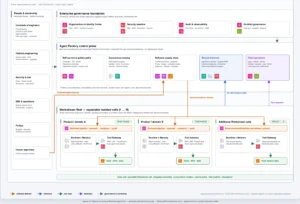
To remedy this systemic shortcoming, enterprise architects are increasingly turning to the concept of the context layer. This specialized architectural infrastructure sits deliberately between an organization’s foundational systems of record—such as enterprise resource planning databases, customer relationship management tools, and proprietary data repositories—and its disparate artificial intelligence platforms.
The primary function of this layer is translation and governance. It ingests raw enterprise intelligence, strips away security risks, and transforms unstructured corporate data into a governed, machine-usable context that autonomous AI agents and large language models can safely interpret. Crucially, this layer acts as an institutional memory, helping knowledge compound over time rather than dissipating across siloed departmental tools.
Without this foundational bridge, organizations run the risk of catastrophic misalignment. "Without a context layer for AI, it’s almost like you’re hiring the smartest intern in the world, blindfolding them, and throwing them into your organization," Sankar explains, capturing the precarious state of ungrounded enterprise deployments.

The Chronology of the Enterprise AI Gold Rush
To fully contextualize the current crisis of ROI in corporate artificial intelligence, it is necessary to examine the rapid historical timeline that brought the global economy to this juncture.
The modern corporate AI era commenced in late 2022 with the mainstream public release of advanced generative pre-trained transformers. The immediate industry reaction was characterized by widespread urgency, frequently described in boardrooms as a technological gold rush or a mandatory modernization race. Fearing obsolescence, executive leadership teams across financial services, healthcare, retail, and manufacturing authorized rapid capital expenditures for standalone AI tools.
Throughout 2023, the prevailing corporate strategy focused on rapid experimentation and proof-of-concept deployments. Companies rushed to subscribe to software-as-a-service AI wrappers, deployed customer service chatbots, and equipped software engineering teams with code-generation assistants. During this phase, success was largely measured by adoption velocity—how quickly employees could access and test the new interfaces—rather than long-term strategic alignment or productivity metrics.
By 2024, as initial pilot programs concluded, enterprises faced a sobering reality check. While individual productivity metrics ticked upward in isolated silos, executives struggled to reconcile software licensing and computational infrastructure costs with bottom-line revenue growth. The limitations of isolated, context-free models became glaringly apparent as hallucinations, data leakage concerns, and regulatory non-compliance incidents surfaced in production environments.
In 2025 and into 2026, the market entered its current phase of maturation and architectural reassessment. Organizations realized that plugging powerful models directly into fragmented databases was insufficient. This realization catalyzed the development of advanced data mesh architectures, semantic search layers, enterprise knowledge graphs, and context governance frameworks—marking a definitive shift from raw model acquisition to foundational data infrastructure.
Analysis of Implications and Strategic Shifts

The empirical findings from the MIT Technology Review Insights poll carry profound implications for the trajectory of enterprise technology spending and corporate governance.
First, the data signals a definitive end to the era of indiscriminate AI adoption. Boards of directors and chief financial officers are increasingly scrutinizing artificial intelligence expenditures through a rigorous financial lens. Projects that cannot demonstrate a clear, governed path to value realization are being downsized, frozen, or subjected to stringent auditing. Consequently, software vendors and cloud providers are being forced to pivot their marketing and product development strategies away from raw parameter counts and computational horsepower toward data governance, security, and context-management solutions.
Second, the structural emphasis on the context layer elevates the role of data engineering and Chief Data Officers (CDOs) within corporate hierarchies. For years, data management was treated as a back-office utility, focused primarily on compliance, storage optimization, and basic reporting. Today, structured and governed data architecture is recognized as the essential prerequisite for autonomous enterprise intelligence. Companies that have historically neglected their internal data hygiene—permitting data silos, uncatalogued assets, and inconsistent taxonomies—are finding themselves structurally incapable of deploying advanced AI agents safely.
Third, the human element of corporate transformation remains a critical bottleneck. As organizations move past simple co-pilot assistants toward autonomous agents capable of executing multi-step business processes, questions of accountability, workflow redesign, and labor displacement come to the forefront. Ensuring that AI systems operate within defined ethical and operational boundaries requires robust human oversight, transforming employees from direct task executors into system supervisors and context curators.
Looking Ahead: The Road to Transformative Value
As the enterprise artificial intelligence market continues to evolve, the distinction between early adopters and market leaders will no longer be determined by who spent the most capital on computational infrastructure. Instead, success will belong to organizations that successfully bridge the gap between machine capability and business reality.
The maturation of the enterprise context layer represents a critical maturation milestone for the industry. By systematically aligning foundational artificial intelligence models with governed, proprietary enterprise data, businesses can finally move past the era of the "blindfolded intern." Only by establishing this crucial architectural bridge can organizations hope to transform the raw promise of artificial intelligence into enduring, compounding, and transformative business value.