The Great Accountability Gap: Why AI Coding Tools Are Facing a Corporate Backlash

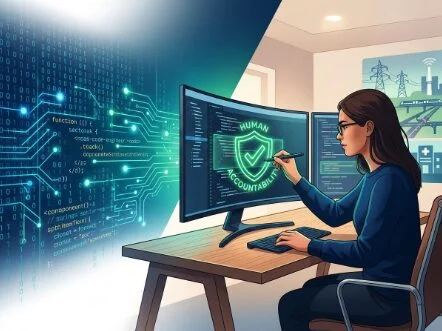
Artificial intelligence is rapidly becoming one of the most powerful forces in modern software engineering, yet a profound paradox is emerging within the tech sector. While generative AI tools promise to slash development timelines and revolutionize productivity, a growing number of security-sensitive organizations—ranging from global financial institutions to critical infrastructure providers—are hitting the brakes. They are choosing to restrict or outright ban the use of AI in high-stakes environments, revealing a widening chasm between the speed of innovation and the necessity of human accountability.
The Acceleration Paradox
The allure of AI-assisted coding is undeniable. According to data from industry benchmarks, AI-powered coding assistants can improve developer productivity by 20% to 50% for routine tasks. By automating boilerplate code, generating unit tests, and suggesting refactoring strategies, these models have allowed companies to ship features at a velocity that seemed impossible just half a decade ago. However, for organizations tasked with maintaining the stability of the global power grid, healthcare systems, and interbank transaction platforms, this speed is often viewed as a liability rather than an asset.
In recent interviews, Chief Technology Officers and Chief Information Security Officers have reached a consensus: while they admire the technical capabilities of current Large Language Models (LLMs), they refuse to allow AI-generated code to enter production without a human engineer willing to sign off on its safety. This "human-in-the-loop" mandate is not merely a preference; it is a defensive strategy against the unique risks posed by non-deterministic software.
The Mechanics of Algorithmic Risk
The core of the issue lies in the fundamental difference between human reasoning and machine pattern matching. Human software engineers are trained to build code with an understanding of intent, edge cases, and long-term architectural stability. Conversely, LLMs operate by predicting the most statistically probable next token in a sequence. While this makes them exceptional at mimicking functional code, it renders them fundamentally incapable of understanding the "why" behind a solution.
This leads to what cybersecurity researchers call "shadow vulnerabilities." An AI might generate a function that is syntactically perfect and passes basic unit tests but contains a hidden dependency on a deprecated library or introduces an subtle, insecure authentication pattern. Because the AI cannot explain its reasoning, these flaws often remain dormant, bypassing standard automated tests until a malicious actor discovers them in a production environment.
Chronology of the AI Coding Boom
The rapid integration of AI into software development has followed a distinct trajectory:
- 2021-2022 (The Discovery Phase): Tools like GitHub Copilot entered the public consciousness, proving that LLMs could handle boilerplate tasks. Early adopters in web development and consumer applications integrated these tools to gain a competitive edge.
- 2023 (The Proliferation Phase): AI-coding tools became enterprise-standard. Integration into IDEs (Integrated Development Environments) became ubiquitous, with companies reporting record-breaking sprint velocities.
- 2024 (The Governance Crisis): High-profile security incidents and "hallucination" events in enterprise environments forced a reevaluation. Companies began formalizing AI usage policies, moving away from "move fast and break things" toward "verify and validate."
- 2025-Present (The Accountability Pivot): We are currently in a phase where regulatory bodies and corporate boards are demanding proof of provenance for all code, leading to the development of "AI-guarded" development pipelines.
The Erosion of the Audit Trail
For decades, software development has relied on a clear chain of custody. When a system failure occurs—such as a flash crash in a financial market or a failure in an electronic health record system—investigators can perform a root-cause analysis by examining the commit history. They can identify exactly which engineer wrote the code, who reviewed it, and who approved the pull request.
AI complicates this chain significantly. When a developer accepts a block of machine-generated code, the "authorship" becomes blurred. If a critical vulnerability is introduced, is the developer responsible for failing to vet the code? Is the company responsible for deploying a model that produced the error? Or is the developer of the AI model liable for the output? This ambiguity creates a legal and regulatory vacuum that most risk-averse organizations are unwilling to enter.

Economic Incentives vs. Operational Risk
The primary driver of AI adoption remains the economic imperative. Companies are under immense pressure to reduce headcount or increase output, and AI provides a way to do both. However, this creates a "deploy first, govern later" incentive structure. Financial analysts note that while the short-term gains of AI-augmented development are high, the potential cost of a catastrophic security breach involving AI-authored code could dwarf those gains.
A 2024 report by a major cybersecurity firm suggested that organizations failing to implement strict governance for AI-assisted code could face a 30% increase in technical debt and security-related remediation costs over a three-year period. The cost of debugging "black box" code generated by machines is inherently higher than debugging code written by human developers who understand the logic behind their own work.
Toward a New Paradigm of Oversight
The solution to this crisis of accountability is not the wholesale rejection of AI. Such a move would be equivalent to banning the use of compilers or automated testing suites in the late 20th century. Instead, the industry is moving toward a model of "Supervised Autonomous Engineering."
This involves three critical pillars:
- Immutable Audit Trails: Every piece of code contributed by an AI must be flagged, documented, and linked to the specific human developer who reviewed and verified it.
- Formal Verification: For critical infrastructure, organizations are beginning to require that AI-generated code undergo rigorous formal verification—a process where the code’s logic is mathematically proven to be correct, rather than just tested against inputs.
- Algorithmic Provenance: Future software development environments will likely require metadata for every module, identifying whether it was written by a human, an AI, or a hybrid of both, allowing security teams to apply different levels of scrutiny based on the source.
The Changing Role of the Engineer
As we look toward the next decade, the role of the software engineer is undergoing a seismic shift. The "author" model—where engineers spend the bulk of their time typing out syntax—is giving way to the "air traffic controller" model. In this new reality, engineers spend less time writing individual lines of code and more time configuring, supervising, and stress-testing the autonomous systems that write the code for them.
This shift does not diminish the value of the human engineer; rather, it elevates it. The human is no longer just a laborer but the ultimate arbiter of safety and intent. The ability to audit, understand, and correct machine-generated logic will become the most sought-after skill set in the job market.
Conclusion: The Accountability Mandate
The most important challenge in the evolution of AI-driven software engineering is not the sophistication of the models or the speed of their outputs; it is the establishment of a robust framework for accountability. As AI continues to integrate itself into the vital infrastructure that sustains modern society—from the transportation of goods to the administration of medical care—the question of "who is responsible when it fails?" cannot be ignored.
Until society and the legal system can provide a clear, indisputable answer to that question, the adoption of AI in software development will remain a calculated risk. The future of software is undoubtedly autonomous, but it must remain tethered to the bedrock of human responsibility. Without that, the speed gained by AI will be stripped away by the inevitable, and potentially catastrophic, cost of failure.