ChartMogul Launches Native AI Analyst to Transform Subscription Data Diagnostics and Unlocks CRM for All Users

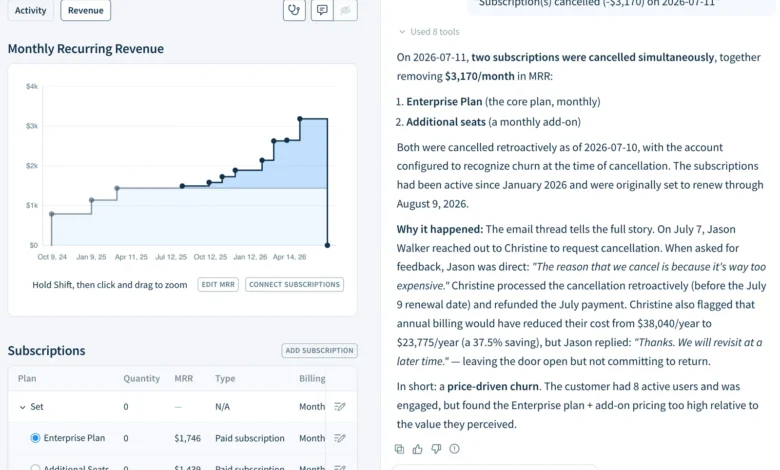
Subscription analytics platform ChartMogul has officially introduced ChartMogul AI, a native analytical assistant designed to autonomously investigate revenue data, trace underlying metric changes back to individual customer activities, and decode the complex mechanics of recurring revenue. Announced by Chief Executive Officer Nick Franklin, the launch aims to bridge the gap between high-level financial dashboards and the granular, often messy reality of subscription business data. Alongside the AI rollout, the company has eliminated paid tiers for its proprietary CRM system, making customer relationship management tools accessible to every user on the platform to feed richer contextual data into the new diagnostic engine.
The rollout addresses a longstanding operational challenge within the Software-as-a-Service (SaaS) and subscription economies: the inherent friction of data hygiene. Subscription metrics—encompassing upgrades, downgrades, churn, reactivations, multi-component subscriptions, refunds, credits, and multi-currency conversions—rely on intricate calculation logic. Minor discrepancies in handling these variables can transform trusted financial dashboards into ambiguous figures requiring constant manual reconciliation and explanation.
For the past twelve years, ChartMogul has positioned itself as an industry standard for translating thousands of real-world billing scenarios into standardized subscription metrics. However, company executives noted that isolating the operational drivers behind a sudden movement in Annual Recurring Revenue (ARR) or Monthly Recurring Revenue (MRR) has historically demanded specialized technical skill, deep database familiarity, and considerable time. Consequently, comprehensive data forensics have frequently been restricted to high-stakes corporate milestones, such as impending fundraises, board meetings, strategic pricing overhauls, or anomalous metric shifts. Day-to-day operations have largely relied on passive observation: executives glance at headline ARR figures, confirm they align with forecasts, and close the application. ChartMogul AI seeks to democratize this diagnostic depth by converting passive metric checks into interactive, conversational investigations.
Engineering Architecture and Specialized Agentic Frameworks
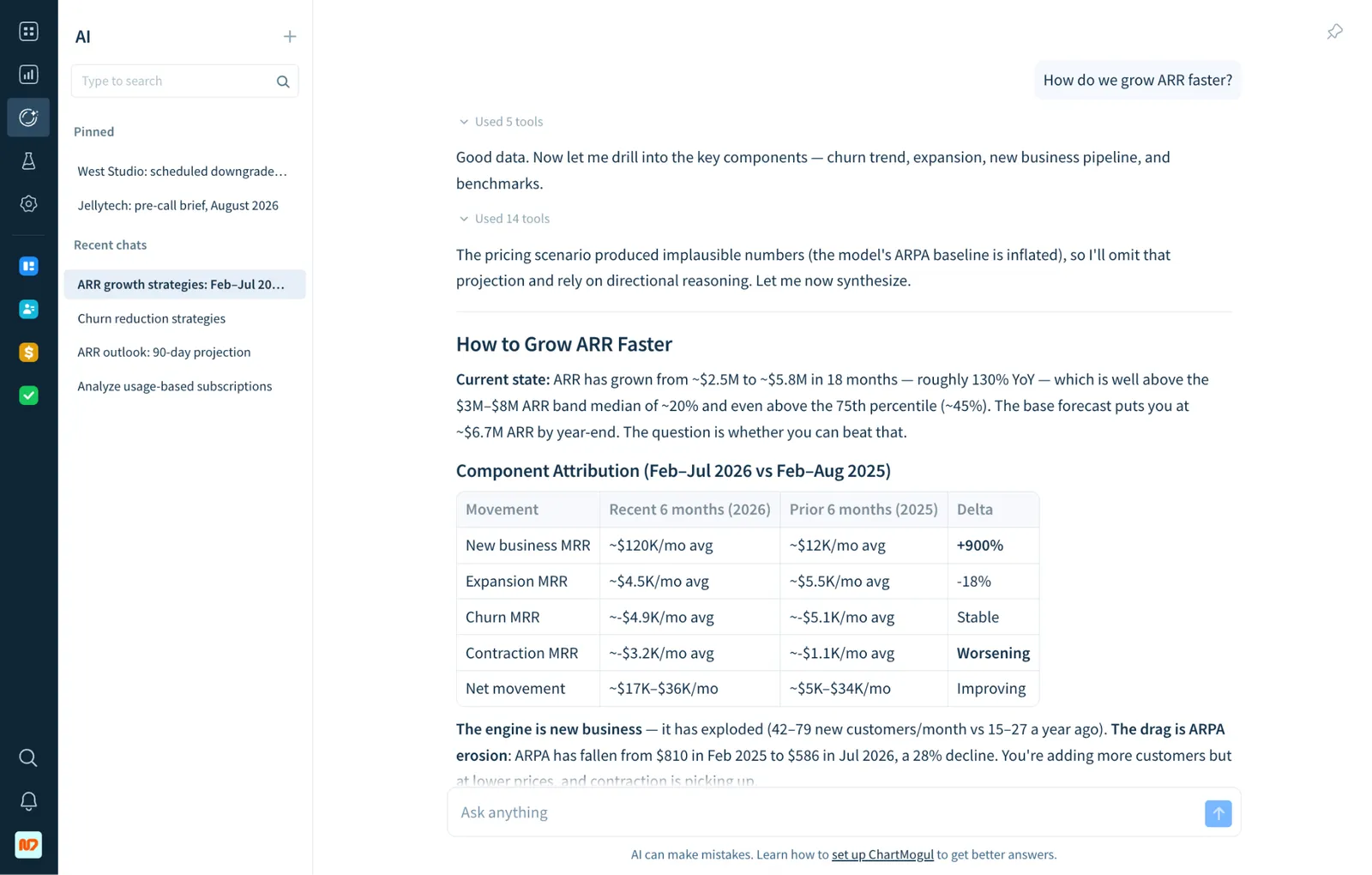
Unlike superficial dashboard chatbots that merely summarize visual representations of charts, ChartMogul AI is deeply integrated into the platform’s core architecture. The system executes multi-step investigative workflows by independently selecting relevant financial metrics, generating precise filters and data segments, inspecting specific customer lifecycles, and synthesizing qualitative CRM context into actionable insights.
The technical complexity behind the user interface addresses common failure modes inherent to general-purpose large language models (LLMs). According to engineering leads at the company, the architecture relies on specialized sub-agents and routing protocols designed to eliminate typical AI hallucinations and shallow analyses. If a general model attempts to query subscription metrics, it frequently misselects diagnostic tools or guesses filter parameters. To counteract this, ChartMogul AI utilizes a dedicated sub-agent that first references the user’s specific billing plans and custom tags before translating natural language requests into the proprietary ChartMogul Filter Language (CFL).

Furthermore, the system employs strict methodological steps, or "skills," tailored to specific recurring revenue inquiry types. To prevent inaccurate hyperlinking or hallucinations regarding customer records, data links are programmatically bound directly to the underlying database objects, ensuring the model can only copy verified references rather than generate them dynamically. While the underlying intelligence currently leverages advanced models from Anthropic, company leadership emphasizes that the competitive advantage stems from combining trusted financial data models with over a decade of domain-specific recurring-revenue expertise.
Unifying Financial Metrics with Qualitative CRM Data
A central thesis of the ChartMogul AI release is that financial metrics can accurately delineate what occurred within a business, but seldom explain why. Diagnosing the root causes of churn, contraction, or expansion typically requires qualitative context buried across multiple departmental silos, including customer success notes, support emails, cancellation logs, and sales call transcripts.
To ensure the AI possesses a comprehensive understanding of each account, ChartMogul has fundamentally restructured its pricing and packaging model. Effective immediately, ChartMogul CRM is included free of charge for every user across all tiers. Previously, connecting corporate email servers and unlocking full CRM functionality required purchasing dedicated "CRM Pro" seats. By removing these paid restrictions and folding the CRM directly into the core platform, ChartMogul is incentivizing users to centralize unstructured customer interactions—such as competitor mentions, product complaints, cancellation reasons, and sentiment shifts—into the database. The system automatically preprocesses this textual data into structured knowledge, empowering the AI to analyze revenue performance alongside direct customer feedback at scale.
Natural Language Processing for Complex Data Segmentation
The integration of natural language processing significantly alters how operators query their databases. Tasks that historically demanded manual navigation through multi-layered filter menus can now be executed conversationally. For example, complex comparative inquiries—such as evaluating ARR growth patterns and net retention rates across various geographic jurisdictions or specific customer cohorts—can be initiated through standard conversational prompts.
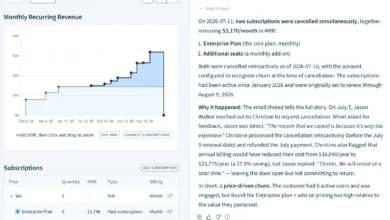
During the initial release phase, ChartMogul AI operates in a read-only capacity, restricting the system to diagnostic investigations, data synthesis, and reporting. However, company roadmaps indicate that write-action capabilities, enabling the system to execute administrative or operational tasks based on insights, are currently under development. Contextual entry points have also been deployed throughout the user interface. When an operator views a specific customer cancellation record, a single interface click initiates an automated retrospective analysis examining the account’s historical engagement, product usage trends, and likely catalysts for churn.
Ecosystem Strategy and the Dual-Path AI Approach
The launch of ChartMogul AI complements the company’s broader ecosystem strategy. In June, ChartMogul released an expanded version of its Model Context Protocol (MCP) server, featuring more than 80 specialized tools integrated directly into developer directories for platforms like Claude and ChatGPT. The MCP server allows external, general-purpose AI environments to securely access the underlying ChartMogul database layer, offering flexibility for engineering teams that prefer working within external AI interfaces or combining financial data with external business intelligence systems.
Conversely, the native ChartMogul AI interface provides a specialized, high-context environment tailored explicitly for subscription metrics. While external tools offer generalized utility, the native platform leverages proprietary algorithms, custom domain taxonomies, and deep structural awareness of the ChartMogul data model to deliver high-fidelity financial investigations.
Broader Industry Implications and Future Outlook
Industry analysts view the release of domain-specific, native financial AI agents as a pivotal step in the evolution of enterprise software. As artificial intelligence matures, software interfaces are transitioning from static visualization tools—such as dashboards and static reports—toward autonomous diagnostic agents capable of operating software controls on behalf of human users.
For the subscription economy, where data complexity scales exponentially with customer volume, tools that automate root-cause analysis could significantly reduce the operational overhead traditionally required by finance, revenue operations (RevOps), and executive leadership teams. While traditional charts, filters, and manual controls will remain vital for regulatory and compliance validation, the long-term strategic trajectory points toward conversational AI becoming the primary interface for complex data exploration.
ChartMogul AI is available immediately to all platform users. As the broader technology sector evaluates the practical utility of generative AI in enterprise environments, the success of domain-specific platforms like ChartMogul will likely serve as a bellwether for how deeply artificial intelligence can integrate into core financial operations without compromising data integrity or security.