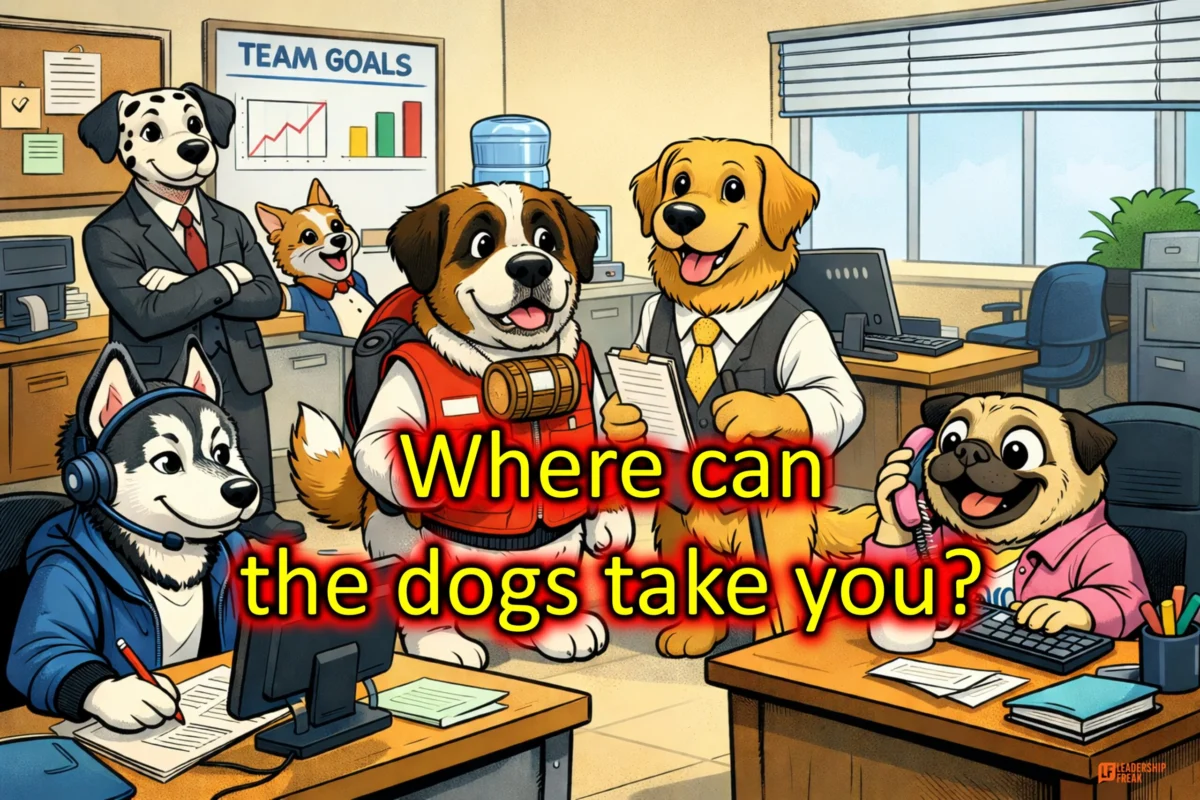
The concept of organizational leadership has undergone a radical transformation in the 21st century, shifting from a model of rigid conformity to one of strategic talent alignment. At the heart of this evolution is the realization that human capital, much like specialized breeds of working animals, possesses inherent designs and predispositions that cannot be fundamentally altered through traditional training. The metaphorical framework of "the dogs in the shed" posits that the primary responsibility of a leader is not to mold employees into a singular, idealized image of a "worker," but rather to identify their innate strengths and position them within the organizational "pack" where they are most likely to flourish. This approach challenges the long-standing management fallacy that any employee can be trained to perform any task, suggesting instead that high-performance teams are built on the foundation of biological and psychological compatibility with specific roles.
The Biological Imperative of Talent Alignment
In the modern corporate landscape, the analogy of canine breeds serves as a poignant reminder of the limitations of professional development. Just as a Greyhound is genetically predisposed for speed and would struggle in a role requiring the steady, slow-paced guidance of a service dog, employees bring specific cognitive "hard-wiring" to their roles. A Pug, bred for companionship and low-impact activity, cannot be expected to perform the high-stakes rescue operations of a Saint Bernard. Conversely, a Saint Bernard, while powerful and resilient, will fail to thrive if tasked with the high-speed, high-endurance requirements of pulling a sled over long distances—a task reserved for Huskies and Malamutes.
Management experts argue that the failure to recognize these inherent differences leads to systemic organizational inefficiency. When a leader attempts to "train" a Greyhound to sit still or a Pug to perform heavy labor, they are not merely wasting resources; they are actively eroding the employee’s morale and the organization’s productivity. The data supporting this is significant. According to a multi-decade study by Gallup, employees who use their strengths every day are six times more likely to be engaged at work and 8% more productive. When leaders focus on fixing weaknesses—the "retraining" mentioned in the source material—rather than maximizing strengths, engagement levels plummet, leading to a "disengagement crisis" that costs the global economy an estimated $8.8 trillion in lost productivity annually.
A Chronology of Management Philosophy: From Taylorism to Strengths-Based Leadership
To understand the weight of the "Dogs in the Shed" philosophy, one must look at the historical trajectory of management science. In the early 20th century, Frederick Winslow Taylor’s "Scientific Management" treated workers as interchangeable parts in a machine. This era emphasized standardization; if a worker was inefficient, the solution was more rigorous training or stricter oversight. The "breed" of the worker was irrelevant; only the output of the assembly line mattered.

By the mid-20th century, the Human Relations Movement began to acknowledge the psychological needs of workers, but it wasn’t until the late 1990s and early 2000s that the paradigm shifted toward the "Strengths-Based" approach popularized by Donald Clifton and Marcus Buckingham. This era introduced the radical idea that an individual’s personality and innate talents are relatively enduring and that the greatest room for growth lies in the areas of greatest strength.
The publication of Jim Collins’ Good to Great in 2001 further solidified this concept with the "First Who, Then What" principle. Collins argued that "great" companies first get the right people on the bus (and the wrong people off the bus) and then figure out where to drive it. The "Dogs in the Shed" model takes this a step further: it isn’t just about having the right people on the bus, but ensuring the Greyhound isn’t trying to drive while the Saint Bernard is trying to navigate the tight aisles.
The Economic and Psychological Cost of Misalignment
The implications of misaligned talent are felt most acutely in the "performance gap"—the difference between what an employee is capable of doing and what they are actually doing. When a leader views their team as a collection of flaws to be fixed, they create an environment of "defensive work." Employees become hyper-focused on hiding their perceived inadequacies rather than leaning into their natural talents.
Research from the Harvard Business Review suggests that the cost of a bad hire—or a mispositioned hire—can be as much as 1.5 to 2 times the employee’s annual salary. This includes the costs of recruitment, onboarding, lost productivity, and the negative impact on team culture. In the context of the "Dogs in the Shed," trying to "reposition" a dog that belongs in the field into an office environment results in a restless, destructive animal. In a corporate setting, this manifests as burnout, high turnover, and toxic workplace dynamics.
Industry analysts point out that the most successful contemporary organizations, such as Google and Netflix, have moved away from traditional performance reviews that focus on "areas for improvement." Instead, they utilize "talent audits" to identify where an individual’s "natural gait" matches the company’s "track." This reflects a broader shift toward the "coaching" model of leadership, where the manager acts as a catalyst rather than a micromanager.

Coaching as an Act of Ignition
The "Dogs in the Shed" framework posits that talent cannot be created; it can only be developed and released. This distinction is crucial for modern leadership. A coach does not "impose" passion on a Greyhound to make it run; the Greyhound runs because it is in its nature to do so. The coach’s job is to provide the track, clear the obstacles, and fan the existing flame of passion.
This requires a fundamental change in the leader’s daily practice. Instead of asking, "How can I make this person better at X?" the leader must ask, "In what environment would this person’s natural Y be most valuable?" This shift moves the burden of performance from "fixing" to "releasing." It acknowledges that every person in the "shed" has a specific "mission" they are designed to fulfill.
Implementing the Talent Audit: A Strategic Framework
For organizations looking to adopt this strengths-based approach, the source text suggests a series of diagnostic exercises designed to inventory the "pack." This process begins with a rigorous assessment of everyone’s strengths and an observation of when they are "most alive." This state of "aliveness"—often referred to by psychologists as "Flow"—is the primary indicator of a talent-role match.
The secondary phase of this implementation involves identifying "mismatched" efforts. Leaders are encouraged to look for instances where they are attempting to "retrain" an employee to perform a task that is fundamentally at odds with their nature. In many cases, the most humane and economically sound decision is to "reposition" the individual. This may mean moving them to a different department, changing their job description, or, in some cases, acknowledging that the organization does not have the "track" that matches their "breed."
Broader Impact and Future Implications
As the global workforce moves further into the "Knowledge Economy," the importance of talent alignment will only grow. Artificial Intelligence and automation are increasingly taking over the "standardized" tasks that were once the hallmark of Taylorism. What remains are the highly specialized, creative, and emotionally intelligent tasks that are deeply tied to individual human "design."

In a world of fractional work and remote teams, the ability to quickly identify the "breed" of a collaborator will be a competitive advantage. Companies that persist in the "fixing" model will likely find themselves struggling with talent retention, as top performers—the Greyhounds and Saint Bernards of the professional world—will naturally migrate toward environments where their specific talents are celebrated and utilized rather than suppressed.
Ultimately, the "Dogs in the Shed" philosophy is a call for leadership humility. it is an admission that the leader is not the creator of talent, but its steward. By matching roles with talent and setting expectations that maximize strengths, leaders can stop wishing for the team they don’t have and start winning with the people they do. The mission of the organization relies on the pack, but the pack can only reach its destination if every dog is allowed to run the race it was born to win.