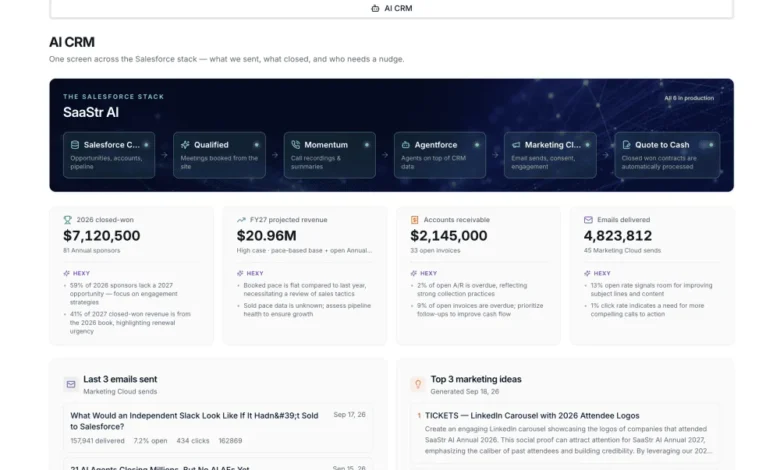
The modern landscape of B2B revenue operations is undergoing a profound structural shift, marked by the integration of autonomous workflows that extend far beyond traditional customer relationship management tools. A prominent example of this operational evolution is unfolding within SaaS community and event ecosystem SaaStr, where a lean team of three human operators now manages more than 21 production-grade artificial intelligence agents. This automated workforce has driven a 2.1-year-over-year expansion in sponsorship revenue, fundamentally redefining the economics of digital media and live event sponsorship sales.
Detailed operational breakdowns shared by executive leadership reveal a system where traditional enterprise software user interfaces have been effectively bypassed in favor of custom-built, headless architectures. Rather than relying on human sales representatives to manually log calls, update pipeline stages, and draft customized proposals, SaaStr’s internal infrastructure—anchored by an AI Vice President of Revenue dubbed “10K” and built on development platforms like Replit—orchestrates the entire sales and renewal lifecycle.
The Architecture of a Headless Revenue Stack
To achieve this level of operational efficiency, the organization moved away from standard administrative bottlenecks. In a conventional enterprise setup, platforms like Salesforce serve as both the system of record and the primary interface for daily data entry. However, in SaaStr’s current operational model, Salesforce functions as a headless backend. Human operators rarely navigate the native Salesforce user interface; instead, autonomous agents interact with the database programmatically, pulling telemetry from call-recording software, marketing automation platforms, and communication channels simultaneously.
This headless approach addresses a core limitation of standard enterprise software: data fragmentation. By centralizing disparate data streams—including website telemetry, historical event attendance, podcast engagement, and social media interactions—into a unified AI orchestrator, the agents possess the contextual depth required to execute complex commercial tasks without human intervention. The transition to this model was iterative, evolving over six months from a basic dashboard into a comprehensive autonomous management layer capable of overseeing lead qualification, pipeline forecasting, and contract renewals.
Transforming Inbound Lead Generation and Conversion
The evolution of SaaStr’s revenue engine is perhaps most visible at the top of the funnel, specifically regarding how inbound sponsor inquiries are handled. Historically, prospective sponsors navigated to a traditional contact page, submitted an inquiry via a static form, and waited up to 48 hours for a human representative to respond with a standardized introductory message.
Leadership identified this traditional friction point as a primary conversion barrier. To rectify this, the organization deployed an interactive conversational avatar integrated into its website infrastructure. Operating around the clock, this agent engages prospective buyers in real-time dialogue, assessing budgetary parameters, specific marketing objectives—such as lead generation versus brand awareness—and competitive considerations.
Over a 12-month evaluation period, this conversational inbound door facilitated approximately 17,000 discrete prospect interactions, resulting in the automated booking of 600 qualified meetings. For technology-centric buyers and AI-native organizations, interacting with an autonomous agent during the sales evaluation process serves as a practical demonstration of the vendor’s technical capabilities. If an organization positions itself as a premier venue for artificial intelligence discourse, prospective sponsors increasingly expect the buying experience to reflect those same technological standards.
Dynamic Prospectus Generation and Personalized Outreach
For prospective buyers who prefer self-service evaluation over real-time chat interactions, standard static PDFs and generalized slide decks have been replaced by tokenized, dynamic prospectuses. When a potential sponsor downloads introductory materials, the underlying system captures their engagement metrics—identifying which sponsorship tiers, pricing models, and case studies receive the most attention.

Within minutes of a download, the document dynamically updates to reflect the prospect’s specific corporate identity, highlighting relevant competitors already committed to the event and tailoring pricing recommendations based on observed browsing behavior. This living document remains accessible via the initial URL, allowing the sales infrastructure to continuously refine the pitch throughout the evaluation cycle. Field tests of this methodology demonstrated immediate engagement improvements, with prospective buyers noting the speed and contextual precision of the automated follow-up communications.
Reinventing the Customer Renewal Lifecycle
While inbound acquisition metrics show substantial gains, the most significant revenue acceleration stems from automated renewal management. A dedicated renewal agent, operating for approximately one month prior to evaluation, systematically engages customer accounts across all Annual Contract Value (ACV) tiers.
Previously, human account executives naturally prioritized enterprise accounts with the largest financial footprints, often leaving mid-tier and smaller sponsors undermanaged until the expiration window approached. The autonomous renewal agent eliminates this coverage gap by maintaining continuous touchpoints, automatically aggregating campaign performance data, impressions, and lead metrics into real-time reporting decks generated via presentation design software.
Importantly, the renewal agent tailors its output based on recipient segmentation. For a chief executive officer, the generated presentation focuses on macro-level visibility, aggregating total annual impressions across all brand touchpoints. Conversely, for an organization’s marketing and events team, the collateral emphasizes granular leaderboard positioning and booth traffic metrics. Furthermore, when historical data indicates a decline in sponsor engagement or category performance, the agent proactively formulates analytical rebuttals and strategic adjustments, successfully re-engaging accounts that might otherwise have lapsed.
Data Enrichment and the Multi-Vendor Integration Strategy
A critical foundation of this autonomous revenue model is robust data enrichment. Maintaining accurate records across a database exceeding 500,000 industry professionals requires continuous monitoring of professional transitions and corporate movements. Rather than relying on a single data provider, the internal agent architecture integrates multiple enrichment waterfalls—incorporating tools such as Clay, Core Signal, and specialized web scrapers—to verify contact accuracy before any outbound sequence is initiated.
This multi-layered verification process ensures that downstream communication agents possess clean, high-fidelity data to work with. Industry analysts note that while third-party signals provide valuable external context, the true differentiator lies in combining external intelligence with proprietary corporate telemetry—such as historical participation records and multi-year sponsorship ROI data.
Broader Industry Implications and Future Outlook
The operational framework demonstrated by SaaStr highlights a broader transformation in business-to-business commerce. As autonomous agents transition from experimental novelties to core production infrastructure, organizations are increasingly challenged to reconsider their internal workflows.
The primary takeaway for commercial enterprises is not necessarily the immediate need to build custom AI infrastructure from scratch, but rather the strategic importance of data centralization. Organizations that successfully unify their proprietary historical data—sales calls, customer support interactions, and event participation metrics—are uniquely positioned to deploy specialized agents that outperform generic, off-the-shelf automation tools.
As software development platforms continue to lower the barrier to custom application creation, organizations across various sectors are expected to adopt similar headless architectures. By automating repetitive administrative tasks and shifting human capital toward high-level strategic relationship management, lean operational teams can achieve scale metrics previously reserved for much larger enterprises. The ongoing evolution of these agentic workflows suggests that the future of revenue operations will be defined less by manual data entry and human-driven pipeline management, and more by intelligent orchestration across integrated, autonomous systems.
Related posts: