Revolutionizing Large-Scale Foundation Model Development with Amazon SageMaker HyperPod Cluster Extensions

Maintaining high-performance computing (HPC) environments, particularly Slurm-based clusters dedicated to the training of foundation models, has historically been an exercise in complex infrastructure orchestration. For years, platform engineers and data scientists have grappled with "configuration drift," a phenomenon where the intended state of a cluster diverges from the actual reality of the running nodes. This drift occurs because cluster management often relies on a fragmented ecosystem of custom shell scripts, manual configuration files, and ad-hoc user rosters. When nodes are added, replaced, or scaled, these disparate components often fail to synchronize, leading to inconsistent environments that can derail large-scale machine learning projects.
In November 2026, Amazon Web Services (AWS) addressed these operational bottlenecks by launching cluster extensions for Amazon SageMaker HyperPod. This development represents the final piece in a year-long evolution of the service, aiming to bring declarative, API-driven management to the most dynamic layer of cluster operations: the software running on active nodes.
The Evolution of Declarative Cluster Management
The year 2026 marked a strategic shift in how AWS approaches the lifecycle of Slurm clusters. Prior to the introduction of cluster extensions, the management of a Slurm environment was effectively divided into six distinct layers. The first five—cluster definition, node setup, capacity provisioning, network topology, and hardware health—had already been brought under the umbrella of declarative management through a series of incremental updates throughout the year.
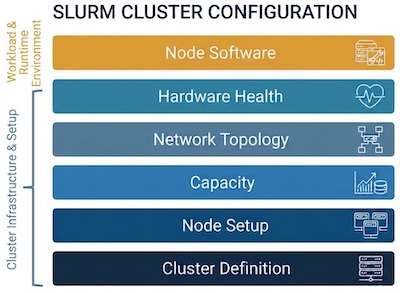
The journey began in February 2026 with the introduction of API-driven Slurm configuration, allowing administrators to programmatically define node roles and partitions. This was followed in March by continuous provisioning, which automated the retries of capacity requests, ensuring that clusters could scale efficiently despite the inherent volatility of cloud hardware availability. By May, the platform had integrated AMI-based configuration, replacing cumbersome initialization scripts with pre-configured images containing optimized stacks like Docker, Enroot, and Pyxis. In July, the introduction of partition-level topology management provided fine-grained control over network layouts, a critical requirement for training large-scale models where inter-node communication latency can become a primary bottleneck.
Despite these advancements, the sixth layer—the software stack running on nodes—remained an outlier. Because software requirements evolve frequently during the lifetime of a cluster—such as when a new metrics exporter is needed or a security patch must be applied across thousands of cores—reliance on traditional lifecycle scripts proved insufficient. These scripts, while functional, were static; they executed only at the moment of node provisioning. Any subsequent change required the redeployment of nodes, a disruptive process that often led to inconsistent software versions across the fleet.
The Technical Architecture of Cluster Extensions
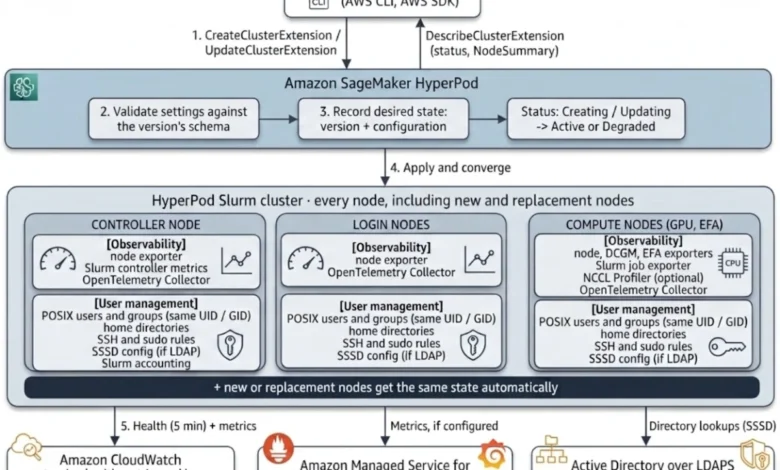
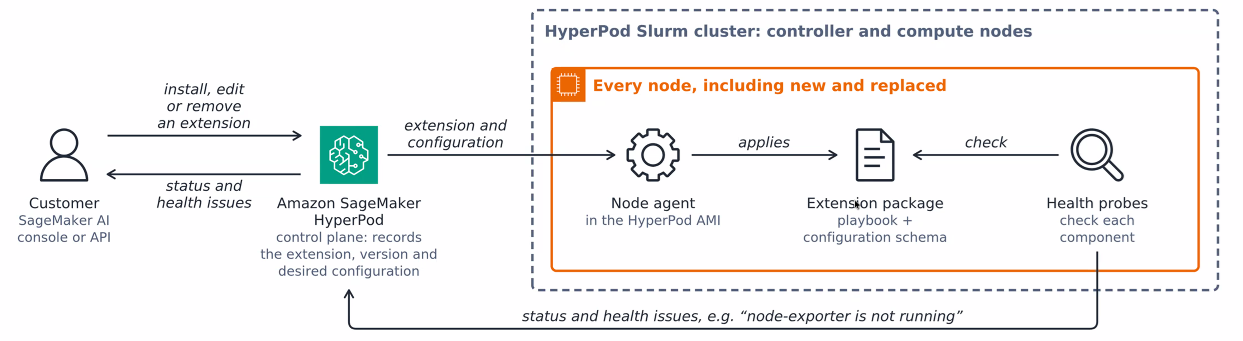
Cluster extensions represent a fundamental architectural departure from script-based configuration. By treating software packages as managed resources, AWS has enabled a "desired state" model for node software. When an administrator declares a configuration through the SageMaker AI console or the AWS API, the system validates the request against a schema before application. Once validated, a node-level agent ensures that the extension is applied consistently to all nodes assigned to a specific role.
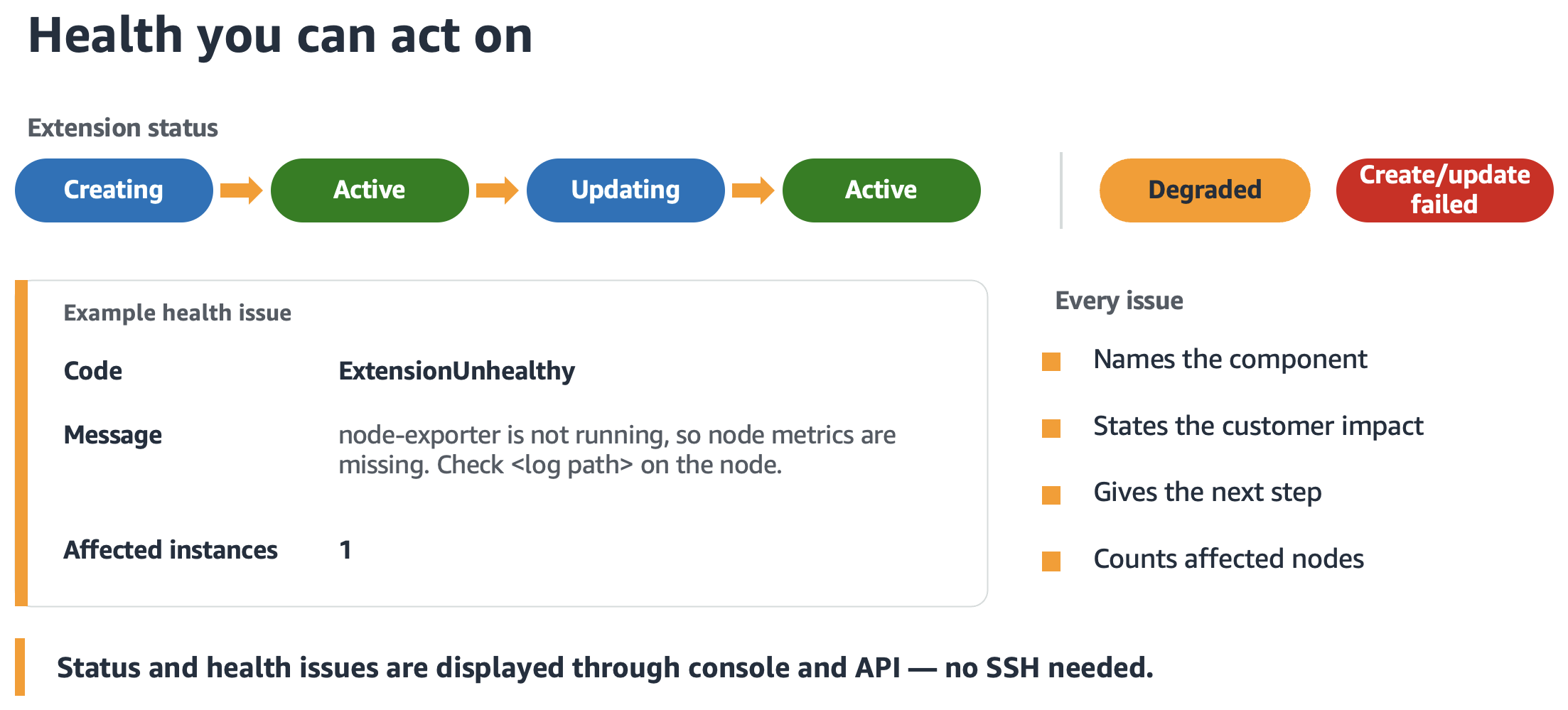
This system is designed to be self-healing. If a node is replaced due to hardware failure, the new instance automatically fetches and applies the extension configuration, ensuring it is immediately compliant with the rest of the cluster. Furthermore, the system provides real-time health reporting. If an extension fails to install or a component within the extension ceases to function, the API reports the specific cause, the number of affected nodes, and suggested remediation steps. This granular visibility allows platform teams to transition from reactive troubleshooting to proactive cluster management.
Observability and User Management: The First Managed Capabilities
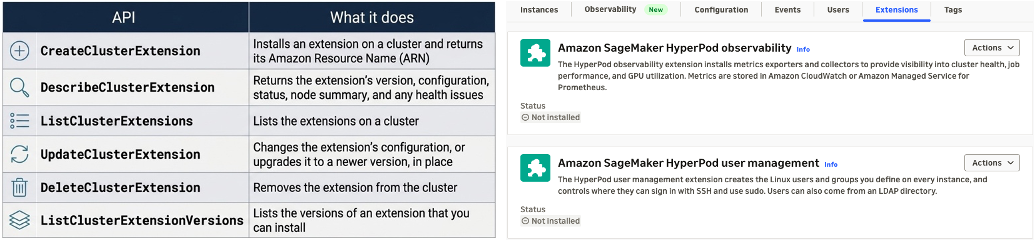
Upon launch, cluster extensions focused on two of the most common pain points for HPC platform teams: observability and user management.
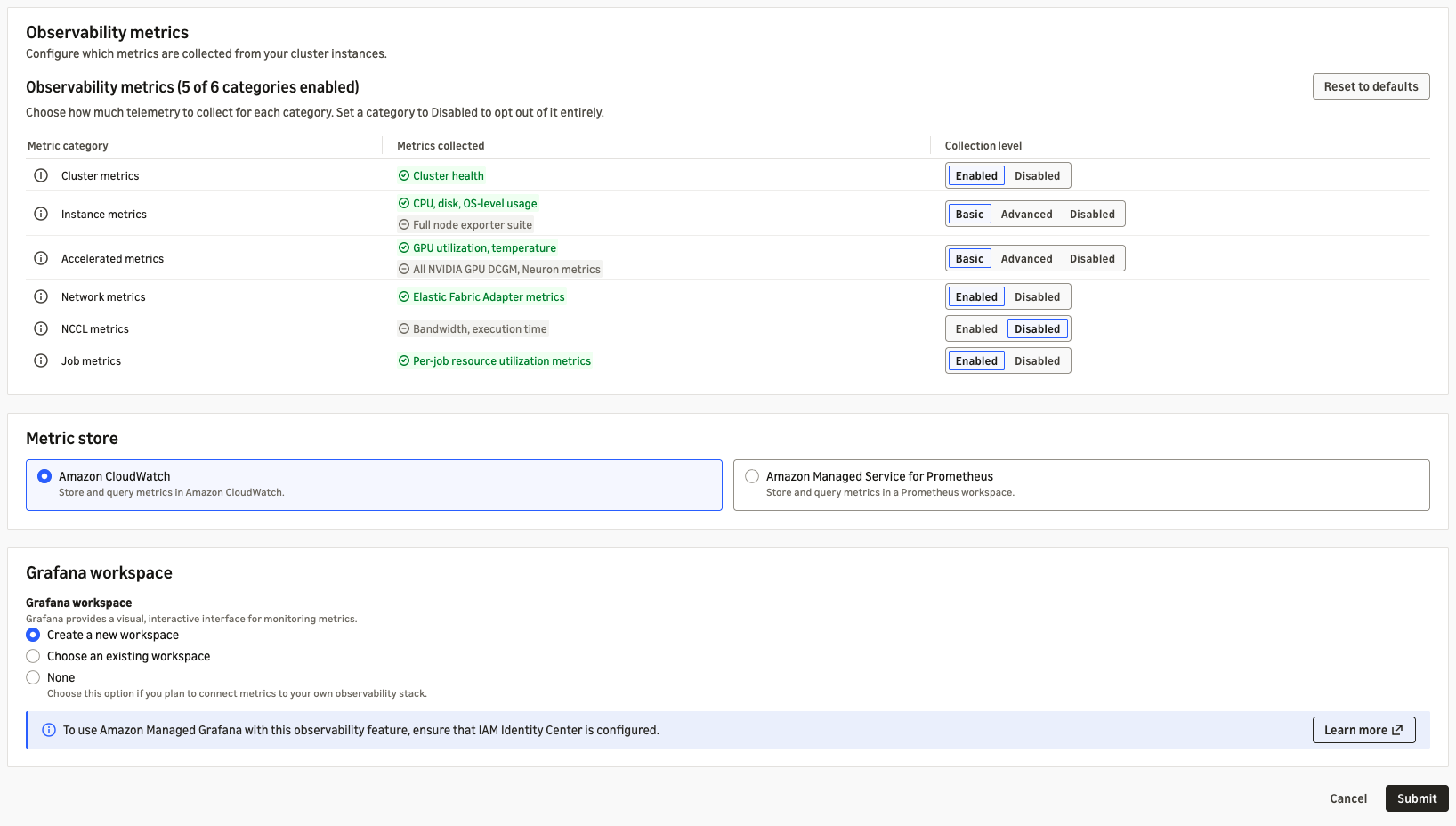
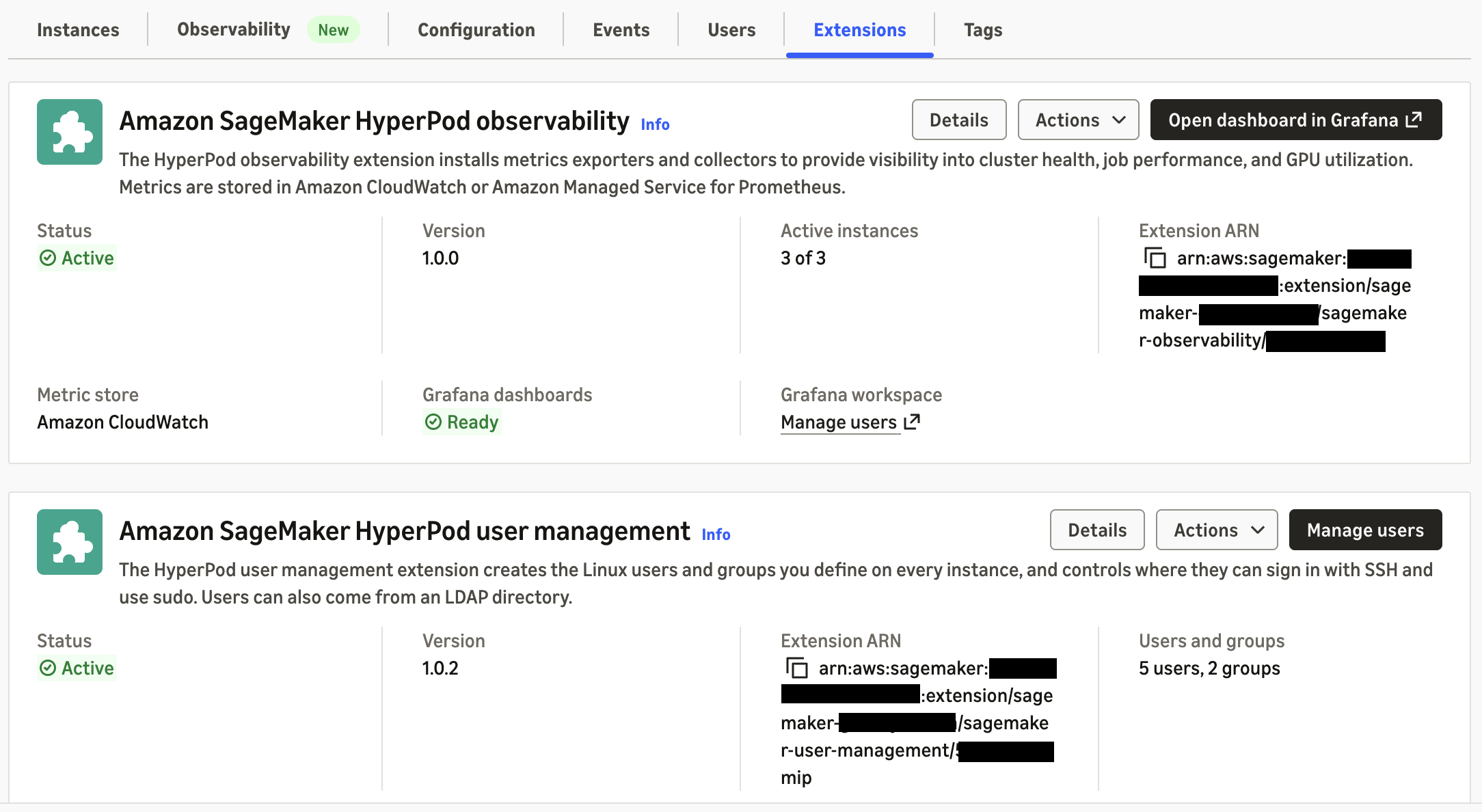
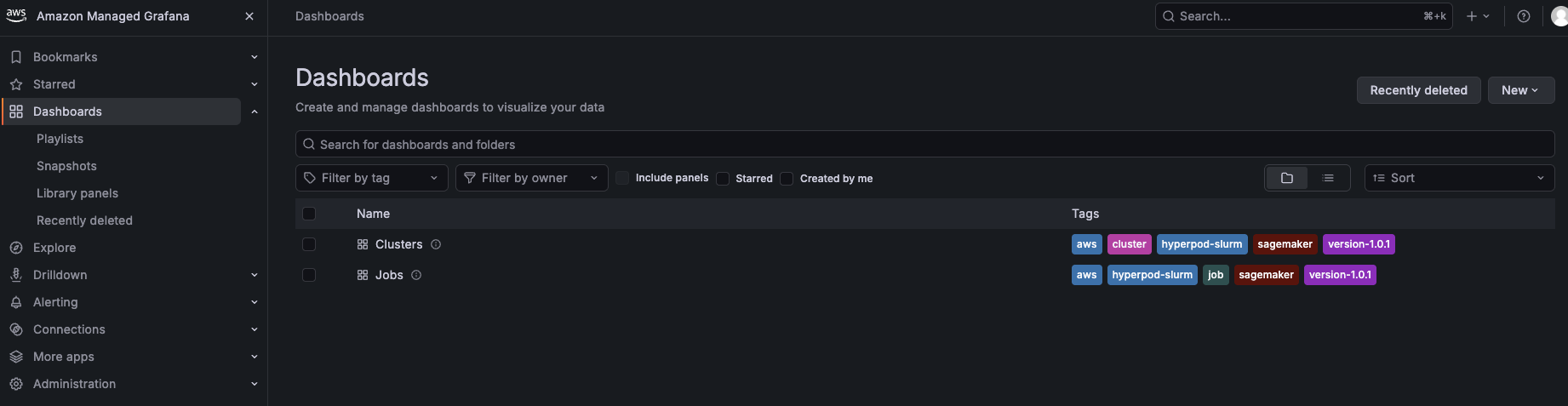
The observability extension provides a standardized mechanism for gathering GPU, CPU, network, and job-level metrics. By integrating with Amazon CloudWatch or Amazon Managed Service for Prometheus, and providing pre-configured dashboards in Amazon Managed Grafana, this extension eliminates the need for teams to build their own monitoring infrastructure. These dashboards allow administrators to monitor the health of the entire cluster at a glance, drill down into per-node performance, or analyze the resource consumption of individual Slurm jobs.
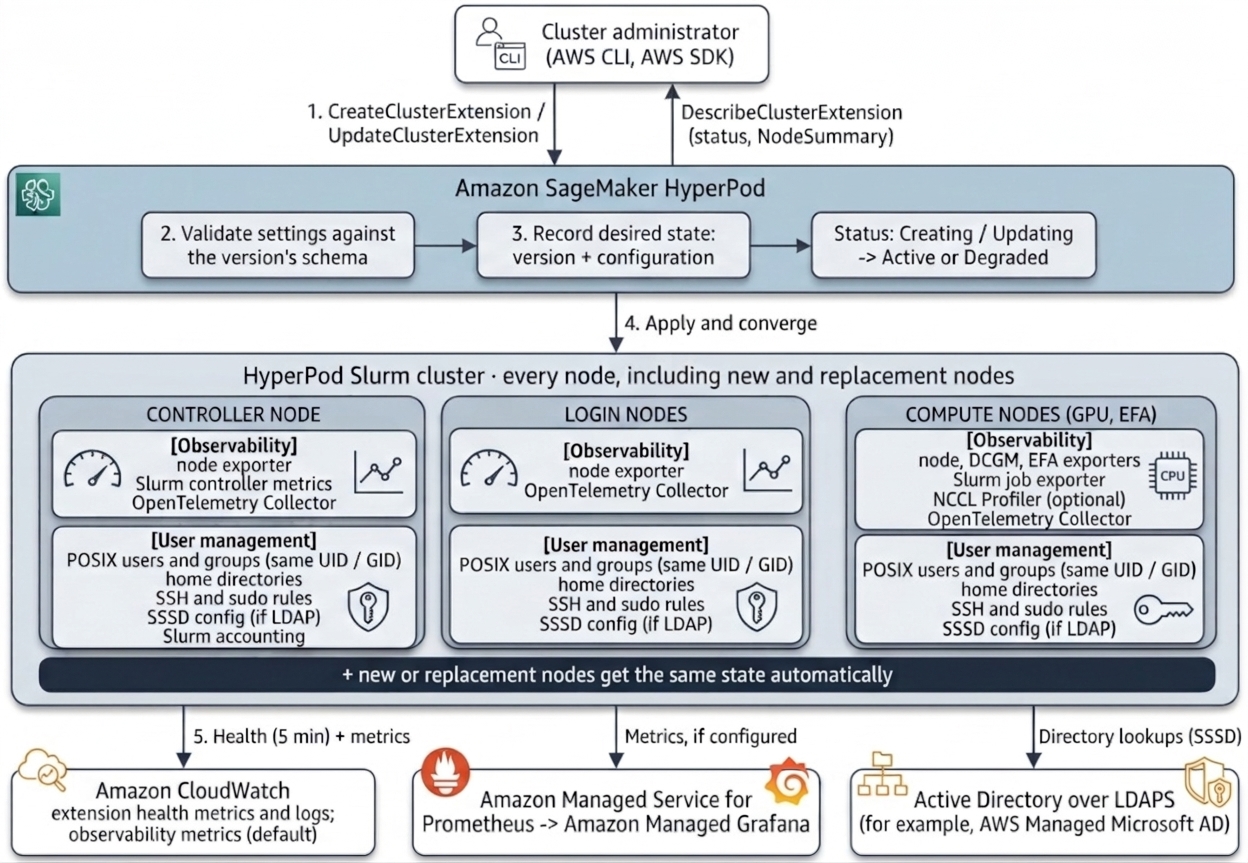
The user management extension tackles the complexities of identity and access management (IAM) at the node level. It allows administrators to define user sources—whether through local lists or LDAP/Active Directory integration—and explicitly assign permissions for SSH access and sudo privileges based on node roles. By centralizing this configuration, the extension ensures that access policies remain consistent across the entire cluster, regardless of how often the fleet scales.
Strategic Implications for Platform Teams
The introduction of cluster extensions fundamentally alters the division of labor within AI research organizations. By offloading the maintenance of common software components to AWS, platform teams can refocus their efforts on organization-specific requirements.
Industry analysts note that this shift is particularly significant for teams managing shared clusters across multiple research groups. Historically, the burden of maintaining parity between development and production environments consumed a significant portion of engineering cycles. With the declarative model, the "source of truth" for the cluster configuration resides in version-controlled code, enabling better auditability and reproducibility—both of which are critical for scientific integrity and compliance.
However, the transition requires a shift in mindset. Organizations must move away from the "snowflake" server approach, where individual nodes are manually tuned, and embrace a policy of uniformity. While custom AMIs and lifecycle scripts remain available for niche requirements, the recommendation from AWS is to prioritize extensions for any capability supported by the service. This hybrid approach allows for flexibility without sacrificing the stability provided by managed extensions.

Operational Workflow and Migration
For organizations looking to migrate existing clusters to this new model, the process is designed to be incremental. The recommended four-step migration involves:
- Identifying a specific capability currently managed by a script.
- Configuring the corresponding cluster extension to mirror that capability.
- Enabling the extension through the API or console.
- Removing the redundant lifecycle script once the extension is confirmed to be in an "Active" state.
This gradual approach minimizes the risk of service interruption. Because extensions are designed to coexist with other configuration methods, teams can migrate one service at a time, ensuring that the cluster remains operational throughout the transition.
Security and Economic Considerations
From a security perspective, the delegation of configuration management to extensions provides a more robust posture. Because extensions are managed via dedicated ARNs (Amazon Resource Names), organizations can apply the principle of least privilege, ensuring that only authorized individuals can modify critical cluster software. Furthermore, by removing the need for broad administrative access to node-level shell environments, the attack surface of the cluster is significantly reduced.
Financially, the model is transparent. There is no additional cost for the cluster extensions themselves; users pay only for the underlying AWS services—such as CloudWatch, Prometheus, and Secrets Manager—that the extensions utilize. This pricing structure aligns with the broader AWS philosophy of commoditizing infrastructure overhead while allowing users to scale their resource consumption linearly with their compute needs.
Looking Ahead: The Future of Cluster Management
The release of cluster extensions signifies a maturing of the cloud-native approach to HPC. As foundation models grow in complexity, the infrastructure supporting them must be equally sophisticated and resilient. The ability to treat an entire cluster as a single, observable, and immutable unit represents a leap forward from the manual, error-prone processes that defined the early era of distributed machine learning.
The collaboration across multiple AWS engineering teams to deliver this feature underscores the importance of the Slurm ecosystem in modern AI development. By providing tools that handle the "heavy lifting" of cluster maintenance, AWS is effectively lowering the barrier to entry for organizations looking to scale their AI research. As these tools continue to evolve, the industry can expect to see further integration between the application layer and the underlying cloud infrastructure, eventually leading to a future where the management of a 10,000-node cluster is as straightforward as managing a single cloud instance.
For now, the message to platform engineers is clear: the era of managing Slurm clusters through a labyrinth of shell scripts is coming to an end. In its place is a more rigorous, API-first framework that promises to make the next generation of foundation model training more predictable, more secure, and significantly easier to maintain.