Inside Anthropic’s Amended S-1: A Deep Dive Into Record Revenue, Skyrocketing Compute Costs, and Massive Infrastructure Commitments Ahead of IPO

Artificial intelligence pioneer Anthropic has officially filed its amended S-1 registration statement with the U.S. Securities and Exchange Commission, providing the public and institutional investors with audited third-quarter financial figures. The newly released documentation replaces preliminary estimates and leaked data points that previously circulated during the company’s October investor day, offering an unvarnished look at the unprecedented financial realities of scaling a frontier artificial intelligence laboratory.
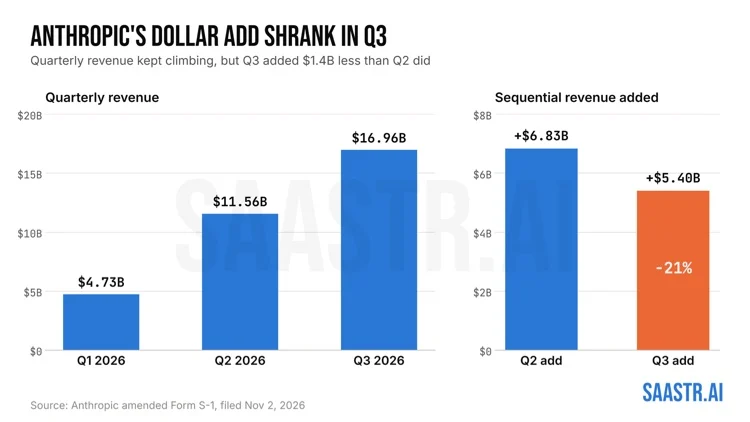
The figures confirm a period of extraordinary hypergrowth accompanied by staggering capital expenditures. For the third quarter, Anthropic reported revenue surging to $16.96 billion, marking a staggering 1,127% year-over-year increase compared to the $1.38 billion recorded in the same period a year prior. Sequentially, top-line performance grew by 47% compared to the second quarter, during which revenue stood at $11.56 billion.
While the percentage growth numbers capture headlines, financial analysts point to the absolute dollar additions, infrastructure commitments, customer concentration risks, and aggressive pricing adjustments as the vital indicators defining the company’s trajectory as it marches toward its highly anticipated initial public offering.
Chronology and Quarterly Trajectory: The Path to Scale
To understand Anthropic’s current market position, one must examine the meteoric quarterly sequence recorded over the past year. In the first quarter of the fiscal year, the company posted $4.73 billion in revenue. That figure jumped by roughly 140% in the second quarter to reach $11.56 billion, adding an unprecedented $6.83 billion in absolute top-line growth.
In the third quarter, the company added another $5.40 billion, bringing total revenue for the first nine months of the year to $33.24 billion. This performance dwarfs the company’s full-year calendar revenue of $4.59 billion from the previous year. When annualized, third-quarter revenue positions Anthropic at an approximate $68 billion run rate.
Market expectations, however, have set an even higher bar. Wall Street analysts and financial media reports indicate that institutional investors anticipate Anthropic to hit an annualized revenue run rate of $110 billion by the end of the fourth quarter. Achieving this ambitious target requires a Q4 absolute dollar addition more than double that of the third quarter. Consequently, market watchers are focusing heavily on absolute dollar growth rather than percentage metrics, knowing that percentage growth naturally decelerates as base revenue scales into the tens of billions of dollars.
The Cost of Unconstrained Scaling: Short-Term Compute and Operating Income
Despite record-breaking top-line figures, Anthropic posted an operating loss of $567 million for the third quarter, reversing the $974 million in operating income recorded during the second quarter.
The S-1 filing clarifies the mechanics behind this financial swing. Total third-quarter operating expenses climbed to $17.5 billion, heavily influenced by $5 billion in premium expenses for short-term compute capacity and a $2 billion noncash accounting charge tied to the company’s employee donation matching program.
Compute and infrastructure expenses surged 78% sequentially to reach $9.86 billion, outpacing the 47% growth in revenue. Consequently, compute costs rose from approximately 48% of revenue in the second quarter to 58% in the third quarter. This translates to roughly $1.72 of revenue generated for every dollar spent on computing power, aligning closely with preliminary disclosures shared with investors in October.
Industry analysts note that Anthropic made a deliberate strategic choice. The company could have implemented strict rate-limiting measures for its users, restricted platform access, and gone public boasting consecutive quarters of GAAP profitability. Instead, management opted to purchase expensive spot-market computing capacity to satisfy surging enterprise demand without throttling service. On an adjusted basis, Anthropic’s operating income rose to $2.5 billion for the quarter, though the adjusted operating margin compressed from 19% in Q2 to 15% in Q3. This operational trade-off—absorbing a $5 billion short-term compute bill to maintain unhindered customer growth—highlights the intense resource demands of maintaining leadership in the generative AI sector.
Balance Sheet Resilience and Massive Long-Term Commitments
To mitigate the volatility of spot-market compute pricing, Anthropic has committed to staggering long-term infrastructure outlays. The amended S-1 reveals that the company has entered into purchase commitments and lease agreements totaling an aggregate spend of approximately $895.4 billion, with substantially all of these obligations tied directly to compute and infrastructure procurement. Independent reviews of the regulatory filing indicate that approximately $100 billion of these new commitments were signed in the brief five-week window following the close of the third quarter while the IPO marketing roadshow was actively underway.
Against these massive future liabilities, Anthropic maintains a robust liquidity position. The balance sheet reflects $95.6 billion in cash and cash equivalents, supplemented by $36.3 billion in short-term investments, bringing total liquid reserves to $131.8 billion. Approximately $69.8 billion of the company’s total commitments are scheduled to come due within the 12 months following September 30, an obligation roughly equivalent to the company’s current quarterly annualized revenue run rate.
Market observers interpret the $895 billion commitment figure—representing roughly 13 times the company’s annualized revenue—as management’s definitive insurance policy against the spot-market compute shortages that necessitated the expensive Q3 short-term purchases.
Enterprise Expansion and Customer Concentration
Anthropic’s growth is increasingly anchored by a rapidly expanding enterprise customer base and extraordinary net revenue retention (NRR). As of September 30, the company recorded more than 11,900 customers generating at least $100,000 in annualized revenue. This represents a 12.5-fold increase compared to the 950 customers in that tier a year prior. Furthermore, the company counts more than 1,900 customers spending upwards of $1 million annually, alongside approximately 250 enterprise accounts spending $10 million or more per year.
This widespread enterprise adoption drove an estimated net revenue retention rate of approximately 900% at the end of the third quarter, indicating that the vast majority of top-line expansion originates from existing accounts scaling their usage rather than new customer acquisition.
A key driver of this expansion is product cross-selling. More than half of customers spending $100,000 or more annually now utilize both the core Claude platform and first-party applications such as Claude Code or Cowork, up from roughly 30% at the end of the previous year. Claude Code has emerged as a primary growth catalyst. Enterprise users who subscribed to Claude Enterprise but bypassed Claude Code averaged less than $75 in monthly spend, whereas the top 5% of users who integrated Claude Code generated roughly twenty times that amount.
Despite these impressive metrics, the S-1 highlights inherent risks, including customer concentration. Fortune 500 companies within the $100,000-plus tier spent, on average, less than 0.1% of their total corporate budgets with Anthropic during the third quarter, indicating vast room for expansion within existing accounts. However, the filing explicitly warns that any adverse shifts in demand or spending curtailment from its largest enterprise clients could materially impact financial performance.
Pricing Pressures, Model Efficiency, and Market Implications
The regulatory filing also sheds light on the deflationary pressures inherent in the frontier AI market. ZeroHedge calculations derived from the S-1 point to roughly $600 million in revenue impact resulting from deliberate price cuts and contractual volume discounts enacted during the third quarter, accounting for approximately 3.5% of quarterly revenue.
These price adjustments correlate directly with rapid algorithmic efficiencies. For instance, the introduction of Claude Opus 5.5 reduced customer costs per task by approximately 40% compared to its predecessor, Claude Opus 5. Across the broader technology landscape, enterprises face intensifying pressure to optimize artificial intelligence expenditures, driving demand toward both cost-effective domestic closed models and emerging open-weight alternatives from international labs.
Anthropic’s strategic thesis rests on the assumption that total computational volume will scale at a rate far exceeding the deflationary decline in price-per-task—a bet validated by the company’s 900% NRR metric. However, this dynamic carries broader implications for the entire business-to-business software and AI application ecosystem. As generative AI model generations consistently reduce task costs by roughly 40%, application vendors must choose whether to pass those savings directly to end-users to capture market share or retain margin expansion.
Broader Industry Impact and Outlook
As Anthropic proceeds toward its public market debut, the amended S-1 serves as a definitive benchmark for the economics of artificial intelligence at scale. The disclosures illustrate that while demand for frontier intelligence is virtually insatiable, the capital intensity required to satisfy that demand is historic in scale. Balancing multi-billion-dollar compute liabilities with rapidly evolving model efficiencies and hyper-growth enterprise sales will remain the central operational challenge for Anthropic and its public shareholders in the quarters ahead.