ChartMogul and Crono Join Forces to Streamline B2B SaaS Outbound Sales and Revenue Tracking

The modern landscape of B2B software-as-a-service (SaaS) growth is undergoing a structural realignment. Driven by escalating customer acquisition costs (CAC) and increasingly saturated digital channels, go-to-market teams are abandoning indiscriminate, high-volume prospecting in favor of precision outbound sales. Recognizing this paradigm shift, subscription analytics and CRM platform ChartMogul has announced a strategic integration with Crono, an advanced outbound sales execution engine. Announced by Sara Archer, Chief Revenue Officer at ChartMogul, the partnership aims to bridge the operational gap between initial sales prospecting and long-term customer lifecycle management.
For years, high-growth startups and enterprise technology firms alike relied heavily on inbound marketing and paid digital acquisition to sustain revenue growth. However, as digital ad spend faces diminishing returns and organic visibility becomes harder to secure, companies are returning to outbound sales as a primary pillar of pipeline generation. This revival, however, looks vastly
different from the aggressive, untargeted cold-calling and emailing tactics of the past. Modern outbound relies heavily on artificial intelligence, sophisticated data enrichment, and hyper-personalized messaging designed to initiate genuine commercial conversations rather than apply brute-force pressure.
The Evolving Economics of SaaS Outbound Sales
The decision by ChartMogul to partner with Crono reflects a broader economic reality within the global tech sector. According to recent B2B SaaS benchmark reports, customer acquisition costs have risen significantly over the past half-decade, forcing executive leadership teams to optimize every stage of the sales funnel. Traditional inbound strategies, while still valuable, are frequently insufficient on their own to penetrate crowded market segments or secure meetings with enterprise decision-makers.
At the same time, technological advancements in artificial intelligence have fundamentally transformed how sales development representatives (SDRs) operate. AI-driven enrichment tools now allow outbound teams to analyze vast datasets, identify precise buyer intent signals, and tailor outreach at a scale that was previously unattainable for lean organizations.
Despite these advancements, a persistent operational bottleneck has plagued many go-to-market teams: the disconnect between prospecting tools and revenue management systems. SDRs typically live and breathe inside dedicated outbound platforms—building lead lists, executing multi-channel sequences, and monitoring engagement metrics. Yet, once a prospect expresses genuine interest and converts into a qualified lead, that crucial context is often lost or siloed when manually transferred into a separate customer relationship management (CRM) database.
ChartMogul and Crono designed their new integration specifically to eliminate this friction, ensuring that valuable prospecting data flows seamlessly into a unified revenue architecture.
Mechanics of the ChartMogul-Crono Integration
The newly launched integration creates a direct pipeline between Crono’s outbound engine and the ChartMogul CRM environment. Under the operational workflow, SDRs manage their day-to-day outbound campaigns within Crono, leveraging its suite of sequencing and tracking tools to engage target accounts.
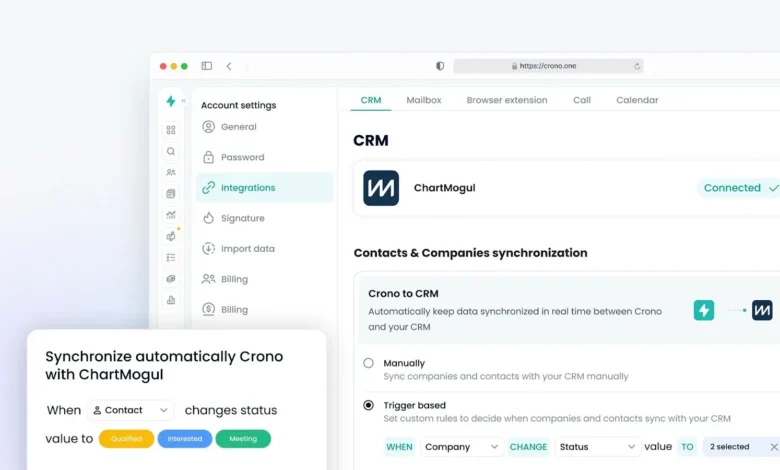
When a prospect reaches a qualified status—such as a status change to "Interested"—the relevant company and contact records can be synchronized directly into the ChartMogul CRM. Sales and revenue operations teams can execute this handoff either manually via a single-click action or automatically through configurable, trigger-based synchronization rules.
Once a record populates within ChartMogul, the system automatically tags Crono as the origin source. This attribution tracking provides revenue leaders with clear visibility into which customer relationships originated from outbound sales initiatives versus inbound channels or partner ecosystems. By keeping outbound activities anchored in a specialized tool while routing qualified leads directly into a subscription-focused CRM, organizations prevent valuable prospect data from becoming isolated in disconnected software silos.
Industry Implications and Strategic Alignment
The partnership underscores a growing consensus among B2B revenue leaders: specialized software tools must interoperate seamlessly to maximize capital efficiency. While Crono serves as the operational engine for top-of-funnel outbound campaigns, ChartMogul functions as the system of record for subscription metrics, customer usage data, and recurring revenue tracking.
Industry analysts note that as software budgets tighten, enterprise buyers increasingly favor integrated, best-of-breed ecosystems over monolithic, all-in-one platforms that compromise on specific functional capabilities. By combining Crono’s prospecting prowess with ChartMogul’s robust subscription analytics, the two companies are offering revenue teams a cohesive framework to trace the entire customer journey from an initial cold email to long-term subscription retention.
Sara Archer emphasized that the partnership was born out of operational necessity rather than a desire to reinvent outbound sales internally. Rather than attempting to build native sequencing tools that replicate best-in-class point solutions, ChartMogul opted to integrate directly with a platform already optimized for outbound excellence.
Future Roadmap and Immediate Availability
The initial release of the ChartMogul and Crono integration focuses heavily on core record synchronization, specifically supporting the seamless transfer of company and contact data into the ChartMogul CRM environment. According to representatives from both organizations, subsequent development phases will depend heavily on user feedback and practical deployment workflows observed in the field.
Future iterations of the integration may introduce deeper synchronization capabilities, including real-time activity tracking, detailed meeting analytics, and advanced opportunity pipeline mapping. By adopting an iterative development approach based on real customer usage, the companies aim to ensure that subsequent feature rollouts directly address the evolving operational needs of modern sales teams.
The integration is available immediately to all eligible users across both platforms. As organizations finalize their go-to-market strategies for the upcoming quarters, executives from ChartMogul and Crono anticipate that the streamlined workflow will provide a distinct competitive advantage for teams seeking to scale their outbound pipeline efficiently without sacrificing data integrity.
Related posts: