ChartMogul Launches AI-Powered Subscription Analytics Analyst to Bridge the Gap Between Headline Metrics and Customer Behavior

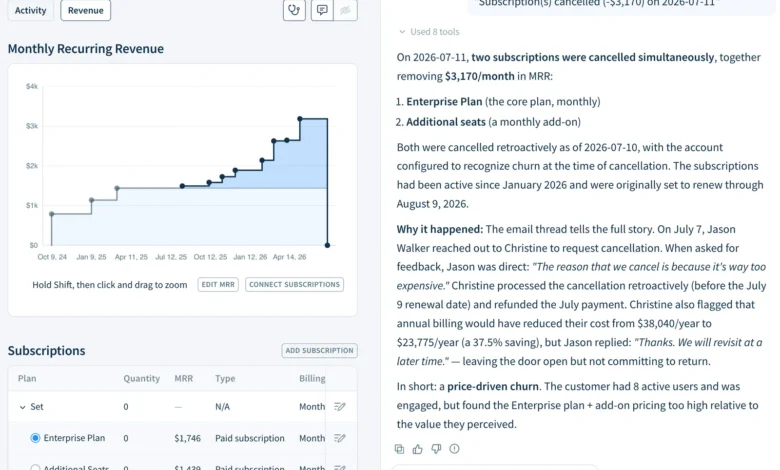
Subscription analytics platform ChartMogul has officially launched ChartMogul AI, a native analytical assistant designed to investigate underlying data, trace metric fluctuations back to specific customer actions, and decode complex billing scenarios. Built upon twelve years of recurring-revenue data modeling, the new tool aims to eliminate the friction traditionally associated with deep data dives, allowing businesses to transition from merely observing headline metrics to understanding the underlying catalysts driving those numbers.
The Complexity of Subscription Data
For more than a decade, subscription businesses have grappled with the inherent messiness of recurring revenue accounting. Unlike traditional commerce, subscription models involve intricate logic governing upgrades, downgrades, churn, reactivations, multi-component subscriptions, refunds, credits, and multi-currency conversions. Achieving accuracy across these variables historically required specialized knowledge, complex filtering, and significant time investment.
While platforms like ChartMogul successfully automated the heavy lifting of translating raw billing data into trusted metrics like Monthly Recurring Revenue (MRR) and Annual Recurring Revenue (ARR), interpreting unexpected movements still demanded manual investigation. Consequently, rigorous data exploration was frequently relegated to high-stakes milestones, such as impending board meetings, fundraising rounds, or significant pricing overhauls. Day-to-day operations typically involved checking headline figures, confirming they aligned with expectations, and moving forward without examining the qualitative reasons behind minor shifts.
ChartMogul AI is engineered to democratize this level of granular analysis. By allowing users to type natural-language queries directly into the platform, the tool bridges the gap between high-level reporting and granular customer context.
Beyond a Surface-Level Dashboard Chatbot
Unlike generic dashboard chatbots that merely describe visual charts, ChartMogul AI operates as an integrated analyst capable of executing multi-step investigations. The system can independently select relevant metrics, construct precise filters and segments, examine individual customer histories, incorporate Customer Relationship Management (CRM) context, and synthesize findings into actionable insights.

The platform achieves this by unifying revenue data, customer profiles, product usage statistics, and CRM records into a single analytical environment. While quantitative revenue metrics illustrate what occurred within a business, understanding why requires qualitative context. To address this, ChartMogul preprocesses unstructured information—such as customer emails, support notes, call logs, and interaction transcripts—extracting cancellation reasons, competitor mentions, customer sentiment, and product feedback. This data is structured and indexed, enabling the AI to analyze high volumes of qualitative interactions alongside hard financial figures.
Democratizing CRM Access for Comprehensive Analysis
To ensure ChartMogul AI possesses the most complete dataset possible for every customer, ChartMogul has restructured its platform pricing and accessibility. Effective immediately, ChartMogul CRM is included at no additional cost for all platform users.
Previously, connecting an email inbox to capture vital qualitative customer context required purchasing a paid CRM Pro seat. By removing paid CRM seats entirely, the company has lowered the barrier to entry for holistic data integration. Every user can now connect their inbox and leverage the full suite of CRM features without incurring supplementary licensing fees, thereby feeding the AI engine the comprehensive context necessary to generate accurate, multi-dimensional insights.
Technical Architecture and Guardrails
The development of ChartMogul AI reflects lessons learned from early experimentation with large language models. According to engineering leads at the company, foundational LLMs frequently falter when left to navigate complex financial data architectures autonomously. Models frequently select inappropriate tools, hallucinate filters, or conduct overly superficial investigations.
To mitigate these failures, ChartMogul engineered a specialized routing architecture. A dedicated sub-agent first identifies real-world plan structures and account tags before constructing precise queries using ChartMogul Filter Language (CFL). Furthermore, the system relies on predefined "skills"—step-by-step methodological frameworks tailored to specific question types—to guide the AI’s investigative process. Data lineage is strictly enforced; links to specific charts and customer records are attached directly to the underlying data at the database level, preventing the model from generating erroneous navigational links.
While the system currently utilizes advanced models provided by Anthropic, company executives emphasize that the competitive advantage stems less from the underlying foundational model and more from the proprietary combination of trusted subscription data, native product context, and more than a decade of recurring-revenue domain expertise.
Current Capabilities and Limitations
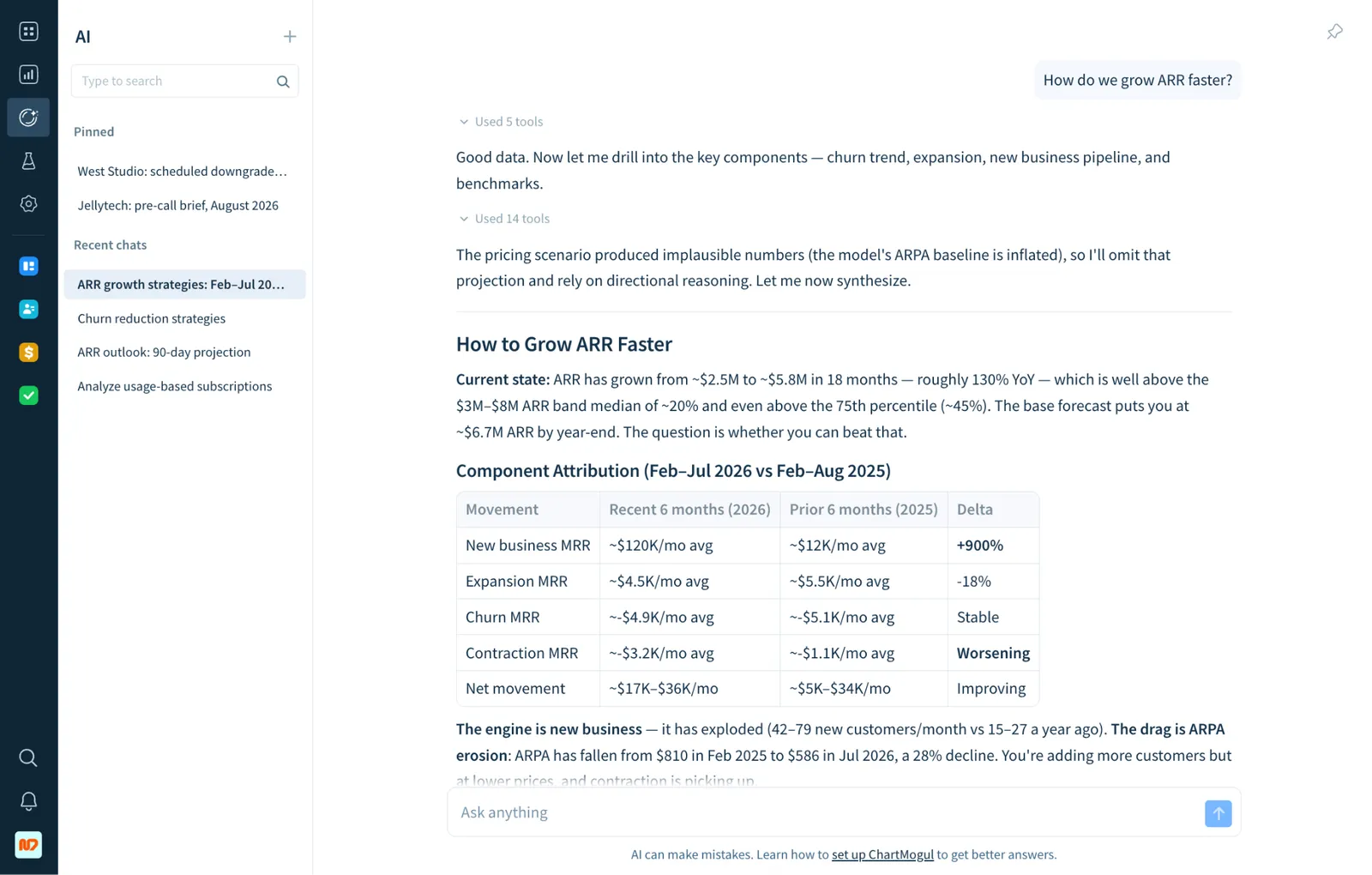
At launch, ChartMogul AI operates in a read-only capacity, designed to query, analyze, and synthesize data without making direct alterations to user accounts or billing systems. The company has indicated that write actions will be introduced in subsequent software updates.
Users can execute complex commands using natural language, such as comparing ARR growth and retention metrics across geographic regions, without manually building multi-layered segments. Contextual entry points have also been embedded throughout the user interface; for instance, identifying a customer cancellation allows users to initiate an automated investigation into that specific account’s history with a single click.
Complementing this native user interface, ChartMogul continues to support its Model Context Protocol (MCP) server, launched earlier in the year. With more than 80 verified tools integrated into directories such as Claude and ChatGPT, the MCP server allows organizations to query ChartMogul data from within general-purpose AI environments or combine it with external enterprise systems.
Implications for the Future of SaaS Analytics
The introduction of native analytical AI signals a broader shift in how software-as-a-service (SaaS) companies interact with business intelligence tools. Rather than serving merely as static reporting dashboards, enterprise software platforms are increasingly evolving into proactive analytical agents capable of interpreting complex business health indicators autonomously.
Industry analysts note that as natural language interfaces mature, the traditional reliance on complex menu navigation and manual filter configuration may recede, replaced entirely by conversational analytics. While visual charts and dashboards will remain vital for validation, the burden of data discovery is shifting from human analysts to automated assistants.
ChartMogul AI is available immediately to all platform users. As organizations adopt the tool for day-to-day revenue monitoring, the industry will watch closely to see how automated qualitative analysis reshapes executive decision-making and customer retention strategies across the broader subscription economy.