Amazon SageMaker Inference Now Supports GPU Partitioning with NVIDIA Multi-Instance GPU Technology

The landscape of cloud-based machine learning inference has undergone a fundamental transformation today as Amazon Web Services (AWS) announced the integration of NVIDIA Multi-Instance GPU (MIG) technology into Amazon SageMaker. For years, the deployment of machine learning models to GPU-accelerated endpoints was constrained by a "one-to-one" rule: a single model required a minimum of one full physical GPU accelerator. This rigid architectural requirement often forced organizations into inefficient resource utilization, where expensive high-performance hardware sat idle because the workload did not demand its full capacity, or conversely, where models were starved of memory because they could not scale across hardware boundaries.
This shift marks a significant departure from previous deployment paradigms, enabling developers to slice a single physical GPU into multiple, hardware-isolated partitions. By leveraging MIG technology, SageMaker can now provide dedicated compute, cache, and memory resources to independent model instances. This development is expected to dramatically alter the cost-benefit analysis for AI infrastructure, allowing enterprises to pack multiple, smaller models onto a single instance or right-size deployments to match the specific memory and compute requirements of diverse AI workloads.
The Historical Constraint and the Rise of Fragmentation
The traditional deployment model for GPU-accelerated inference in cloud environments was defined by the physical specifications of the hardware. For instance, an ml.p4d.24xlarge instance contains eight NVIDIA A100 accelerators. Under the previous SageMaker framework, that instance could host a maximum of eight models, regardless of whether a model required 40 GB of VRAM or a mere 5 GB. If a developer had nine small models to deploy, they were forced to provision a second instance, effectively paying for 16 GPUs while only utilizing a fraction of the compute power of the second unit.
This "all-or-nothing" approach created a persistent tension between performance and cost. To circumvent these inefficiencies, many organizations resorted to complex workarounds. Some consolidated disparate workloads onto single endpoints, which often resulted in noisy-neighbor issues where one resource-intensive model would degrade the performance of others sharing the same device. Others opted to migrate their infrastructure to self-managed Kubernetes clusters, utilizing open-source drivers to implement manual partitioning. While this granted granular control, it introduced significant operational overhead, forcing teams to manage driver versioning, device plugins, and cluster scheduling—tasks that distracted engineers from the core mission of model development and optimization.
Chronology of the Integration
The introduction of GPU partitioning on SageMaker is the culmination of a multi-year effort to refine inference efficiency. The timeline for this transition began with the broader adoption of "Inference Components" in early 2024, a construct designed to allow multiple models to share a single endpoint. This was the foundational step required to move away from single-model endpoints.
By late 2024, AWS began collaborating with industry leaders, including Salesforce, to define the technical requirements for hardware-level isolation. Following a period of private preview and rigorous validation against production-grade workloads, the feature was finalized for broad release in November 2025. This rollout includes support for a wide array of high-performance NVIDIA hardware, ranging from the A100 and H100 series to the newer Blackwell-based RTX PRO 4500 and 6000 series.
Technical Mechanics: How Hardware Isolation Works
Unlike software-level virtualization, which can often lead to resource contention, MIG provides true hardware-level isolation. When a GPU is partitioned, the physical hardware is subdivided into distinct instances. Each partition possesses its own dedicated compute units (Streaming Multiprocessors), cache hierarchies, and memory bandwidth. Because the isolation is enforced at the hardware level, a process executing within one partition cannot access or influence the memory space of another, ensuring predictable performance even under heavy load.
The integration into SageMaker is designed to be seamless for existing users. Developers do not need to rewrite their invocation code or adopt new API operations. Instead, two optional parameters—AcceleratorPartitionLayouts and AcceleratorPartitionType—are introduced into the existing CreateEndpointConfig and InferenceComponent API calls. When an endpoint is provisioned, SageMaker automatically handles the complex task of carving the physical GPUs into the specified partitions. In internal testing, this provisioning process adds approximately 17 seconds to the overall setup time, a negligible trade-off for the resulting flexibility.
Data-Driven Performance Analysis
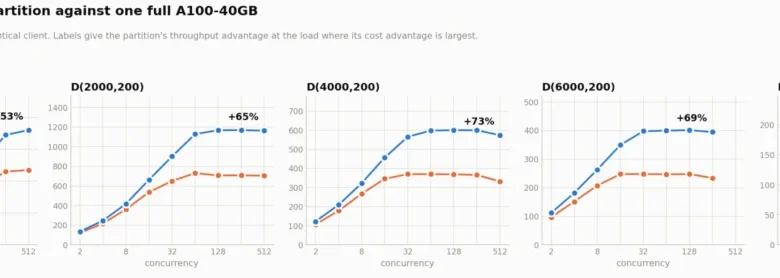
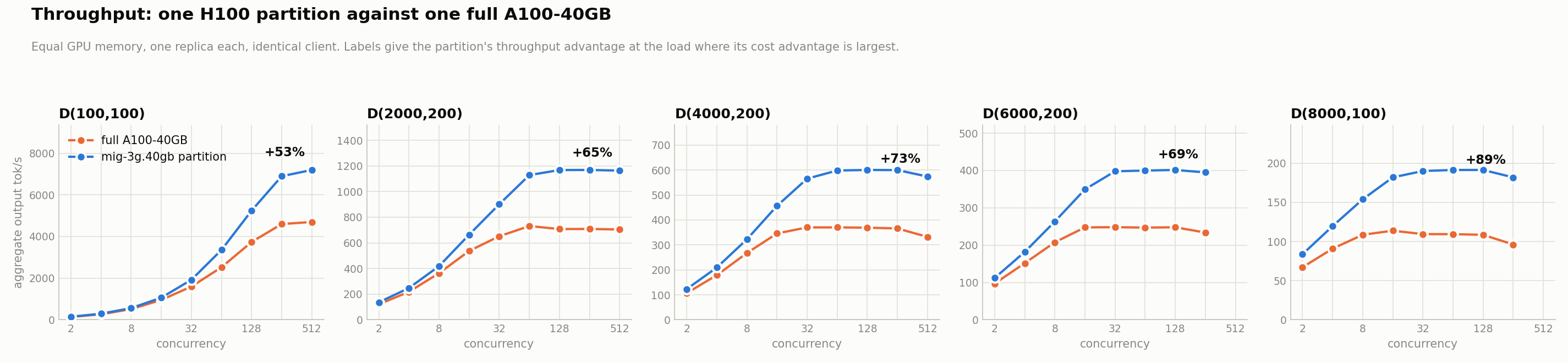
To quantify the impact of this new capability, AWS conducted a series of benchmarking tests comparing a fractional H100 partition (specifically the mig-3g.40gb profile) against a full, unpartitioned A100-40GB. Using the genai-bench tool to simulate traffic for the Llama-3.1-8B-Instruct model, the researchers observed significant improvements in efficiency.
The data suggests that for high-concurrency, long-context workloads, the partitioned H100 slice outperformed the full A100 in terms of aggregate output tokens per second. The cost benefit becomes particularly pronounced as concurrency increases; because the H100 architecture is inherently more efficient at handling parallel requests, a smaller slice of that newer hardware can often outpace a full, older-generation accelerator. However, the analysis also highlights that partitioning is not a universal panacea. For low-concurrency or short-input tasks, the overhead of the newer hardware may not yield a cost advantage, proving that the right-sizing of GPU resources remains a strategic decision that depends heavily on the specific traffic patterns of the application.
Industry Perspectives
The move has been welcomed by enterprise users who have long grappled with the scaling challenges of generative AI. Richard Chang, a Software Engineering Architect at Salesforce, noted that the ability to consolidate workloads without sacrificing performance is a "game changer" for large-scale AI operations. According to Salesforce, the primary value lies in the predictability of performance. By providing strict isolation, MIG allows teams to safely colocate sensitive, high-priority workloads alongside secondary services, thereby maximizing the return on investment for high-end GPU instances.
"Many inference workloads simply do not require an entire GPU," Chang stated during the validation phase. "By moving to a partitioned model, we can safely consolidate our infrastructure, significantly improving our utilization rates while maintaining the robust performance guarantees that our customers expect."
Broader Implications for the AI Ecosystem
The implications of this update extend beyond simple cost savings. By lowering the barrier to entry for deploying multiple, specialized models, AWS is effectively enabling a new architecture for AI services. Developers can now design complex, multi-stage pipelines—such as a chain involving a transcription model, a diarization tool, and a language generator—all hosted on a single instance. This eliminates the need for expensive network hops between different stages of a pipeline, further reducing latency and simplifying the overall architecture.
Moreover, the ability to carve GPUs into smaller pieces allows for better "canary" testing and model deployment. Organizations can now run candidate models alongside production models on the same piece of hardware, facilitating A/B testing with significantly lower infrastructure costs.
Strategic Considerations and Limitations
Despite the advantages, there are critical considerations for teams planning to adopt GPU partitioning. First, the partition layout is static for the life of the endpoint; modifying the carve requires the creation of a new endpoint and a subsequent traffic migration. This makes the feature best suited for stable, production-grade model portfolios rather than environments characterized by frequent, experimental changes.
Second, the system does not support "fallback" mechanisms. If a developer requests a partition that has not been declared in the endpoint configuration, the request will be rejected rather than automatically failing over to a full GPU. This places a greater emphasis on rigorous capacity planning. Furthermore, the feature is currently limited to real-time inference; asynchronous workloads and serverless endpoints are not supported at this time.
As the industry continues to move toward more specialized, smaller language models (SLMs) and highly specific fine-tuned variants, the ability to efficiently manage these "long-tail" models will become a key differentiator for cloud providers. Amazon’s integration of MIG technology is a clear signal that the next phase of cloud-based AI will be defined not just by raw compute power, but by the intelligence and efficiency with which that power is distributed and utilized. For enterprises managing large, diverse fleets of models, the era of paying for idle GPU overhead is rapidly coming to an end.
Related posts: