Standardizing Agentic Workflows: Amazon Quick Introduces a Taxonomy for Autonomous Systems

The rapid evolution of artificial intelligence from static chatbots to active, goal-oriented agents has created a significant architectural challenge: the lack of a universal language for agentic behavior. As development teams at Amazon Quick spent the past year transitioning their systems from simple query-response models to complex, task-executing agents capable of scheduling meetings, conducting research, and generating nuanced reports, they encountered a recurring structural redundancy. Different engineers were independently rebuilding the same core functional components—actors, signals, procedures, and memory systems—under varying nomenclature. This fragmentation not only hindered development speed but also introduced cognitive friction for end-users, who were forced to navigate a confusing landscape of agents, workflows, and skills that often overlapped in purpose.
To resolve this, Amazon Quick has unveiled a formal taxonomy designed to decompose agentic work into four fundamental, intuitive questions: When, What, Who, and How. By aligning the system’s architecture with this simple framework, the company aims to move away from the current industry trend of treating every automated task as a bespoke agent. Instead, this new paradigm posits that most user requests can be satisfied by configuring existing agents with different triggers and capabilities.
The Anatomy of the Framework
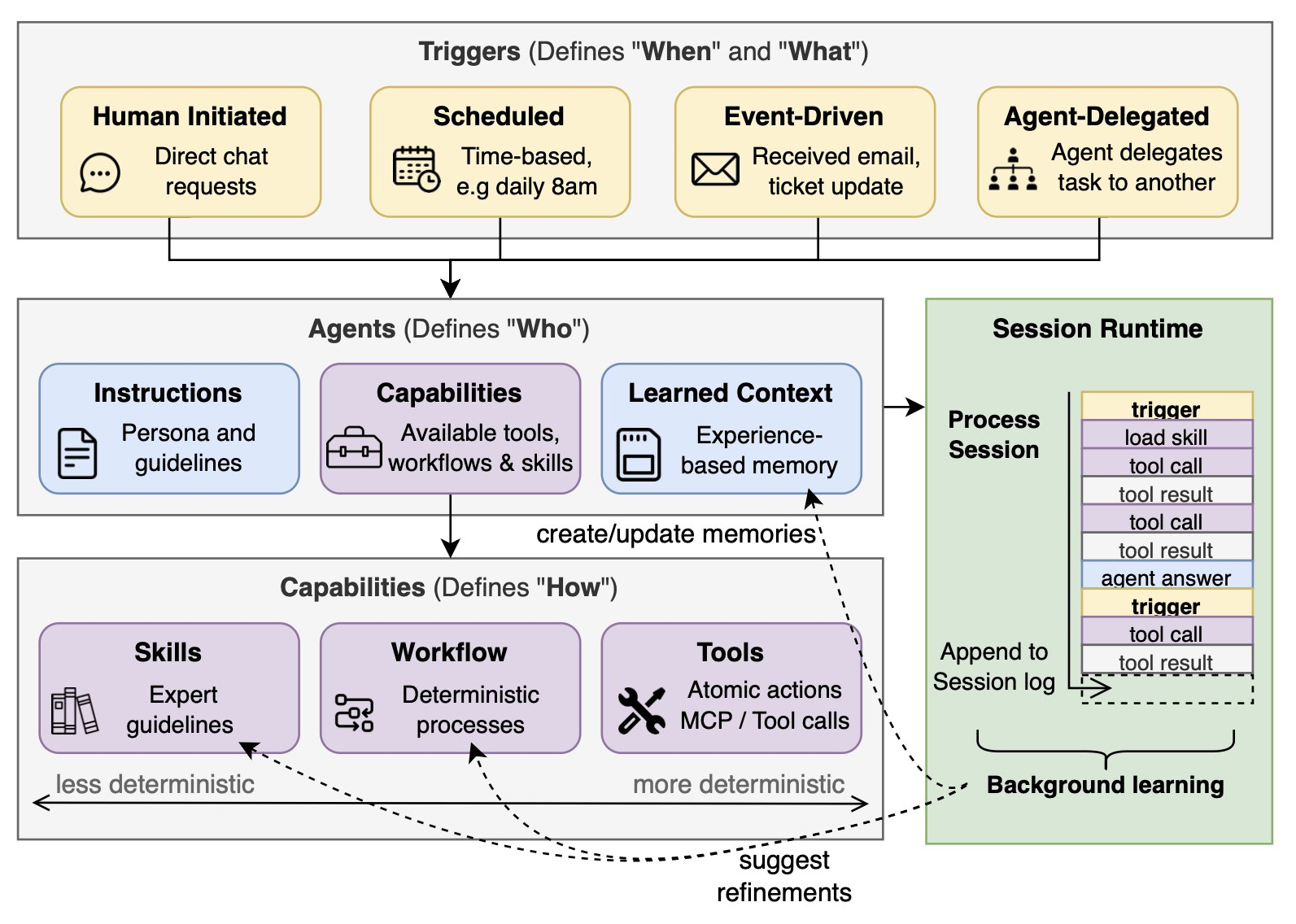
The core of the Amazon Quick framework relies on the interaction between three primary pillars: triggers, agents, and capabilities. A trigger serves as the ignition point, answering the questions of when an action should occur and what specifically needs to be done. The agent, serving as the persistent "who," acts as the orchestrator that interprets these triggers. Finally, the capabilities define the "how," providing the agent with the necessary tools, skills, and workflows to execute the task.
This architectural shift is significant because it recognizes that the underlying Large Language Model (LLM) is merely a parameter, rather than the agent itself. By separating the identity of the agent—defined by its instructions, capabilities, and accumulated history—from the transient state of a conversation or a specific model, Amazon Quick has created a more modular and robust environment. This distinction allows for a "confidence contract" between the user and the system. A user can choose between a highly autonomous agent for simple tasks or a strictly governed, deterministic workflow for compliance-heavy, high-stakes operations.
Chronology and Development Context
The road to this framework began in early 2025, following a surge in demand for enterprise-grade autonomous agents. Data from that period indicated that while organizations were eager to deploy agents, nearly 40% of initial projects stalled during the transition from prototype to production. The primary point of failure was often "agent drift," where an agent’s behavior would become unpredictable due to poorly defined boundaries between autonomous reasoning and deterministic process requirements.
By mid-2025, the internal engineering teams at Amazon Quick began a systematic audit of their codebase. They found that developers were frequently duplicating logic for task scheduling and memory retention. In November 2026, the team formalized the current taxonomy, moving from a disparate set of experimental features to a unified "Agentic Operating System" architecture. This transition was marked by a shift in how the user interface presents these agents: instead of asking users to build a new agent for every sub-task, the system now encourages users to add specific triggers or capabilities to existing, "living" agents.
The Spectrum of Capabilities: Tools, Skills, and Workflows
Amazon’s framework introduces a clear categorization for how agents execute tasks, ranging from the purely atomic to the rigidly structured:
- Tools: These are the most granular operations. Whether through a standard function call or a Model Context Protocol (MCP) server, tools provide a uniform interface for actions like querying databases, fetching file metadata, or triggering external API requests. They are inherently deterministic and atomic.
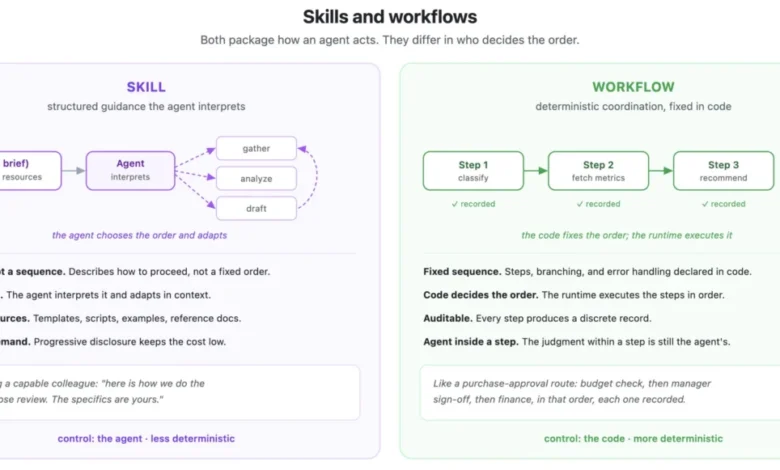
- Skills: Representing the middle ground of the confidence spectrum, skills provide agents with guidance, templates, and contextual examples. Unlike a hard-coded script, a skill allows the agent to exercise judgment within a set of boundaries. Amazon’s implementation of "progressive disclosure" ensures that these skills do not bloat the agent’s memory; the agent only loads the relevant details when a specific trigger demands it.
- Workflows: These are the most restrictive components, designed for scenarios requiring strict auditability. By encoding the sequence of operations into a deterministic logic flow—such as a multi-stage approval process for financial expenditures—workflows ensure that even if the agent’s reasoning is flexible, the compliance steps remain inviolate.
Market Implications and Future Outlook
The implications of this taxonomy for the broader AI industry are substantial. As companies shift toward "agentic" enterprise applications, the ability to maintain consistency while scaling is paramount. Industry analysts observe that the "confidence contract" model effectively addresses the biggest hurdle to AI adoption in regulated sectors: the lack of predictability. By allowing developers to "crystallize" a skill into a workflow or "dissolve" a rigid workflow back into a skill based on performance data, Amazon Quick is introducing a dynamic lifecycle for automation.
Furthermore, the framework’s focus on "background learning" suggests that Amazon is moving toward an ecosystem where agents improve over time without manual intervention. The goal is a system where the tenth execution of a task is qualitatively superior to the first, as the agent refines its understanding of user preferences, formatting, and domain-specific requirements.
Technical Synthesis: A Move Toward Modularity
The technical shift toward a shared vocabulary is intended to hide complexity from the end-user. When a user requests that an agent "monitor a Slack channel and provide a daily digest," they should not need to understand whether this requires a new agent, a workflow, or a skill. Under the new taxonomy, the system evaluates the request’s requirements for precision and reliability. If the user values speed and autonomy, the system deploys a skill-based approach. If the user requires absolute consistency for compliance purposes, the system utilizes a workflow.
This approach addresses the "primitive" problem identified by the Amazon Quick team. By defining these primitives, the company is effectively building a foundational layer for what could be described as an "Agentic Operating System." As this series continues, upcoming installments are expected to detail how this OS handles proactive feeds, background learning processes, and the inter-agent orchestration necessary for large-scale enterprise deployments.
Conclusion
The introduction of this four-part taxonomy—When, What, Who, and How—marks a maturing phase in the development of agentic AI. By moving away from an ad-hoc approach to building agents and toward a structured, primitive-based design, Amazon Quick is establishing a framework that prioritizes reliability and developer efficiency. As AI systems become more deeply integrated into the fabric of enterprise workflows, the ability to reason about these systems through a shared, standardized vocabulary will become an essential competitive advantage. For the end-user, the result is a system that feels more capable, more predictable, and increasingly intuitive, handling complex orchestrations behind a simple, human-centric interface. This development sets a clear precedent for how next-generation autonomous systems will be architected, versioned, and deployed in the coming decade.