Manufacturing CEOs Year-Ahead Outlook Hits 2026 Low Amidst Election Uncertainty and Economic Headwinds

The American manufacturing sector, a primary engine of the national economy, navigated a period of heightened apprehension in November 2026. Data from the latest CEO Confidence Index, published by Chief Executive, reveals that confidence among manufacturing leaders regarding the year ahead has plummeted to its lowest point of the calendar year. This cooling of sentiment reflects a complex intersection of political volatility, shifting consumer behavior, and the persistent, long-shadowed impact of macroeconomic pressures like inflation and interest rate adjustments.
The survey, which captured the responses of 435 U.S.-based CEOs between November 3 and November 5, highlights a sector caught between the promise of industrial expansion and the reality of rising operational costs. While the broader outlook remains cautiously optimistic for 2027, the immediate horizon is clouded by a significant shift in how leadership perceives the stability of the current business climate.
A Chronology of Sentiment: The Midterm Election Effect
The timing of the survey proved critical to understanding the data. Because the polling period straddled the outcome of the midterm elections, analysts were able to isolate the impact of political results on corporate confidence.
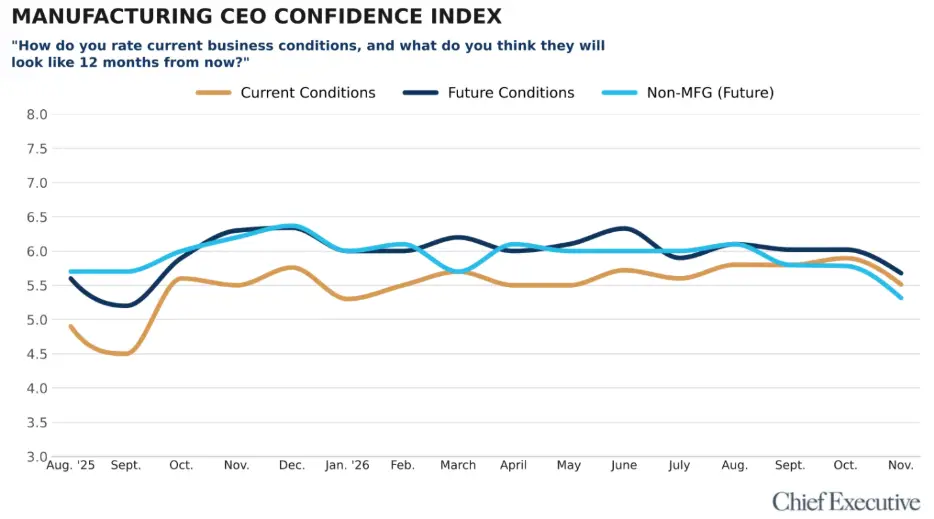
Before the election results were fully processed on November 3, manufacturing CEOs registered a year-ahead outlook rating of 5.5 on a 10-point scale. However, sentiment saw a tangible, albeit modest, uplift among those who responded after the election results were known, with their outlook rising to 5.9. This divergence suggests that while the political climate remains a source of tension, the resolution of the election cycle provided at least a temporary floor for business expectations.
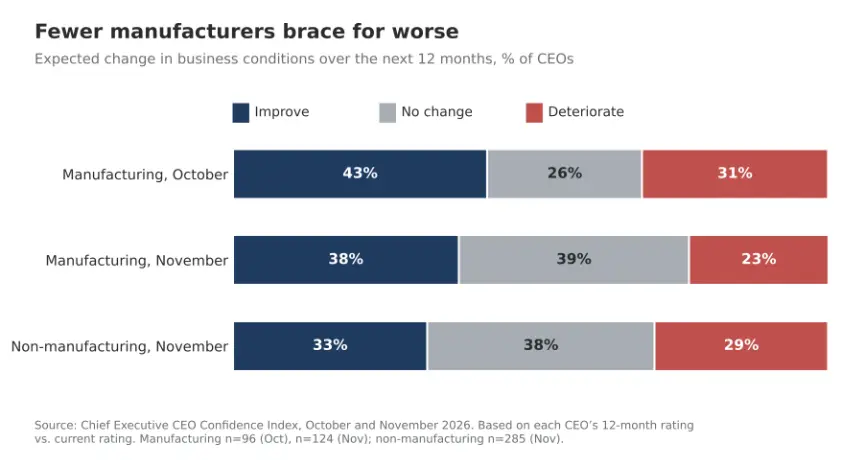
For many, the election was viewed through the lens of policy continuity versus disruption. One industrial manufacturer noted that the election results served as a catalyst for a brighter outlook, particularly when paired with signs of recovery in the automotive sector. Conversely, others expressed deep-seated concerns, citing the “continuing impact of tariffs” and the inherent uncertainty that accompanies changes in the legislative balance of power. The data indicates that 43 percent of respondents who answered after the election expected conditions to improve, compared to only 34 percent of those who weighed in before the results were finalized.
Sector-Specific Disparities: Industrial vs. Consumer Goods
The burden of the recent downturn has not been distributed equally across the manufacturing landscape. The Chief Executive Index reveals a deepening divide between industrial manufacturers and those producing consumer goods.
Industrial manufacturing, bolstered by robust activity in data centers, power and utility infrastructure, semiconductor fabrication, and the aerospace and defense sectors, has shown higher resilience. Scott Wood of LISI Aerospace Fasteners North America characterized the current climate as a "10," citing growth across defense and space sectors as a primary driver.
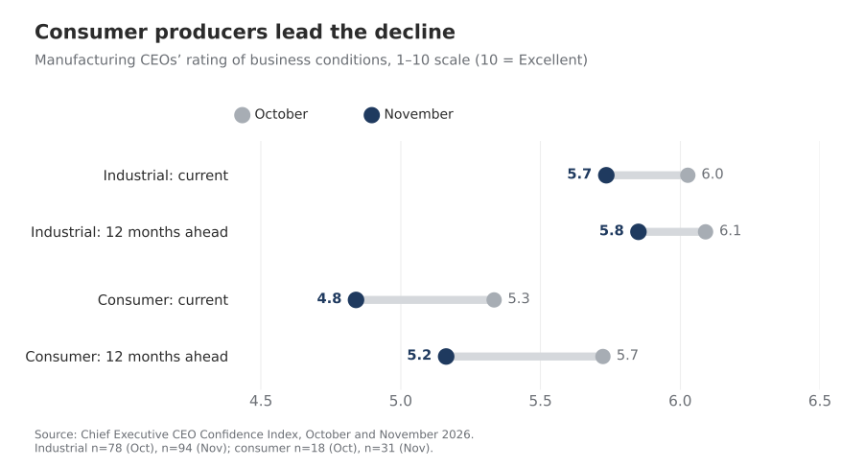
In stark contrast, the consumer goods segment is experiencing a more pronounced contraction. Current business conditions for consumer goods producers fell 9 percent in November to a rating of 4.8, while their year-ahead forecasts dropped by 10 percent to 5.2. This decline is largely attributed to a fundamental shift in household spending. As one CEO of a small consumer goods firm observed, while consumers are still spending, they have become increasingly discerning, prioritizing essential goods and pulling back from discretionary purchases. This trend is further evidenced by the 29 percent of consumer goods CEOs who are now forecasting a potential recession, more than double the 13 percent recorded among industrial counterparts.
Macroeconomic Pressures and the Cost of Doing Business
Despite the variability in sentiment, the overarching economic environment remains characterized by significant cost volatility. Approximately one in five manufacturing leaders identified inflation and input costs—ranging from raw materials like steel to energy commodities like fuel—as the primary impediments to their growth strategy.
Interest rates remain the second most cited concern. Jim Nelson, CEO of Parr Instrument Company, which manufactures laboratory pressure reactors and calorimeters, stated plainly that "rising interest rates will slow the economy in 2027." This expectation is corroborated by the index data, which shows that 82 percent of manufacturers now anticipate an increase in operating expenses for the coming year, a significant jump from the 65 percent who projected such increases in October.
The shift in capital allocation is perhaps the most telling indicator of how CEOs are preparing for these pressures. While hiring plans have slipped by 4 percent—suggesting a cautious approach to payroll expansion—capital spending plans have surged. Manufacturers are increasingly prioritizing investment in equipment and automation, likely as a hedge against labor costs and a means to improve long-term productivity. This stands in sharp contrast to non-manufacturing sectors, where capital expenditure plans have trended downward, suggesting that the manufacturing sector retains a more aggressive long-term investment horizon.
Broader Economic Implications and Recession Forecasts
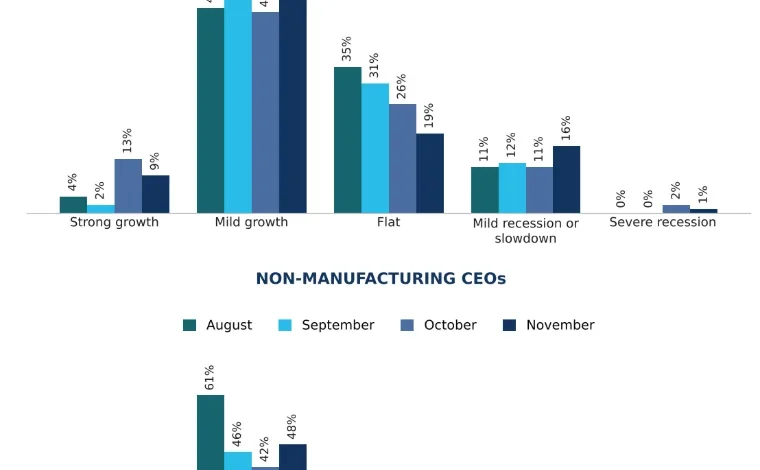
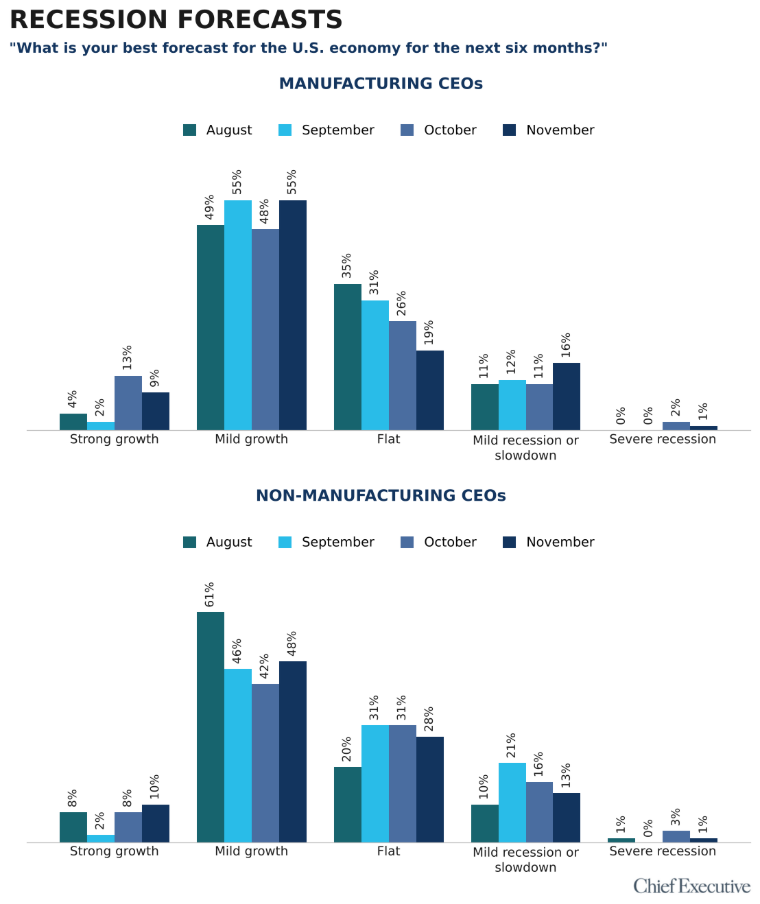
The view of the broader economy has become increasingly polarized. There is a palpable trend toward both extremes: 64 percent of manufacturers now forecast some level of growth over the next six months, up from 60 percent in October. Simultaneously, the share of manufacturers bracing for a recession has risen to 17 percent, up from 14 percent.
This "barbell" effect—where CEOs are increasingly confident in their own firm’s revenue growth while simultaneously hedging against a broader economic downturn—is indicative of a "wait-and-see" leadership style. The data shows that 75 percent of manufacturers expect to finish 2026 with higher revenues than they recorded in 2025, and 67 percent expect higher profits. These figures outperform non-manufacturing sectors, which trail at 65 percent for revenue growth and 61 percent for profit margins.
The implications for 2027 are significant. Manufacturers are signaling that they intend to push through the current volatility by focusing on core industrial markets where demand remains inelastic—such as infrastructure and national security—while trimming operational excesses.
Expert Analysis and the Role of Leadership Intuition
As the manufacturing sector closes out 2026, the reliance on traditional forecasting models is being supplemented by a renewed focus on executive judgment. The consensus among many surveyed leaders is that the current economic data points are often contradictory, making it difficult to rely on purely quantitative analysis.
"Experience, judgment, and the willingness to trust your gut still matter," remarked the CEO of a mid-size, family-owned industrial manufacturing firm. This sentiment underscores a broader trend identified in the index: that successful leadership in the current environment requires the ability to make strategic decisions before the data fully confirms the wisdom of those moves.
Contextualizing the CEO Confidence Index
The CEO Confidence Index has served as a benchmark for the American industrial climate since 2002. By polling a diverse array of organizations—ranging from small, family-owned enterprises to large, publicly traded corporations—the Index provides a unique window into the decision-making processes of those at the helm of the economy.
The drop in November’s confidence levels, while notable, must be viewed in the context of the year’s historical average. Manufacturers have maintained a 12-month forecast average of 6.1 throughout 2026; the current dip to 5.7 represents a regression to a more conservative, yet still stable, stance rather than a collapse of sentiment.
Future Outlook: Navigating 2027
As organizations finalize their 2027 budgets and operational roadmaps, the divergence between the industrial and consumer sectors is expected to widen. Industrial manufacturers are likely to continue leveraging their role in critical infrastructure projects to offset broader economic cooling. Meanwhile, the consumer goods sector faces a sustained period of adjustment as it attempts to anticipate the changing habits of a price-sensitive public.
The primary takeaway from the November data is one of managed resilience. While manufacturing CEOs have lowered their expectations in response to political uncertainty and inflationary pressures, they remain committed to growth. The trend toward increased capital spending suggests that the manufacturing sector is not merely hunkering down; it is actively modernizing. Whether this investment will be sufficient to mitigate the headwinds of 2027 remains the defining question for the year ahead. As the sector moves into the final weeks of 2026, the focus will undoubtedly shift from the volatility of the midterms toward the reality of interest rate policies and their long-term impact on the cost of capital.