The AI Integration Paradox: Why 95 Percent of Corporate Pilots Fail and How Chief Learning Officers Can Fix the Human Gap

Organizations across the global economy have integrated artificial intelligence at a velocity that outpaces any previous workplace technological shift in modern corporate history. Yet, despite widespread implementation, a profound operational disconnect remains. While nearly nine in ten enterprises have adopted AI regularly within at least one core business function, a striking majority of these deployments have failed to produce tangible financial returns. This phenomenon, increasingly referred to by workplace strategists as the AI adoption paradox, highlights a critical reality: the primary barrier to digital transformation is no longer technical capability, but human adaptability.
For chief learning officers and corporate executives, the challenge has shifted from procuring software to fostering organizational resilience. According to enterprise data from recent multi-year technology studies, the friction of transformation is rooted in a failure to evolve workflows and mindsets alongside machine intelligence. Without a fundamental redesign of how people learn, judge, and collaborate with automated systems, companies risk remaining trapped in cycles of perpetual piloting that yield minimal strategic value.
The Evolution of the AI Adoption Timeline: From Rapid Deployment to Stagnation
To understand the current state of enterprise artificial intelligence, it is necessary to examine the rapid chronology of its adoption over the past half-decade. The trajectory of workplace AI can be mapped across distinct phases, each revealing deeper systemic hurdles:
- 2022–2023: The Surge of Experimentation. Following the mainstream release of generative AI applications, corporate leadership rushed to deploy tools across engineering, marketing, and customer service. Driven by the fear of missing out, organizations authorized thousands of isolated software pilots without comprehensive enterprise strategies.
- 2024: The Productivity Illusion. During this period, basic usage metrics soared. Employees utilized tools for drafting emails, summarizing documents, and writing preliminary code. However, finance departments noted a distinct absence of corresponding improvements in profit-and-loss statements, signaling that local efficiencies were not translating into broader organizational growth.
- 2025: The Reality Check of Project NANDA. Comprehensive enterprise evaluations, most notably research conducted by MIT’s Project NANDA involving more than 300 corporate deployments, quantified the crisis. The findings revealed that approximately 95 percent of generative AI pilots failed to generate measurable financial impact. Researchers concluded that the issue was not software inadequacy, but a learning gap—employees were utilizing new tools without altering their fundamental work behaviors.
- 2026 and Beyond: The Shift to Adaptive Leadership. Organizations began moving away from standalone technology training toward holistic workforce transformation frameworks. Enterprise leaders recognized that sustainable AI integration requires addressing professional identity, ethical distribution of risk, and continuous organizational learning.
Unpacking the Data: The Pilot-to-Production Chasm
The quantitative evidence gathered by major research institutions underscores the depth of the corporate AI dilemma. Surveys conducted by McKinsey & Company established that nearly 90 percent of organizations incorporated AI into daily operations by late 2025. However, the subsequent findings from MIT’s Project NANDA demonstrated that this high deployment rate masked profound inefficiencies.
The 95 percent failure rate of generative AI pilots to move the financial needle points directly to what organizational theorists term the "AI cul-de-sac." Companies frequently become trapped in local optimization, where isolated teams achieve minor time savings on narrow tasks, but the broader operational workflow remains unchanged.
Industry analysts note that traditional corporate training models are poorly equipped for this environment. Standard software onboarding assumes a static tool with fixed inputs and outputs. Generative AI, by contrast, is dynamic, probabilistic, and prone to error. When employees treat AI outputs as definitive answers rather than probabilistic suggestions, organizations encounter compliance bottlenecks, trust deficits, and diminished critical thinking skills.
The Adaptive Leadership Framework: Technical vs. Adaptive Challenges
To bridge the gap between tool adoption and actual value creation, organizational scholars point to the adaptive leadership framework, originally pioneered by Harvard researchers. This model draws a sharp distinction between technical challenges and adaptive challenges.
Technical challenges are problems that can be diagnosed and resolved using existing knowledge and structural expertise. Installing enterprise software, updating cybersecurity protocols, or migrating cloud databases are fundamentally technical tasks. They require clear instructions, proper funding, and trained personnel.
Adaptive challenges, conversely, require people to change their behaviors, beliefs, habits, and priorities. The integration of artificial intelligence is overwhelmingly an adaptive challenge. AI alters professional identity by automating tasks that once served as the foundational building blocks of early-career expertise. It redistributes authority, blurs lines of accountability, and forces workers to confront uncomfortable questions regarding job security and ethical responsibility.
When enterprises treat AI integration purely as a technical implementation exercise, they overlook the psychological and cultural friction experienced by the workforce. This oversight manifests as passive resistance, knowledge hoarding, and superficial compliance, ultimately undermining long-term strategic objectives.
The Flux 5: Leadership Mindsets for the AI Era
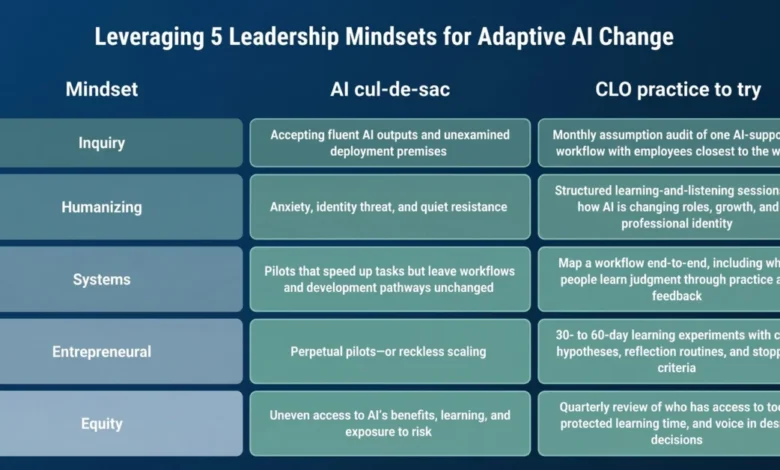
Navigating the complexities of adaptive workforce development requires leaders to cultivate specific cognitive capacities. Scholars have introduced comprehensive leadership models—such as the Flux 5 framework—which identify five essential mindsets required to guide organizations through systemic disruption: the Inquiry mindset, the Humanizing mindset, the Systems mindset, the Entrepreneurial mindset, and the Equity mindset.

1. The Inquiry Mindset: Questioning Outputs and Premises
In an operational environment where automated tools frequently generate confident inaccuracies, an inquiry mindset acts as a vital safeguard. This involves institutionalizing two levels of questioning: interrogating the output of specific AI tools and examining the underlying premises of automated workflows.
For learning and development professionals, fostering inquiry means moving beyond basic prompt engineering courses toward work-embedded learning laboratories. Employees must be trained to compare AI recommendations against expert judgment, verify claims across trusted sources, and identify systemic blind spots. Key practices include conducting monthly AI assumption audits, establishing rapid-feedback listening loops, and running judgment labs where teams analyze real-world artifacts alongside machine-generated suggestions.
2. The Humanizing Mindset: Supporting People Through Transition
Workplace anxiety regarding automation is both widespread and rational. When leadership frames artificial intelligence exclusively as a headcount-reduction lever or a pure productivity metric, employee trust deteriorates. A humanizing mindset centers on empathy, purpose, and professional identity, recognizing that adults learn and experiment most effectively when provided with a secure psychological environment.
Drawing on concepts of institutional holding developed by organizational psychologists, modern learning ecosystems must provide scaffolding for workforce anxieties. Organizations must create structured dialogue spaces to discuss the gap between stated leadership intent and daily employee experiences, while intentionally redesigning entry-level professional development pipelines to ensure junior staff still acquire foundational expertise.
3. The Systems Mindset: Redesigning End-to-End Workflows
Local optimization remains a primary trap for digital transformation initiatives. A systems mindset equips leaders to view organizational workflows through an interconnected lens, evaluating how a speed increase in one department impacts upstream dependencies and downstream outputs.
Chief learning officers play a pivotal role here by mapping operations end-to-end prior to automation, identifying where tacit knowledge is gained or lost, and replacing superficial usage metrics with comprehensive outcome measures. By tracking cycle times, quality metrics, and overall employee capacity rather than mere login frequencies, organizations can prevent unintended bottlenecks.
4. The Entrepreneurial Mindset: Disciplined Experimentation
Enterprises frequently oscillate between two counterproductive extremes: perpetual piloting that scales nothing, and rapid, premature enterprise-wide commitments to unproven vendors. An entrepreneurial mindset resolves this tension through disciplined experimentation.
Rather than treating pilots as indefinite tests, organizations should establish 30- to 60-day bounded experiments with clear hypotheses, predefined success metrics, and structured learning reviews. This approach ensures that even when a specific tool deployment is discontinued, the organization retains valuable operational knowledge regarding workflow friction and human capability requirements.
5. The Equity Mindset: Distributing Gains and Mitigating Risks
Artificial intelligence does not inherently distribute its benefits or its operational risks evenly across an enterprise. Access to advanced tools and protected experimentation time often mirror existing corporate hierarchies, exposing demographic groups with the least organizational leverage to unmonitored automation. Furthermore, models trained on historical data can inadvertently reinforce legacy biases in hiring, performance evaluation, and client service delivery.
An equity mindset treats fairness as a core metric of organizational performance. Enterprises must institute regular AI equity reviews, democratize access to learning resources and protected time, and mandate rigorous human oversight checkpoints for high-stakes decisions involving promotions, compensation, and public-facing services.
Strategic Implications for Chief Learning Officers
The broader implications of these findings redefine the strategic mandate of chief learning officers and enterprise development teams. Artificial intelligence is not a static destination point that an organization reaches and subsequently stabilizes around; it is an ongoing, iterative learning process that accelerates continuous organizational change.
As technological capabilities continue to evolve, fundamental questions regarding professional trust, corporate structure, fairness, and human identity will repeatedly resurface. Sustainable value creation in the modern economy depends on an organization’s collective capacity to adapt. By fostering inquiry, humanizing the transition, maintaining systemic awareness, practicing disciplined boldness, and committing to operational equity, leaders can successfully navigate the AI integration paradox and build resilient, future-ready workforces.