Beyond the Talent Pipeline: Why Modern Organizations Face a Leadership Readiness Crisis

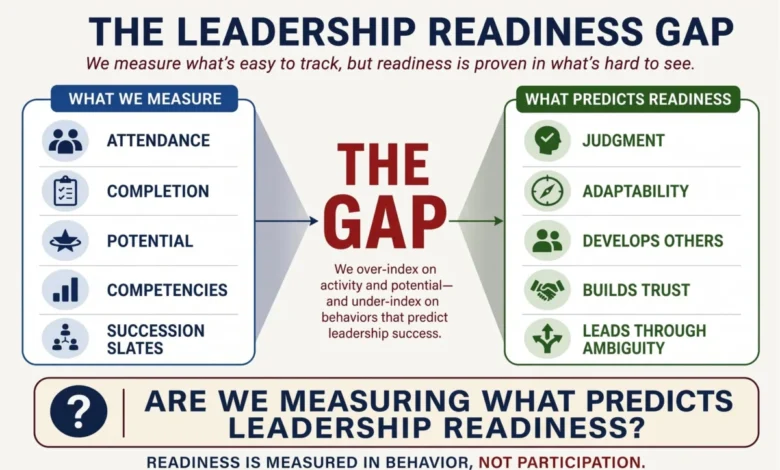
Over the past decade, human resources executives and corporate boards have routinely converged on a singular, high-stakes operational priority: identifying and cultivating high-potential talent to secure organizational continuity. Millions of dollars are funneled annually into executive coaching, leadership development programs, and meticulous succession mapping exercises. Yet, despite these extensive corporate investments, a recurring operational friction persists. When a critical executive or leadership position suddenly opens due to unexpected departures, retirements, or rapid market expansions, the foundational boardroom question frequently shifts from the optimistic inquiry of Who is next? to the far more anxious realization of Who is actually ready?
Industry data underscores a widespread systemic disconnect. According to the DDI Global Leadership Forecast, a staggering 80 percent of organizations continue to report a profound lack of confidence in their existing leadership pipelines. This persistent statistic exposes a critical flaw in modern corporate strategy: while enterprises have become exceptionally proficient at identifying raw talent and academic potential, they have historically lagged in engineering systematic, operational readiness. Consequently, when promotions occur based strictly on past individual performance rather than demonstrated leadership capability at scale, the resulting performance gaps become acutely visible, exposing systemic vulnerabilities that extend far beyond individual shortcomings.
The Evolution of Succession Planning and the Emergence of the Readiness Gap
To understand the current crisis in executive pipelines, it is necessary to examine the evolution of corporate talent management. Historically, succession planning operated as a static, administrative exercise. Organizations maintained closed-door replacement charts—often referred to as “tombstone charts”—that designated backup candidates for top-tier executive slots based on tenure, technical competence, and subjective supervisor evaluations.
As corporate environments grew exponentially more complex through globalization, rapid technological disruption, and shifting workforce expectations, human resources methodologies evolved. During the late 1990s and 2000s, the paradigm shifted toward identifying high-potential (HiPo) employees. Corporations introduced rigorous psychometric testing, 360-degree feedback loops, and multi-year leadership academies designed to fast-track top performers into leadership ranks.
However, this systemic focus on potential inadvertently created a dangerous vacuum. Potential indicates what an employee might achieve given adequate time and support; readiness dictates what an employee can execute, manage, and sustain under pressure in the immediate present. Leadership readiness is inherently contextual. A manager may demonstrate exceptional readiness when steering a stable, mature business unit through incremental growth, yet prove entirely unequipped to navigate an aggressive corporate turnaround, a complex merger and acquisition, or a cultural transformation driven by macroeconomic shocks.
Examining the Data: The DDI Global Leadership Forecast and Industry Implications
The disconnect between talent identification and actual operational readiness is not merely an isolated human resources grievance; it is a macro-economic liability documented extensively by global workforce research. The DDI Global Leadership Forecast serves as a benchmark for evaluating organizational health, repeatedly highlighting that confidence in executive benches remains stagnant despite surging corporate expenditure on leadership development.
Analysts point to several structural catalysts driving this trend. First, the half-life of professional skills has shrunk dramatically. Technical competencies that once guaranteed a decade of secure middle-management performance can become obsolete within years due to artificial intelligence, automation, and shifting market dynamics. Second, the nature of leadership has fundamentally transformed. Modern leaders are no longer expected to act merely as authoritative directors of task-oriented teams; they are increasingly required to navigate ambiguity, champion inclusivity, manage distributed hybrid workforces, and articulate authentic corporate purpose.
When organizations rely exclusively on historical metrics—such as sales quotas met, projects delivered on time, or individual technical mastery—they frequently misdiagnose an individual’s readiness for enterprise-wide leadership. The transition from an individual contributor or tactical manager to a strategic enterprise leader requires a fundamental rewiring of professional identity, emotional intelligence, and cognitive perspective. When this transition fails, the fallout affects team morale, operational velocity, and the long-term career trajectory of the newly promoted leader.
Case Study: The High-Performer Trap and Systemic Accountability
The perils of conflating potential with readiness are frequently illustrated in corporate environments through the trajectory of classic high performers. Consider a scenario mirrored across global enterprises: an engineer, sales director, or financial analyst achieves consistent top-tier results. They exhibit deep institutional knowledge, unwavering ambition, and unquestioned credibility among peers.
When a leadership vacancy arises, promoting this individual appears to be the logical, low-risk choice. Yet, upon stepping into the broader role, the newly minted leader discovers that the very behaviors that drove their individual success—such as diving in to solve complex technical problems directly, controlling workflows, and measuring achievement through personal output—now actively sabotage their effectiveness. The new mandate requires leading through others, exercising indirect influence, and measuring success not by what they produce, but by the capabilities and achievements of the teams they empower.

When such transitions stall, organizations historically default to individual attribution, concluding that the employee “just wasn’t ready” or lacked natural leadership aptitude. Industry experts and organizational psychologists, however, increasingly argue that this perspective absolves the enterprise of structural responsibility. If an organization’s talent systems explicitly identified the individual as ready, promoted them through formal channels, and subsequently watched them founder, the failure lies not solely with the employee, but within the assessment and development systems that certified their readiness prematurely.
Three Strategic Shifts for Closing the Readiness Gap
To bridge the chasm between identifying future leaders and ensuring their operational readiness, progressive human resources and learning leaders are advocating for three fundamental shifts in organizational philosophy and practice.
1. From Potential to Demonstrated Readiness
Organizations must deliberately decouple the identification of potential from immediate promotion decisions. While potential outlines a trajectory, readiness demands verifiable evidence. Enterprises are increasingly implementing "readiness audits" that require candidates to demonstrate cross-functional leadership, crisis management, and strategic decision-making in controlled, simulated, or interim capacities before securing permanent promotions. This ensures that promotions do not serve as expensive discovery mechanisms for competency gaps.
2. From Isolated Programs to Integrated Leadership Systems
Traditional leadership development has long relied on episodic interventions—such as annual off-site retreats, executive education modules at universities, or modular online courses. While valuable, these programs operate in vacuums. Closing the readiness gap requires treating leadership development as a continuous, operational system.
This systematic loop follows a continuous cadence: succession decisions identify readiness gaps; targeted development experiences are assigned to address those gaps; real-world execution is observed and evaluated with constructive feedback; and readiness is reassessed. By embedding development directly into live business challenges—such as tasking a developing leader with steering an ambiguous cross-functional initiative—organizations cultivate lived performance rather than relying on theoretical competence.
3. From Measuring Activity to Measuring Impact and Readiness
For decades, corporate learning and development functions have measured success through quantitative participation metrics: hours spent in training, course completion rates, and satisfaction survey scores. While operational data remains necessary for administrative oversight, it fails to answer the foundational question: What value is this investment adding to the business?
Forward-thinking enterprises are redefining their measurement architectures around a progression model moving from Activity to Capability, Behavior, and ultimately Impact. Instead of asking how many leaders attended a seminar, talent teams are evaluating whether those leaders demonstrate enhanced capabilities in high-stakes environments—such as holding difficult performance conversations, navigating ambiguity successfully, and elevating the performance of their direct reports. The ultimate metric of a leadership development system is not attendance, but observable behavioral change on the job.
Expert Perspectives and Industry Reactions
Corporate governance specialists and executive search consultants have increasingly weighed in on the urgency of overhauling succession protocols. Market pressures demand greater agility, leaving boards with zero tolerance for prolonged executive onboarding failures or leadership vacuums.
Industry analysts suggest that boards of directors are beginning to demand deeper transparency from chief human resources officers regarding the qualitative health of leadership pipelines. Rather than accepting high-level executive summaries listing potential successors for C-suite roles, boards are increasingly asking for empirical evidence regarding how those successors have been tested, what stretch assignments they have successfully navigated, and what specific competency gaps remain unaddressed.
Furthermore, organizational development leaders emphasize that fostering readiness requires psychological safety and structural patience. When organizations rush individuals into roles prematurely to satisfy immediate operational vacancies, they risk burning out top-tier talent and eroding organizational trust. Conversely, when enterprises invest in transparent developmental pathways where readiness gaps are identified and methodically closed, the entire corporate ecosystem benefits from stable, seasoned, and resilient leadership.
Broader Impact and Future Implications
The shift from succession planning to leadership readiness carries profound implications for the future of corporate governance, talent retention, and organizational resilience. As macroeconomic volatility, technological innovation, and geopolitical complexities continue to reshape the global business landscape, the margin for leadership error has narrowed significantly.
Organizations that cling to legacy succession models—treating talent identification as a static, once-a-year administrative chore—will likely continue to experience high leadership churn, costly executive missteps, and stagnant bench strength. Conversely, enterprises that embrace a systemic approach to readiness—focusing on lived performance, continuous behavioral assessment, and rigorous operational feedback loops—will cultivate leadership pipelines capable of navigating whatever challenges emerge on the horizon.
Ultimately, the core challenge facing modern organizations is not a scarcity of ambitious or talented individuals. It is the systemic discipline required to bridge the gap between who employees might become and what they are demonstrably ready to execute today. By shifting the foundational boardroom question from Who is next? to What evidence proves they are ready for what comes next?, organizations can build sustainable leadership pipelines designed for long-term viability and impact.