Yelp Revolutionizes Conversational AI with a Hybrid Server-Driven UI Architecture for Its Assistant

Yelp has officially rolled out a sophisticated hybrid user interface architecture designed specifically for its conversational Yelp Assistant, merging the responsiveness of native mobile controls with the dynamic flexibility of server-driven conversation rendering. This strategic architectural overhaul is aimed at empowering engineering teams to accelerate feature updates and seamlessly deploy interface adjustments across multiple platforms—including iOS, Android, and web environments—without constantly requiring traditional, cumbersome client-side application updates.
At the core of this technical evolution is Yelp’s proprietary CHAOS framework, an acronym standing for Content Hosting Architecture with Optimization Strategies. Originally deployed to streamline web and mobile application development by allowing backends to dictate client-side display logic and interaction responses, CHAOS has now been successfully adapted to handle the intricate, real-time demands of an artificial intelligence-driven chat assistant. By leveraging this framework, Yelp has built a scalable ecosystem that separates static interface shells from dynamic, rapidly changing conversational content.
The Evolution and Expansion of the Yelp Assistant
The journey of the Yelp Assistant began in 2024 with a targeted launch on iOS. Initially, the conversational tool served a singular, highly specific purpose: helping users effortlessly craft detailed project requests to connect with local service professionals such as contractors, plumbers, and electricians. This initial iteration proved that consumers were receptive to conversational interfaces when searching for complex local services, validating Yelp’s broader vision for AI-driven customer interaction.
Buoyed by early user adoption and positive feedback, Yelp systematically expanded the Assistant’s capabilities. Over subsequent updates, the tool evolved far beyond simple project request generation. Today, the Yelp Assistant functions as a comprehensive concierge capable of answering nuanced queries about local businesses, summarizing review trends, and supporting transactional actions such as restaurant food orders, table reservations, and appointment bookings. As the functional scope of the Assistant widened, however, the engineering challenges associated with maintaining a fast, responsive user interface across fragmented mobile platforms multiplied exponentially, prompting the development of the new hybrid architecture.
Engineering the Hybrid Architecture: Balancing Native Controls and Server Rendering
The primary technical hurdle faced by Yelp’s engineering division was that the existing iteration of the CHAOS framework lacked several essential capabilities required to build a modern, high-performing conversational assistant. Specifically, the framework did not natively support advanced text input fields, persistent session handling, or complex, real-time asynchronous network requests.
Extending the foundational CHAOS framework to accommodate every single requirement of the Assistant from scratch would have significantly delayed delivery timelines, forcing product managers to push back critical feature rollouts. To bypass this bottleneck, Daniel Andrade Groppe, Services Tech Lead at Yelp, and his engineering team opted for a pragmatic hybrid approach.
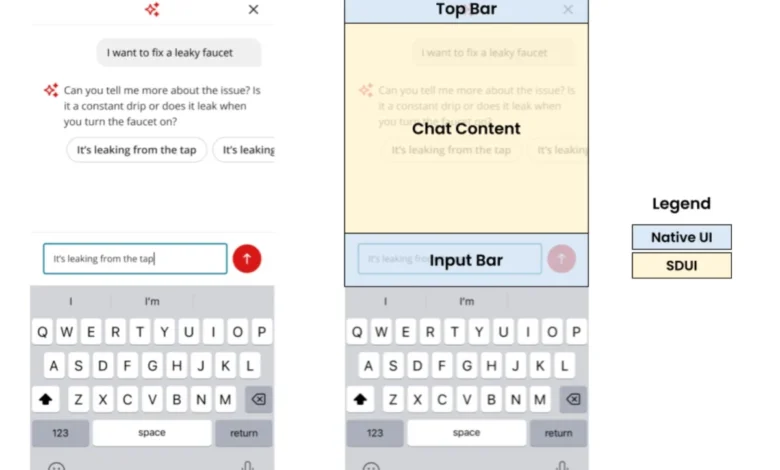
Under this innovative design paradigm, navigation bars, bottom tab bars, and message input fields remain strictly native to ensure optimal tactile responsiveness and smooth typing experiences. Meanwhile, the core conversation rendering area—including chat bubbles, rich media cards, and interactive prompts—is dynamically driven by the CHAOS server-driven UI backend. This division of labor allows the application to retain the fluid performance of a native app while enjoying the configuration agility of a web service.
Decoupling View Configuration from Conversation Data
A critical breakthrough in Yelp’s hybrid implementation is the absolute separation of view configuration data from the actual conversation event log. When a user initiates a chat session with the Yelp Assistant, the client application fetches the baseline CHAOS configuration file and initializes a structured dataset dedicated strictly to tracking message events.
Subsequent chat events do not require the client to refetch the bulky view configuration. Instead, incoming events update the existing view incrementally. These events encompass a wide array of UI states, including persistent user and bot messages, temporary typing indicators designed to simulate human response latency, interactive quick-reply buttons, and rich hyperlinks that open specific platform destinations.
Furthermore, the backend possesses the ability to transmit explicit interface-control actions. For instance, once a user successfully completes a complex home improvement project request, the server can simultaneously transmit a confirmation message, a direct link to view matched local contractors, and a control action that systematically disables the chat input field to prevent further redundant messaging. This event-driven design effectively decouples rendering mechanics from core conversation logic, insulating the user experience from transient network latency.
Industry Context: The Rise of Server-Driven UI at Scale
Yelp is not alone in recognizing the immense potential of server-driven user interface architectures. In recent years, several major technology companies have invested heavily in similar paradigms to decouple product release cycles from app store review bottlenecks. Most notably, Airbnb documented a closely related approach through its proprietary Ghost Platform, which utilizes server-defined UI elements across web, iOS, and Android clients.

Both Yelp’s CHAOS framework and Airbnb’s Ghost Platform share a fundamental underlying philosophy: empowering product and engineering teams to update supported presentation layers dynamically without requiring every minor UI tweak to ship inside a brand-new client application release. However, Yelp’s implementation distinguishes itself by successfully applying this model to a highly complex, real-time conversational interface while meticulously retaining native controls and robust client-side state management for message interactions.
Operational Mechanics and Error Handling in the Chat Flow
Maintaining a seamless user experience within a hybrid conversational framework requires rigorous state management, particularly when handling network interruptions or server errors. Yelp’s technical documentation outlines a precise operational flow for message submission and response handling.
When a user submits a message, the client application immediately renders the text locally, displays a dynamic typing indicator to signal processing, temporarily disables the chat input field to prevent duplicate submissions, and dispatches an asynchronous request to the backend. Upon receiving a successful response from the server, the client renders the bot’s reply along with any associated quick-reply chips, and automatically re-enables the chat input field for subsequent user interaction.
In scenarios where network issues or server timeouts occur, the system classifies failures into distinct categories. Recoverable errors automatically trigger silent client-side retries, ensuring the user is not disrupted by transient connectivity blips. Conversely, non-recoverable failures immediately disable the chat input field and present a clean, actionable prompt advising the user to try their request again later, thereby preventing application freezes or corrupted chat states.
Challenges, Cross-Platform Coordination, and Future Implications
Despite the operational successes of the hybrid architecture, Yelp’s engineering teams noted that adopting a novel framework introduced distinct coordination challenges. Engineers required dedicated ramp-up time to thoroughly master both the conversational nuances of the Assistant and the underlying mechanics of the CHAOS framework. Additionally, maintaining shared implementations across disparate mobile operating systems requires continuous vigilance to ensure uniform behavior and visual consistency on both iOS and Android devices.
Nevertheless, separating view configuration from conversation data has yielded profound long-term engineering benefits, enabling independent feature development cycles and significantly reducing time-to-market for new conversational capabilities. Proof of this architectural scalability arrived when Yelp successfully reused the Android Assistant infrastructure to rapidly launch the Biz Ask Anything pilot program. According to official statements from Yelp, this foundational engineering work has effectively laid the structural groundwork for its next-generation conversational assistant ecosystem, which seamlessly bridges granular business directory information with immediate, real-world transactional actions for consumers worldwide.
Related posts: