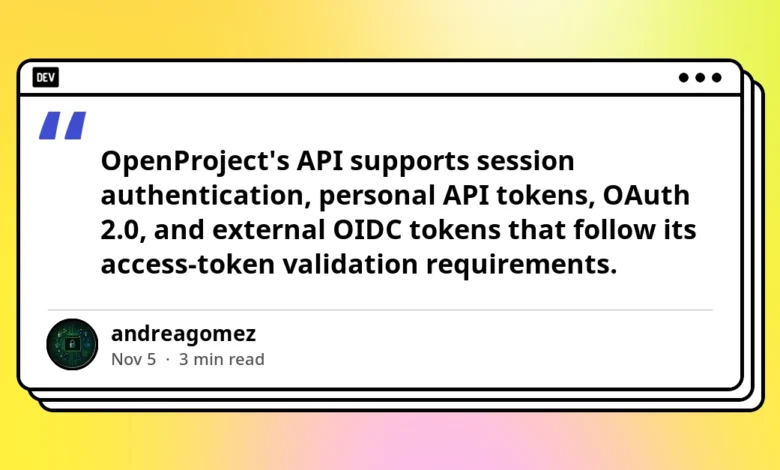
The security architecture of OpenProject relies heavily on the nuanced relationship between authentication and authorization, a distinction that has come under increased scrutiny as organizations scale their project management integrations. While OpenProject provides robust support for session authentication, personal API tokens, OAuth 2.0, and external OpenID Connect (OIDC) tokens, the mere validation of a token is insufficient to ensure a secure environment. The critical vulnerability often lies not in the credential itself, but in the oversight of the project membership context—the specific permissions and roles tied to the user associated with that token.
The core of the issue stems from the way OpenProject manages access control. An API token acts as a digital key, but that key must be mapped to a specific user who holds project-level memberships. If an organization maintains an inventory of API tokens without mapping those tokens to the corresponding projects, work packages, and role-based access control (RBAC) definitions, they expose themselves to significant security gaps. This is particularly dangerous when administrator tokens are inadvertently used for routine automation tasks, effectively granting those automated scripts far more power than the principle of least privilege would dictate.
The Mechanism of HAL+JSON and Permission Inference
OpenProject’s API documentation specifies that all responses are delivered in HAL+JSON format. This format is designed to include links that guide the client on what actions are available. For instance, a work package resource will contain an "update" link only if the authenticated user possesses the appropriate permissions to modify that specific work package.
While this design is highly efficient for front-end development, it has led to a dangerous misconception among some developers: the belief that a client-side application can safely infer permissions based on the presence or absence of these links. This approach is fundamentally flawed. Server-side authorization must remain the final arbiter of security. Relying on cached links or client-side logic to determine if a user can perform an action is a recipe for privilege escalation, especially when membership status changes frequently in dynamic corporate environments. If an employee is removed from a project but their personal token remains active, a client that relies on cached state may still attempt to perform unauthorized operations, leading to potential data exposure.
Mapping the Credential Lifecycle
To mitigate these risks, security teams must move toward a more disciplined lifecycle management for API tokens. This includes recording not just the token ID, but the owner, the specific purpose of the token, its creation date, its physical storage location, and—most importantly—its current project memberships.
Where the product architecture permits, organizations should move away from personal tokens for automation and toward dedicated "automation accounts." These accounts should be provisioned with the minimum necessary permissions required to complete their specific tasks. If an instance supports OAuth client credentials, developers should bind the application to a least-privileged user and document the authorization flow thoroughly.
The complexity of OpenProject’s membership model adds another layer of difficulty. A user might hold an administrative role in one project, such as "Project A," while possessing no access at all to "Project B." Consequently, a security review cannot simply check the user’s global role. Administrators must review the intersection of the project role and the operation-level permission. A role configured to edit work packages should not be conflated with the ability to perform project administration. Failing to delineate these boundaries is a common precursor to configuration errors that allow unauthorized users to modify project settings.
Scrutinizing Anonymous and OAuth Paths
The security landscape is further complicated by the handling of anonymous and OAuth-authenticated requests. Documentation indicates that unauthenticated clients typically receive the permissions of the "anonymous user," unless the system is specifically configured to mandate authentication for every request. Organizations must audit this setting regularly. While public projects may be intentional, the accidental exposure of work packages, sensitive attachments, or internal user lists through an overly permissive anonymous setting remains a persistent threat.
For OAuth implementations, the validation process must be comprehensive. It is not enough to confirm that a token is validly signed. Administrators must validate the registered client, ensure the redirect URI is correct, confirm the requested scope is limited to the task at hand, and verify the token audience and expiry. If an external OIDC path is configured, it must be subject to the same level of rigorous testing as local authentication methods. A valid bearer token is only as secure as the user it represents and the scope it has been granted.
Insights from Recent ZoomEye Observations
Recent data gathered through the ZoomEye search engine has highlighted the potential scale of OpenProject deployments and the varying degrees of their visibility. A count-only search utilizing broad parameters revealed that 11,685 instances are identified as "OpenProject" by app tag, 12,441 by title, and over 45,000 by HTTP body content. While these figures do not explicitly reveal the underlying authentication models or the exposure of project metadata, they illustrate the vast footprint of these tools in the enterprise space.
This data serves as a diagnostic tool rather than an exploit vector. Security teams should use such information to identify forgotten, legacy, or shadow IT instances of OpenProject that may have been deployed by individual teams without central oversight. Once identified, these instances should be correlated with the organization’s official DNS and cloud inventory. It is critical that security professionals refrain from attempting to enumerate projects or work packages on deployments they do not own, as this would constitute unauthorized probing.
Validating the Authorization Boundary
To ensure the integrity of the authorization boundary, security testing must be systematic. It is insufficient to test a token under a single set of conditions. Teams should test a token as an ordinary project member, as a user with no project membership, and as an administrator. These tests should cover the full spectrum of API actions: project listing, work-package read/write/delete operations, membership management, attachment retrieval, and the triggering of webhooks.
A crucial part of this validation is testing the "revocation flow." When a token is revoked from the account page, the API should cease to function for that token immediately. If there is a delay or a cache-related persistence, the system is vulnerable.
Furthermore, the integration of onboarding and offboarding procedures is vital. When an employee departs an organization, their access must be terminated holistically. If an employee is removed from the corporate directory but their personal API token remains active, the system retains a "ghost" credential that can be exploited. Security teams must ensure that the removal of a user from the organization’s identity provider automatically triggers the revocation of all associated API tokens in OpenProject.
Broader Implications and Best Practices
The necessity for project membership context in API tokens is a microcosm of a broader shift in enterprise security: the movement toward "identity-aware" infrastructure. As API-driven architectures become the backbone of modern collaboration, the identity of the requester—and the context of their relationship to the data—is the only reliable barrier against unauthorized access.
The implications for developers are clear: security cannot be an afterthought in API integration. It must be baked into the client’s request logic. For administrators, the burden is to ensure that the environment is hardened against both external intrusion and internal misconfiguration. By strictly enforcing the principle of least privilege, mapping credentials to specific project contexts, and performing regular, systematic audits of authorization boundaries, organizations can leverage the power of the OpenProject API without compromising the security of their sensitive project data.
Ultimately, a token is only as powerful as the context in which it operates. An empty key grants no access, but a key with excessive permissions is a liability. By treating API tokens as sensitive credentials that require constant oversight, and by ensuring that server-side authorization remains the final check, organizations can maintain the agility of their workflows while upholding the highest standards of security. The goal is a seamless, automated environment where every action is authenticated, every user is correctly mapped to their role, and every project boundary is respected.