Inside the Mind of the Enterprise Buyer: Unlocking Breakthroughs in SaaS Marketing and Sales Funnel Conversion Rates


In the highly competitive landscape of Software-as-a-Service (SaaS), customer acquisition costs continue to rise, and profit margins are frequently squeezed by inefficient pipeline management. To address these perennial challenges, industry veteran and venture capitalist David Skok took to the stage at the annual SaaStock conference to deliver a masterclass on optimizing marketing and sales funnels. His core thesis challenged traditional metrics-obsessed optimization, arguing instead that true conversion breakthroughs occur only when businesses develop a deep, psychological understanding of what transpires within a buyer’s mind throughout the purchasing journey.
The presentation, titled "Get Inside Your Buyer’s Head: Improve Funnel Conversion Rates," synthesized decades of operational experience and advisory work with high-growth technology companies. By mapping cognitive buyer behaviors directly to traditional funnel stages, Skok demonstrated how minor realignments in messaging, friction reduction, and empathetic value proposition delivery can yield exponential improvements in conversion metrics.
The Context of SaaStock and the Evolution of SaaS Growth
SaaStock has established itself as one of the preeminent global gatherings for SaaS founders, executives, investors, and go-to-market professionals. Founded to connect the European and global software ecosystems, the conference routinely attracts thousands of attendees eager to dissect the mechanics of scalable growth. In recent years, macroeconomic headwinds—including tightening venture capital markets, elevated interest rates, and cautious corporate spending budgets—have forced a dramatic shift in SaaS strategies.
Historically, the dominant playbook emphasized "growth at all costs," prioritizing top-of-funnel lead generation and market share acquisition over capital efficiency. However, as capital became scarcer, software enterprises pivoted toward sustainable growth, net revenue retention (NRR), and capital efficiency. Within this shifting paradigm, conversion rate optimization (CRO) ceased to be a tactical concern reserved for junior marketing specialists; it became a board-level imperative.
It was against this backdrop of financial prudence and operational rigor that Skok’s presentation resonated so profoundly. Rather than counseling companies to simply increase their advertising spend or hire larger outbound sales teams, Skok argued for a more sophisticated, buyer-centric methodology. By diagnosing the psychological friction points that cause prospective buyers to stall or churn out of a pipeline, organizations can unlock hidden capacity within their existing marketing and sales investments.
Decoding the Buyer’s Mindset: A Psychological Framework
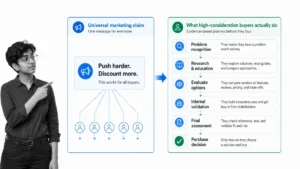
Traditional sales and marketing funnels are frequently built from an internal, company-centric viewpoint. Organizations map out the stages they wish the customer to traverse—such as Awareness, Consideration, Decision, and Retention—and build automated sequences, white papers, and demo calls to push the prospect downward. Skok’s presentation argued that this mechanical approach frequently fails because it ignores the internal dialogue, anxieties, and risk assessments occurring on the buyer’s side of the table.
Enterprise software purchases, in particular, are fraught with cognitive and professional risk for the buyer. When a mid-level manager or C-suite executive evaluates a new SaaS platform, they are not merely assessing feature sets and pricing tiers. They are evaluating career risk, implementation complexity, integration hurdles with legacy technology stacks, and internal political capital. If a software implementation fails, the champion who brought the tool into the organization often bears the professional consequences.
By examining the purchasing process through this empathetic lens, Skok outlined how marketing messages and sales interactions must actively neutralize these hidden anxieties.
Key Psychological Barriers in the Funnel:
- Status Quo Bias: Prospects often prefer the familiar inefficiencies of their current processes over the perceived uncertainty of adopting a new solution. Marketing collateral must effectively contrast the hidden costs of inaction against the clear benefits of change.
- Cognitive Overload: When websites or sales pitches feature overly complex jargon or endless feature lists, buyers experience decision fatigue. Simplifying the value narrative accelerates comprehension and moves prospects past initial hesitation.
- Trust Deficit: Particularly in the evaluation phase, buyers harbor skepticism regarding vendor claims. Social proof, transparent case studies, and peer validation act as psychological anchors that stabilize the buyer’s confidence.
Chronology of Funnel Optimization Methodologies
To understand the weight of Skok’s presentation, it is useful to examine the evolution of funnel optimization over the past two decades.
In the early days of cloud software, customer acquisition was heavily reliant on high-touch enterprise sales reps engaging in protracted, relationship-driven cycles. As the market matured in the 2010s, the widespread adoption of marketing automation platforms—such as HubSpot, Marketo, and Pardot—allowed companies to scale lead generation through inbound marketing, content creation, and email nurturing sequences.
By the late 2010s and early 2020s, the market experienced a proliferation of point solutions aimed at CRO, A/B testing, and intent data tracking. Tools like Clearbit, Gong, and Optimizely enabled data-driven teams to track user behavior with surgical precision. However, Skok noted that while telemetry and analytics improved dramatically, many organizations suffered from "data richness and insight poverty." They knew where users were dropping off in the funnel, but they failed to understand why those drop-offs were happening at a human level.
Skok’s framework bridges this gap by marrying quantitative pipeline analytics with qualitative buyer psychology. By analyzing drop-off points alongside customer interviews and usability sessions, companies can diagnose the underlying emotional and cognitive disconnects causing pipeline leakage.
Quantitative Impact and Industry Reactions
While proprietary internal metrics vary across the portfolio companies advised by industry experts, case studies presented at forums like SaaStock consistently demonstrate the power of buyer-centric funnel redesign. According to aggregated benchmarks from B2B SaaS advisory groups, optimizing top-of-funnel messaging and reducing mid-funnel friction can yield compound improvements across the entire revenue engine.
For instance, a minor 15% improvement in conversion from the Marketing Qualified Lead (MQL) to the Sales Qualified Lead (SQL) stage, combined with a corresponding lift in trial-to-paid conversion rates, can easily translate into a 30% to 50% increase in annual recurring revenue (ARR) growth without adding a single dollar to the customer acquisition budget.
Industry reactions to Skok’s methodologies have been overwhelmingly positive, particularly among founders navigating the complex transition from early-stage product-market fit to scale-up efficiency.
"Too many technical founders fall in love with their product architecture rather than the customer’s problem," noted a prominent venture capital investor attending SaaStock. "David’s framework acts as an essential corrective. It reminds us that software isn’t bought because of how brilliant the code is; it’s bought because the buyer feels understood, safe, and convinced that their business will materially improve."
Sales leaders have similarly praised the emphasis on aligning sales enablement with the buyer’s internal risk calculus. By training sales teams to address unstated objections proactively—such as security compliance, migration timelines, and change management overhead—sales cycles shorten significantly, and win rates climb.
Broader Implications and Strategic Takeaways for SaaS Leaders
The implications of adopting a psychology-driven funnel strategy extend far beyond immediate conversion rate improvements. As artificial intelligence and automation increasingly commoditize basic content creation and lead generation, human empathy and deep customer understanding become the ultimate differentiators in enterprise software markets.
When companies invest time in mapping the buyer’s psychological journey, the benefits permeate every department:
- Product Development: Feedback loops from sales objections inform product roadmaps, ensuring that new features directly address the anxieties that stall deals.
- Customer Success: Onboarding programs designed with the buyer’s initial psychological hurdles in mind experience lower early churn and faster time-to-value.
- Marketing Messaging: Copywriting shifts away from self-referential product feature lists toward outcome-oriented narratives that validate the buyer’s professional ambitions and operational challenges.
For executives seeking to implement these insights within their own organizations, industry experts recommend a systematic audit of existing pipeline touchpoints. By reviewing lost-deal analyses, conducting qualitative interviews with recent buyers, and evaluating website user journeys through the lens of cognitive load and risk mitigation, SaaS companies can uncover the hidden bottlenecks restricting their growth.
As the software sector continues to mature and compete for increasingly discerning buyers, the enterprises that master the intersection of data analytics and human psychology will secure a decisive, sustainable advantage in the marketplace.