Sales Rep Annual Quotas in 2026: What High Performers Are Actually Carrying: $750k for SMB, $1.35m for Mid-Market, $2.25m for Enterprise

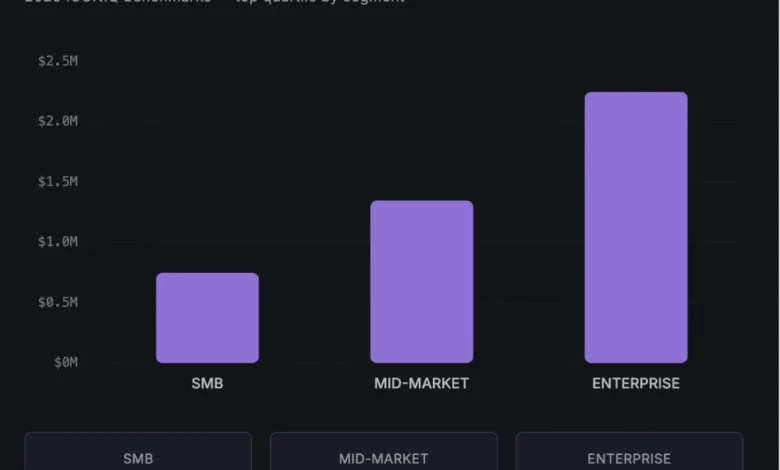
A comprehensive new report released by ICONIQ, a prominent growth-stage investor in B2B and AI software companies, indicates that despite the pervasive integration of artificial intelligence, fundamental sales quotas and operational processes within these high-growth organizations have remained remarkably consistent with the pre-AI era. However, the report, based on a survey of over 150 GTM executives, highlights significant "ramping up" in specific areas, particularly concerning cross-selling, customer expansion, and sales compensation structures. The findings suggest that while AI is augmenting sales capabilities, the core framework of how sales teams are structured and incentivized is undergoing a more nuanced evolution, driven by the need to maximize revenue from existing customer bases and attract top sales talent.
The ICONIQ 2026 GTM Benchmark Report draws its data from a survey conducted among GTM (Go-To-Market) executives at more than 150 B2B and AI software companies. These companies represent a spectrum from early-stage startups to late-stage enterprises, with the survey sample size ranging from approximately 143 to 149 respondents depending on the specific question. Given ICONIQ’s investment focus on the growth stage across a broad array of leading B2B and AI firms, the benchmarks presented are skewed towards top-tier performers. As such, the report is intended to serve as a guide to the practices of fast-growing, well-funded startups that have achieved significant product-market fit. This context is crucial for understanding the implications of the report’s findings, as it suggests these are not aspirational goals but rather the current operational realities of highly successful companies.
One of the most striking observations from the ICONIQ report is the persistent reliance on traditional sales quota structures. While AI tools are increasingly being deployed to enhance lead generation, qualification, and customer engagement, the underlying targets for sales representatives and the processes by which these targets are set have not seen a dramatic overhaul. This suggests a degree of inertia or a careful, evolutionary approach to integrating AI into established sales methodologies. The report explicitly states that overall sales quotas and processes remain similar to the pre-AI era, with the primary adjustment being an increase in the intensity and scope of these existing frameworks.
The Evolving Landscape of Sales Operations in the AI Era
The report’s findings challenge a common assumption that the widespread adoption of AI would necessitate a complete reinvention of sales operations. Instead, ICONIQ’s data points to a more incremental adaptation, where AI acts as an accelerant and enhancer rather than a disruptive force to foundational sales principles. This perspective is further supported by the observation that the underlying economics of sales compensation, specifically the ratio of sales representative compensation to closed revenue, has not materially changed. The report notes that paying reps, in total, approximately 20% of what they close in base and bonus remains a consistent practice. However, the how of selling and the what of quotas have indeed been adjusted.
The survey data reveals several key areas where GTM strategies are evolving, even if the core quota structures appear familiar. These shifts are indicative of a strategic reorientation aimed at maximizing revenue per customer and optimizing sales team performance in a competitive market.
1. Cross-Sell and Upsell Initiatives Gain Prominence
A significant trend identified in the ICONIQ report is the increased ownership of cross-selling and upselling activities by sales teams. The data indicates that 65% of high-performing companies have their sales departments actively managing cross-sell initiatives, a notable increase compared to 49% of other companies. Similarly, 55% of top performers empower their sales teams to handle upsell opportunities, versus 44% of their counterparts. Furthermore, the responsibility for managing renewals has also shifted, with 37% of high-performing companies assigning this to sales, compared to 24% of others.
This elevated focus on expanding revenue from existing customers suggests a strategic imperative to deepen customer relationships and extract greater lifetime value. In an era where customer acquisition costs can be substantial, maximizing revenue from loyal clients becomes a critical growth lever. The integration of AI tools in customer success and account management may be facilitating this shift, providing sales teams with better insights into customer needs and opportunities for expansion. The report implies that top-tier companies are leveraging their sales forces more effectively to nurture and grow their customer base, rather than solely focusing on new logo acquisition.
2. Elevated Attainment Rates Among Leading B2B/AI Companies
Contrary to the general expectation that higher quotas often lead to lower attainment rates, ICONIQ’s data reveals a different picture for leading B2B and AI companies. In a traditional B2B sales organization, it is common for approximately 65% to 75% of sales representatives to achieve their quota. However, the report highlights that cutting-edge B2B and B2B + AI companies are now achieving attainment rates of 85% to 90%. This suggests that these organizations are not only setting more ambitious targets but are also equipping their sales teams with the tools and strategies to meet them consistently.
This phenomenon can be attributed to several factors. The increased efficiency and effectiveness brought about by AI-powered sales tools likely play a significant role. These tools can automate mundane tasks, provide real-time insights, and improve the quality of leads and customer interactions, thereby enabling reps to be more productive. The report posits that for top AI leaders, higher quotas are currently correlating with higher attainment, a trend that signifies a powerful combination of aggressive growth targets and enhanced operational capacity. This is not merely a matter of setting unrealistic goals; rather, it reflects an improved ability to support and enable sales success.
The implication here is that the "ceiling" for sales performance may be rising due to technological advancements. Companies that effectively integrate AI into their sales workflows are not only capable of setting higher quotas but are also enabling their teams to surpass them more frequently. This creates a virtuous cycle of performance and motivation, which is crucial for sustained growth.
3. Compensation Structures Realign with Customer Expansion
A notable shift in sales compensation strategies is evident, with a growing emphasis on rewarding customer expansion. The report indicates that as Account Executives (AEs) increasingly take on more responsibility for the entire customer lifecycle, compensation plans are following suit. Companies that are still operating with compensation structures heavily weighted towards new business (e.g., 80% new business / 20% expansion) are falling out of step with the practices of leading organizations.
The data suggests that top-performing reps, particularly those capable of carrying $2 million or more in quotas, expect substantial compensation for driving expansion revenue. They are likely to seek out companies that offer competitive incentives in this area, leading to potential attrition for organizations that fail to adapt. This indicates a market where talent acquisition and retention are increasingly influenced by the alignment of compensation with evolving sales responsibilities.
The report highlights a "gap" between the compensation plans of many founders and the current best practices. While the underlying economics of sales commissions may remain consistent, the allocation of these commissions between new business acquisition and customer expansion is a critical differentiator. Companies that are able to offer attractive expansion commissions are better positioned to incentivize their AEs to focus on growing existing accounts, which is often a more profitable and sustainable growth strategy than solely relying on new customer acquisition. This strategic realignment of compensation is a direct response to the increasing importance of customer lifetime value.
4. AI-Driven Pipeline Generation as the True Quota Enabler
The ICONIQ report underscores a fundamental principle of sales: a quota is only as effective as the pipeline that supports it. The report argues that AI’s most significant impact on sales quotas is through its ability to generate a more robust and qualified pipeline. Companies that have successfully embedded AI into their marketing and Sales Development Representative (SDR) processes are observing substantial improvements in conversion rates. Specifically, these organizations are experiencing 10-11 percentage points higher lead-to-Marketing Qualified Lead (MQL) conversion and an 8 percentage point increase in MQL-to-Sales Qualified Lead (SQL) conversion.
This increased efficiency in pipeline generation is what enables companies to raise quotas without experiencing a significant drop in attainment. The report frames this not as a punitive measure for sales reps but as an expansion of their "capacity." When the pipeline is demonstrably stronger and more qualified, sales representatives are better equipped to handle larger targets. Conversely, if pipeline generation does not keep pace with quota increases, sales attainment will inevitably suffer, leading to frustration and potential turnover within the sales team.
The analysis suggests that AI’s role in sales is not just about automating tasks but about fundamentally improving the quality and quantity of opportunities that sales teams work with. This enhanced pipeline capacity is the bedrock upon which higher quotas can be built and achieved. The report implies that companies that fail to invest in AI-driven pipeline generation will find it increasingly difficult to set and achieve ambitious sales targets in the evolving B2B and AI landscape.
The 2026 Baseline for Sales Quotas and Operations
For organizations in the process of building their first dedicated sales force or re-evaluating their existing quota structures for 2026, ICONIQ provides a clear benchmark. The report suggests that an enterprise AE quota of $1.5 million may be leaving as much as 30% of potential revenue on the table. This indicates a significant opportunity for growth by increasing sales targets.
However, the report also issues a cautionary note: a rapid increase in quotas to, for example, $2.5 million without the commensurate pipeline generation and compensation structures to support such targets, is likely to result in a spike in attrition. The success of higher quotas is contingent upon a holistic approach that includes robust pipeline management, effective sales enablement, and a compensation plan that adequately rewards performance at these elevated levels.
The widening gap between high-performing sales organizations and others is no longer attributed to strategic differences in market approach but rather to the granular details of quota setting, pipeline generation capabilities, and the architecture of compensation plans. This emphasizes the importance of operational excellence and the strategic deployment of resources, including AI, to optimize sales performance.
The report’s findings have significant implications for the future of sales in the B2B and AI software sectors. As AI continues to mature and become more deeply integrated into business processes, sales organizations will need to remain agile and adapt their strategies accordingly. The data from ICONIQ’s 2026 GTM Benchmark Report serves as a critical guide for companies looking to navigate this evolving landscape and position themselves for sustained growth and market leadership. The emphasis on cross-selling, customer expansion, and AI-driven pipeline optimization suggests a move towards a more customer-centric and efficient sales model, where technology and human expertise work in tandem to unlock new levels of performance.