
In the modern digital landscape, marketers are frequently overwhelmed by a fragmented ecosystem of hundreds of platforms and thousands of potential tactics. This “channel fatigue” often leads to a diluted strategy where teams spread their resources too thin, losing the clarity required to drive meaningful business outcomes. To overcome this, high-growth companies are returning to the foundational mechanics of online business: the mathematical relationship between web traffic and conversion rates. At its core, the growth equation is binary: New Signups equal total Traffic multiplied by the Conversion Rate. By systematically categorizing every marketing channel, landing page, and piece of content against these two variables, businesses can transform their growth strategy from a collection of guesses into a repeatable, scientific process.
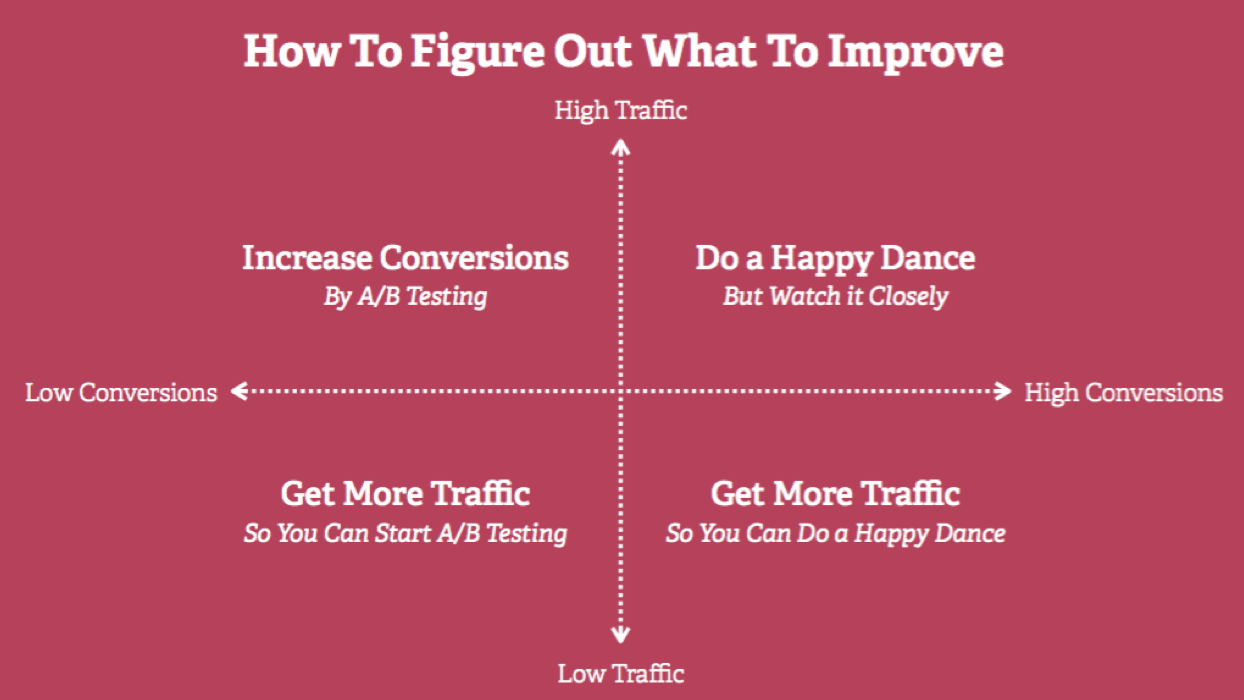
The Anatomy of the Conversion Map
The conversion map serves as a diagnostic tool that segments marketing assets into four distinct quadrants, each requiring a specific tactical intervention. This framework moves beyond vanity metrics—such as social media shares or raw impressions—to focus on the levers that directly impact revenue. By plotting marketing initiatives on a two-axis grid where the Y-axis represents conversion rates and the X-axis represents traffic volume, organizations can identify where they are wasting capital and where they are missing low-hanging fruit.
The methodology is predicated on a logical, chronological prioritization of tasks. Instead of chasing new, unproven channels, the framework dictates that organizations should first stabilize their current assets. By auditing existing content and landing pages, businesses can determine whether their problem is a lack of exposure (low traffic) or a failure to resonate with the audience (low conversion).

Prioritizing Growth: The Four Quadrant Hierarchy
The most efficient path to growth involves addressing imbalances within the conversion map. The priority list for any marketing department should follow a strict order of operations to maximize ROI while minimizing the cost of acquisition.
- High Traffic, Low Conversion: This quadrant represents the most immediate opportunity for revenue growth. Because the traffic volume is already sufficient to provide statistical significance, these pages are prime candidates for rigorous A/B testing. Organizations can experiment with call-to-action (CTA) placement, copy refinement, and visual hierarchy to nudge visitors toward the signup stage.
- Low Traffic, High Conversion: These assets often consist of specialized, high-intent content or technical documentation. While they convert well, they suffer from limited reach. The objective here is scalability; businesses should look to amplify these pages through SEO, targeted outreach, or cross-linking from higher-traffic areas of the site to increase their exposure.
- Low Traffic, Low Conversion: This is the most challenging quadrant, often populated by legacy content or failed experiments. The focus here is not on optimization, but on reassessment. If a piece of content fails to attract visitors and fails to convert them, it should either be overhauled to match user intent or retired to allow the team to focus on higher-potential assets.
- High Traffic, High Conversion: These are the “cash cows” of a marketing strategy. They require only periodic maintenance to ensure that links are functional and the value proposition remains current. These assets provide the financial foundation that allows companies to fund riskier growth experiments in other areas.
Historical Context and Performance Data
The transition from broad, speculative marketing to this systematic framework has historical roots in the evolution of SaaS (Software as a Service) marketing. During the mid-2010s, firms like KISSmetrics demonstrated the efficacy of this approach by prioritizing content-driven acquisition over expensive paid search. Data from that era indicated that companies could reduce their customer acquisition cost (CAC) significantly by shifting focus toward owned organic content that converted at higher rates.

For example, by identifying high-performing content “islands,” companies were able to link these pieces together to form a broader “continent” of authority. This strategy proved that, while paid advertising offers immediate spikes in traffic, a long-term investment in content optimization provides a sustainable, compounding return on investment. Organizations that followed this trajectory reported that even during periods of traffic stagnation, their overall signup volume continued to climb due to improved conversion efficiency.
The Psychology of Intent and Audience Scaling
A critical nuance in the conversion map is the inverse relationship between traffic volume and conversion intent. As a website scales its reach from a niche audience of 100 visitors to a mass audience of 100,000, the conversion rate almost invariably experiences a decline. This is because the initial audience usually consists of “early adopters” or individuals with high, pre-existing intent. As the audience broadens, the incoming traffic becomes more generalized, requiring a shift in strategy.

When traffic scales, the focus must pivot from broad acquisition to conversion rate optimization (CRO). Using tools such as onsite surveys, heatmaps, and session recording, marketers can gain qualitative insights into why broader audiences are not converting. This transition—from growth-at-all-costs to a balanced model of acquisition and retention—is the hallmark of a mature marketing operation.
Broader Implications for Modern Marketing
The implications of this framework are significant for CMOs and startup founders alike. In an era where customer acquisition costs are rising across all major platforms, the ability to squeeze more value out of existing traffic is a competitive advantage.

Recent industry analysis suggests that the “Peak SaaS” era has forced a pivot from rapid, undisciplined expansion to unit-economic efficiency. Investors are increasingly looking at the LTV:CAC (Lifetime Value to Customer Acquisition Cost) ratio as the definitive measure of a company’s health. By adopting a structured approach to the conversion map, companies can stabilize their CAC, making them more resilient to shifts in the advertising market, such as changes in privacy laws or rising cost-per-click (CPC) rates on platforms like Google and Meta.
Furthermore, the discipline required to maintain this framework prevents the common pitfall of "shiny object syndrome," where teams abandon working strategies to chase unproven trends. By doubling down on what is already functioning—leveraging data to inform each decision—marketers can create a predictable pipeline of growth that supports long-term valuation.

Ultimately, the conversion map is not just a tactical guide; it is a philosophy of rigor. It demands that marketing departments operate with the same analytical precision as engineering or finance teams. By treating every landing page as a testable hypothesis and every visitor as a data point in a broader growth equation, organizations can move away from the volatility of guesswork and toward a systematic, repeatable model of success. Whether a business is in its early stages or scaling toward an enterprise model, the path to growth remains the same: identify the bottleneck, optimize the conversion, and sustain the traffic.