The Evolution of Venture Capital in 2026: Why $25 Billion Has Replaced the Unicorn as the New Benchmark for Mega-Funds

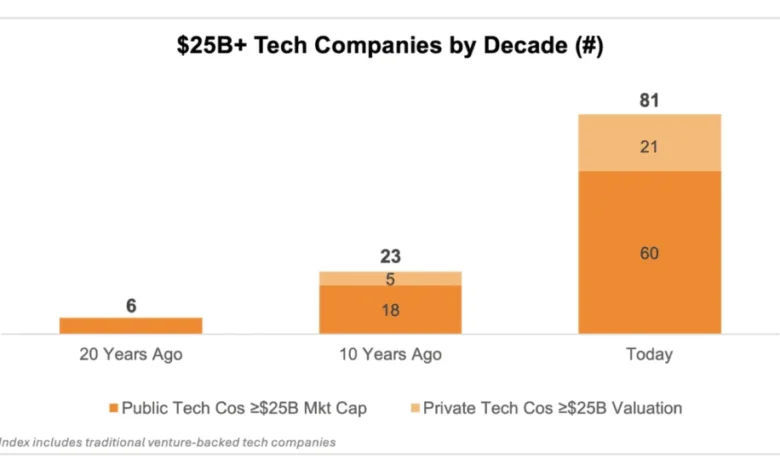
The venture capital ecosystem is undergoing a fundamental structural transformation, moving past the era of the traditional $1 billion "unicorn" toward an elite tier of enterprise valuations exceeding $25 billion. This shift, highlighted by recent industry data and strategic realignments among top-tier venture firms, reflects a changing landscape where massive fund sizes necessitate exponentially larger liquidity events to deliver target returns to institutional limited partners.
The Shift from Unicorns to Decacorns and Beyond
Over the past decade, venture capital metrics have shifted dramatically. A decade ago, investors scoured the market for unicorns—startups valued at $1 billion or more. Coined in 2013 to describe a statistical rarity, the term has since become obsolete due to sheer volume, with more than 1,300 companies now holding unicorn status globally.
As the supply of billion-dollar startups expanded, venture capitalists adjusted their sights toward decacorns and, increasingly, enterprises valued north of $25 billion. Data from PitchBook indicates that the number of active United States decacorns reached 63 by mid-2026, up significantly from 53 the previous year and just 26 in 2021. Furthermore, 19 new companies crossed the $10 billion valuation threshold in the first half of 2026 alone, already eclipsing the full-year total of 18 recorded in 2025. Mega-deals exceeding $100 million accounted for an overwhelming 87.5% of the $412.7 billion invested during the first half of the year.
This concentration of capital has fundamentally altered how private companies mature. Historically, achieving a $25 billion valuation required a public market listing. Today, a growing cohort of private entities commands this level of capitalization before ever holding an initial public offering, keeping the compounding phase of their growth entirely within private markets.
Recent Market Milestones and Accelerated Valuations
The rapid pace at which artificial intelligence and hyper-growth technology companies scale has compressed multi-year corporate lifecycles into mere quarters. Two prominent milestones in the second half of 2026 underscore this phenomenon.
On August 14, SpaceX completed an all-stock acquisition of Anysphere, the developer of AI coding assistant Cursor, in a deal valued at $60 billion. Confirmed via regulatory filings, the transaction stands as the largest acquisition of a venture-backed startup on record. Cursor had achieved a valuation of $2.5 billion at the start of 2025, scaling to $29.3 billion during its Series D round in November of that year, before exiting at roughly 15 times its annualized revenue of approximately $4 billion, just four years after its founding.
Weeks later, on September 8, AI development firm Cognition announced a Series E funding round exceeding $2 billion at a $48 billion valuation. Led by prominent institutional investors including Andreessen Horowitz, Accel, Founders Fund, General Catalyst, and Avenir, the round followed a May financing event that valued the company at $26 billion on a $492 million revenue run rate. With run-rate revenue rapidly approaching $900 million, Cognition’s valuation nearly doubled in little more than three months.
These velocity metrics have established a new baseline for early-stage underwriting. When venture partners evaluate Series A opportunities, their financial models are increasingly anchored to the possibility of hyper-scaling outcomes, making traditional mid-tier trajectories less viable for large-scale funds.

The Arithmetic of Multi-Billion-Dollar Funds
The push toward $25 billion-plus outcomes is driven primarily by the mathematics of modern fund construction. Major venture capital institutions are raising larger pools of capital than ever before—exemplified by Menlo Ventures closing $3 billion in new capital in June for its largest fund in the firm’s 50-year history.
To achieve a standard 3x net return on a $3 billion fund, an institution must generate approximately $9 billion to $10 billion in gross proceeds. However, institutional ownership stakes decline significantly as companies mature through successive financing rounds. According to market data from Carta, the median founding team’s equity ownership drops from 56% at the seed stage to 36% following the Series A, and down to roughly 16% by the Series C. Early investors experience similar dilution unless they execute pro-rata rights in every subsequent round. For early-stage leads defending their positions, holding an 8% to 12% stake at the point of exit is a common scenario.
Under these parameters, achieving a $2.5 billion return on a single investment requires a 10% ownership stake in a $25 billion enterprise. A $3 billion fund would need four such outcomes over a ten-year lifecycle to hit its return targets. By contrast, a traditional $1 billion exit yielding a 10% stake returns $100 million—moving the needle only marginally for a multi-billion-dollar fund. Consequently, the threshold for meaningful liquidity has shifted upward, forcing growth funds to target massive valuation multiples at entry or rely on continued hyper-growth post-investment.
Implications for Founders and Early-Stage Fundraising
For entrepreneurs seeking venture backing, this mathematical reality alters the dynamics of the pitch meeting. Institutional investors are no longer simply assessing whether a business model is viable; they are evaluating whether the addressable market and execution velocity can support a decacorn-scale ceiling.
A credible path to a multi-billion-dollar outcome now outweighs a high-probability path to a $500 million acquisition. Companies that cannot realistically scale to meet these return profiles face a mismatch with large institutional funds. While a $300 million or $500 million exit represents a life-changing outcome for founders and a solid return for smaller seed funds, it registers negligibly for funds managing capital pools in the billions.
Industry experts note that founders whose realistic business ceilings fall below the decacorn threshold may find better alignment with smaller venture funds, micro-VCs, or bootstrapped operational models. Smaller funds, such as solo general practitioner funds capitalized at $60 million, can achieve strong returns from $500 million or $2 billion exits without requiring portfolio companies to reach outlier status.
Outlook and Future Market Trends
As the venture capital industry adapts to the realities of 2026, the division between mega-funds targeting outlier returns and smaller funds pursuing focused exits is expected to widen. The number of private companies valued at $25 billion or more—currently standing at over 20—is projected to grow as private markets retain liquidity-generating assets for longer periods.
Ultimately, the transformation of the venture landscape underscores a permanent recalibration of risk, reward, and valuation. As artificial intelligence and software automation continue to compress the timeline from inception to market dominance, the metrics governing venture capital will remain anchored to the upper tail of the economic distribution.