Demystifying Startup Signaling: New Data Shows VC Seed Round Myths Fall Flat in Today’s Competitive Market


The modern venture capital ecosystem is built upon a towering labyrinth of unwritten rules, conventional wisdom, and intricate theories regarding market signals. Among the most pervasive and debated doctrines is the notion of the seed-to-Series-A signaling risk. For years, founders navigating the treacherous waters of early-stage fundraising have been cautioned by advisors, incubators, and veteran entrepreneurs to exercise extreme caution when accepting capital from institutional venture capital firms during their seed rounds. The prevailing narrative suggests that bringing a formal venture firm on board too early could inadvertently poison the well for subsequent financing, scaring away rival firms who might assume the incumbent insider holds an insurmountable informational and structural advantage.
According to this theoretical framework, competing investors see little upside in entering a game they perceive as rigged or already decided. Conversely, venture capitalists are routinely advised to bypass startups already backed by rival firms, operating under the assumption that if a company is truly exceptional, the insider will preempt the Series A round, while a flawed startup should be avoided entirely to escape the embarrassment of misjudging a competitor’s troubled asset. Yet, a comprehensive empirical analysis conducted by venture capital firm Matrix challenges these long-held assumptions, revealing that the actual market operates with far more pragmatism, efficiency, and disregard for purported palace intrigue than conventional startup folklore would suggest.
Examining the Reality of Series A Funding Dynamics
To determine whether market participants actually adhere to these complex signaling theories or simply focus on identifying strong business fundamentals, researchers at Matrix analyzed a curated dataset of Series A transactions completed throughout 2018. The objective was to strip away the theoretical anxieties plaguing boardrooms and evaluate how top-tier venture capital firms genuinely behave when evaluating early-stage companies with existing institutional seed backing.
Focusing the scope on investments led by the top 30 venture capital firms—defined objectively by the researchers to maintain analytical consistency—the study evaluated a robust sample of companies across the United States, with specific localized deep dives into the hyper-competitive ecosystems of the San Francisco Bay Area, as well as the combined New York and Boston metropolitan markets. By examining the seed histories of these successful Series A recipients, the researchers sought to measure the real-world impact of institutional seed investment on subsequent funding rounds.
The findings decisively dismantle the myth of adverse signaling. Rather than shunning companies backed by rival institutions, the modern venture capital market demonstrates a strong appetite for these assets, prioritizing empirical business performance and entrepreneurial potential over speculative signaling concerns.

Detailed Breakdown of Regional Data and Insights
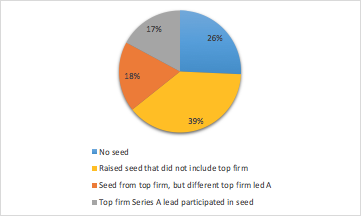
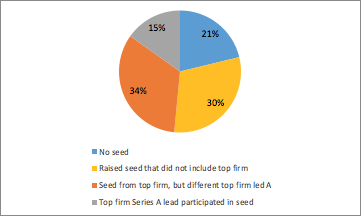
The empirical data gathered by the Matrix team offers a striking counter-narrative to traditional startup advisory dogma. Across the broader United States dataset, companies that successfully secured a Series A investment from a top-tier firm fell into distinct categories regarding their seed-stage history. Crucially, every single company analyzed in the dataset successfully achieved a Series A round led by a premier institution, providing a clear window into the behaviors of leading investors.
If the conventional theory holding that venture capitalists actively avoid companies backed by rival seed investors were true, a specific segment of the data—representing companies that raised a seed from a top firm and subsequently raised a Series A from a different top firm—would be virtually nonexistent. However, the data reveals the exact opposite. This cohort accounts for approximately one-third of all analyzed Series A rounds in the San Francisco Bay Area, roughly one-fifth of the nationwide dataset, and approximately nine percent in the Boston and New York corridors.
In the fiercely competitive Bay Area market, high-quality companies that included a prominent venture firm in their seed round were actually twice as likely to have their Series A round led by a different top-tier firm that did not participate in the seed stage, compared to companies that bypassed institutional seed investors entirely. This empirical reality thoroughly invalidates the fear that early institutional backing creates a toxic signal that repels subsequent tier-one capital.
Furthermore, the data indicates that savvy entrepreneurs are systematically ignoring the advice to exclude institutional venture firms from their seed caps tables. More than a third of the companies in the national dataset—and roughly half of those that raised a formal seed round at all—opted to include a top-tier venture firm in their initial financing. In the Bay Area, this trend was even more pronounced, with approximately half of all high-quality companies, and 62 percent of those executing a formal seed round, partnering with a premier firm from day one. These figures likely understate the true participation rate when accounting for scout funds, seed-stage vehicles, and affiliated investment arms.
The rarity of the so-called "high school sweetheart" scenario—where a startup raises its seed and Series A rounds from the exact same venture firm—further highlights the fluidity of the market. Across the dataset, fewer than one in five startups maintained an exclusive relationship with their initial seed investor for their Series A financing. The vast majority of founders continue to shop the market, evaluate alternative partners, and make decisions based on strategic alignment rather than misplaced loyalty.
Background Context: The Evolution of Seed Investing
To fully understand the significance of these findings, it is necessary to examine how the early-stage venture capital landscape has transformed over the past two decades. Historically, the boundary between seed capital and Series A financing was starkly defined. Seed rounds were predominantly small, localized affairs funded by angel investors, friends and family, and micro-VCs writing modest checks. Series A rounds represented the true institutional gateway, typically managed by traditional venture capital partnerships.
However, as the technology sector boomed in the 2010s, traditional venture firms began moving downstream, establishing dedicated seed funds, scout programs, and multi-stage investment strategies designed to capture promising companies at their inception. This shift blurred traditional lines and sparked intense debate within the startup community. Critics argued that institutionalizing the seed stage would create conflicts of interest, distort valuations, and introduce harmful signaling dynamics that could trap founders or freeze out competing investors.
Conversely, proponents of institutional seed investing argued that early involvement by experienced venture partners provides startups with invaluable operational support, governance infrastructure, and network access that significantly enhances their probability of survival and long-term growth. The Matrix study provides empirical validation for the latter perspective, suggesting that the maturation of the seed market has created a more integrated ecosystem where institutional backing is viewed as a stamp of validation rather than a red flag.
Industry Reactions and Expert Perspectives
The publication of the Matrix findings has generated widespread discussion across venture capital forums, executive suites, and entrepreneurial networks. Industry observers note that the data aligns with the daily operational realities of modern investing, where velocity, competition, and deal flow frequently supersede theoretical risk models.
Prominent angel investors and early-stage founders have largely welcomed the study, arguing that it brings much-needed data to a domain historically dominated by anecdotal advice and gatekeeper folklore. Many founders have expressed relief, noting that the pressure to orchestrate a clean cap table free of institutional seed funds often created artificial constraints during their earliest and most vulnerable fundraising phases.
At the same time, veteran venture capitalists have pointed out important nuances within the data. While the study demonstrates that top-tier firms routinely invest in companies backed by rival seed investors, analysts emphasize that quality remains the ultimate arbiter. Startups exhibiting exceptional traction, robust revenue growth, and massive market potential will invariably attract competitive interest, rendering nuanced signaling theories largely irrelevant. Conversely, underperforming startups will struggle to raise subsequent capital regardless of who participated in their seed round.
Broader Implications for Entrepreneurs and Investors
The implications of this empirical research extend far beyond academic debates over venture capital theory, offering actionable insights for both founders currently raising capital and investors deploying deployment strategies.
For entrepreneurs, the primary takeaway is the freedom to optimize for partnership quality, strategic value, and capital availability rather than engineering their cap tables around speculative signaling fears. Founders are encouraged to seek out the best possible investors at every stage of their company’s lifecycle. Whether an institutional seed fund or a prominent venture firm adds value to the business, entrepreneurs can proceed with confidence that subsequent tier-one investors will evaluate the enterprise based on its underlying business metrics, product-market fit, and commercial traction rather than outdated institutional biases.
For venture capitalists, the study serves as a reminder to maintain rigorous, data-driven evaluation processes rather than relying on lazy heuristics or avoiding opportunities due to perceived political dynamics within the syndicate ecosystem. As the venture capital market grows increasingly competitive and globalized, firms that cling to insular dogmas risk missing out on exceptional proprietary deal flow.
Conclusion: A More Efficient Market
Ultimately, the Matrix analysis demonstrates that the contemporary venture capital market is considerably more rational, efficient, and pragmatic than conventional wisdom suggests. While pundits and advisors will undoubtedly continue to debate the finer points of cap table architecture and signaling mechanics, the empirical evidence confirms that top-tier investors and ambitious entrepreneurs are primarily focused on building enduring, high-value enterprises. In an environment defined by high velocity and intense competition, sound business fundamentals consistently outweigh theoretical court intrigue.
Related posts: