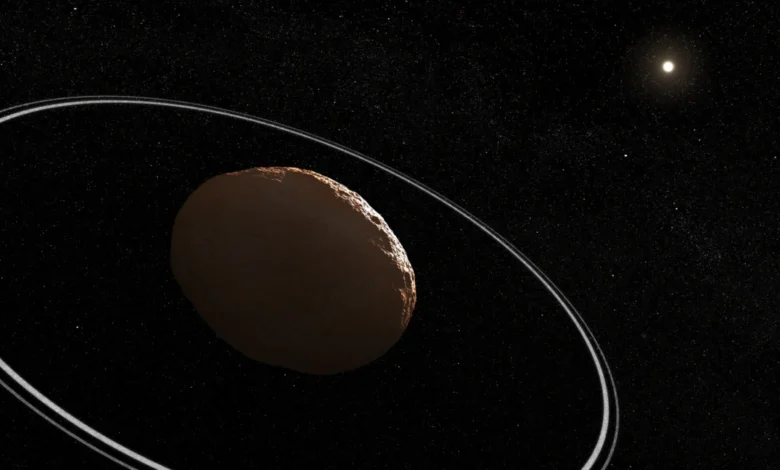
For decades, the scientific community operated under the assumption that ring systems were the exclusive domain of the solar system’s gas giants. Jupiter, Saturn, Uranus, and Neptune—the massive, hulking worlds of the outer solar system—were believed to be the only bodies capable of retaining the complex, orbiting debris fields that constitute rings. This long-standing paradigm was shattered in 2013 when researchers observed an occultation event involving Chariklo, a minor body roughly 250 kilometers in diameter. As Chariklo passed in front of a distant star, the light did not simply blink out once; it flickered in a pattern that revealed the presence of two distinct, narrow rings.
This discovery fundamentally altered our understanding of celestial mechanics, proving that even small, dark bodies—specifically Centaurs, which orbit between Saturn and Uranus—can possess the gravitational stability required to host ring systems. Recent observations conducted by the James Webb Space Telescope (JWST) have now provided evidence that these rings are not static relics but dynamic, evolving structures. Data from an October 2022 occultation indicates that one of Chariklo’s rings has grown significantly denser, while the other has faded to near-invisibility. This dramatic shift suggests that the lifecycle of these rings is far more volatile and active than previously hypothesized.
A Chronology of Discovery
The study of Chariklo has been a decade-long exercise in precision astronomy. Following the 2013 discovery, astronomers identified two specific rings, designated C1R and C2R. These rings were measured at 390 and 405 kilometers from the center of the body, respectively, separated by a narrow gap of only seven kilometers. For years, ground-based telescopes provided the primary data for studying these features, but their resolution was limited by the obscuring veil of Earth’s atmosphere.
The ambition to use the James Webb Space Telescope for this purpose represented a significant technological leap. Unlike ground-based instruments, JWST operates from the L2 Lagrange point, a location that offers a clear, unobstructed view of the cosmos. However, this position introduces extreme logistical complexities. To track a minor body like Chariklo, scientists must predict its path across a star with pinpoint accuracy. The process is a "tricky task," according to Pablo Santos-Sanz of the Instituto de Astrofísica de Andalucía.
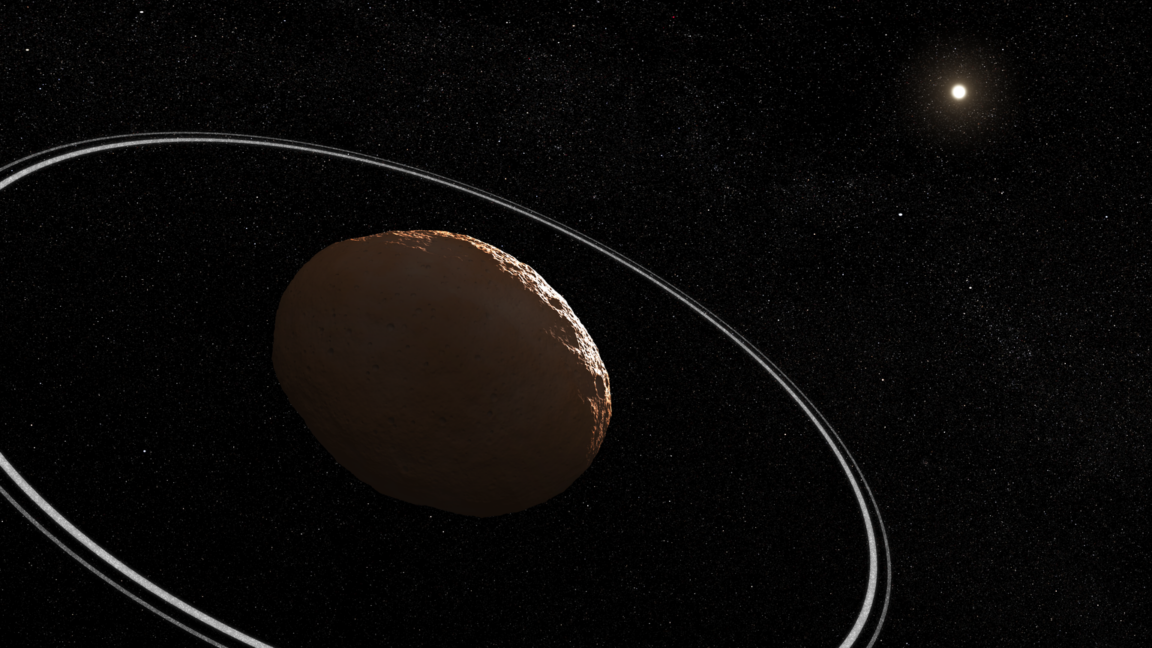
In August 2022, the research team began refining their predictions for an upcoming occultation. The challenge was compounded by the fact that JWST requires observation requests to be finalized 14 days in advance. Between the initial calculation and the final flight plan, the projected line of sight shifted by approximately 110 kilometers. The team was forced to navigate this uncertainty with little room for error. Ultimately, the observation on October 18, 2022, was a success. The telescope’s sightline passed just 7.4 kilometers above the surface of Chariklo, successfully capturing the rings while avoiding the main body itself.
The Physics of Flux: Analyzing the Data
The JWST data provided a unprecedented look at the rings, capturing them in two near-infrared bands: 1.5 and 3.2 micrometers. This was the first time a minor body’s ring system had been observed beyond the three-micrometer threshold. The results were startling. The inner ring, C1R, exhibited a marked increase in opacity. While the average opacity recorded by ground-based telescopes over the previous decade sat at approximately 0.303, the JWST data measured it at 0.431.
Initial skepticism among the research team led to rigorous validation efforts. Concerned that the higher opacity might be a result of "clumping" within the ring—where the telescope happened to pass through a particularly dense region—the team developed a comprehensive computer model. They simulated 10 million occultations, accounting for various levels of ring density and distribution. The probability that the observed density was a result of random chance was calculated at approximately 1 in 1,000 for the 1.5-micrometer band and 4 in 100,000 for the 3.2-micrometer band. These figures strongly suggest that the increase in density is a physical reality rather than a geometric anomaly.
Conversely, the outer ring, C2R, displayed a reverse trajectory. It was nearly undetectable at 1.5 micrometers and vanished entirely at 3.2 micrometers. This simultaneous thickening of one ring and fading of another suggests a transfer of material or an underlying mechanism that has yet to be fully defined. Radiative transfer models indicate that the shift is not merely a byproduct of how light interacts with different grain sizes, but rather a structural evolution of the ring system itself.
Theoretical Frameworks and the "Ghost Moon"
The question remains: what mechanism is responsible for this rapid evolution? One prominent hypothesis involves the presence of a "shepherd moon." In larger planetary systems, shepherd satellites act as gravitational anchors, maintaining the sharp edges and stability of rings by containing the debris through orbital resonance. If a small, as-yet-undetected satellite exists in an orbit near or within Chariklo’s rings, it could be responsible for the observed redistribution of material.

Such a satellite could theoretically shed debris that accumulates in the inner ring, explaining its increased density, while simultaneously destabilizing the outer ring. This model aligns with the observed morphology of the rings, which remain notably sharp and well-defined. However, the researchers emphasize that this remains a working hypothesis. The composition of the rings also appears to differ; initial modeling suggests the inner ring is comprised of larger particles, while the outer ring is more characteristically "dusty." Further observations, ideally using visible light to complement the infrared data, are required to confirm the mineralogical composition and the presence of any secondary bodies.
Broader Scientific Implications
The volatility of Chariklo’s rings forces a reconsideration of the longevity of ring systems around small bodies. For years, scientists believed such structures would be transient, quickly dissipated by the lack of gravitational hold or lost to space. Instead, the evidence points to a system that is constantly being replenished or reorganized.
This finding is not an isolated curiosity. The discovery of rings around other minor bodies—including the dwarf planet Haumea, the object Chiron, and the trans-Neptunian object Quaoar—suggests that ring formation is a common phenomenon in the outer solar system. By comparing the behavior of these small-body rings to the long-term changes observed in the D ring of Saturn or the arcs of Neptune, astronomers can begin to build a unified theory of ring dynamics.
The implications for planetary science are profound. If minor bodies can sustain and modify complex ring systems, our understanding of the early solar system’s formation and the subsequent scattering of material must be updated. Every observation of Chariklo acts as a critical piece of a larger puzzle. As Santos-Sanz noted, while the current data is merely one step in a much longer investigation, it provides an essential clue for understanding how these celestial structures function across different scales.
Moving forward, the search for future occultation events remains a top priority. Each event provides a longitudinal data point that is vital for establishing the rate of change in these systems. By moving beyond the static images of the past and embracing the dynamic reality of these objects, the scientific community is entering a new era of understanding one of the most enigmatic features of the outer solar system. The study, published in Science Advances, serves as a testament to the power of modern instrumentation in peeling back the layers of our cosmic neighborhood, revealing that even the smallest bodies can host surprisingly complex and ever-changing environments.
Related posts: