XAI Grok 4.6 Launches on Amazon Bedrock to Advance Agentic AI and Complex Reasoning Capabilities

The release of xAI’s Grok 4.6 on Amazon Bedrock, effective August 18, 2026, marks a significant expansion in the available high-performance models for enterprise-grade generative AI applications. This integration provides developers with access to a frontier-level model specifically engineered to handle long-running autonomous agents, sophisticated coding tasks, and intensive knowledge work. With a robust 500K token context window and four distinct levels of configurable reasoning effort—ranging from low to xhigh—Grok 4.6 represents a strategic effort by xAI and Amazon Web Services (AWS) to capture the growing market for agentic workflows that require sustained logical coherence over extended periods.
The Evolution of the xAI-Amazon Partnership
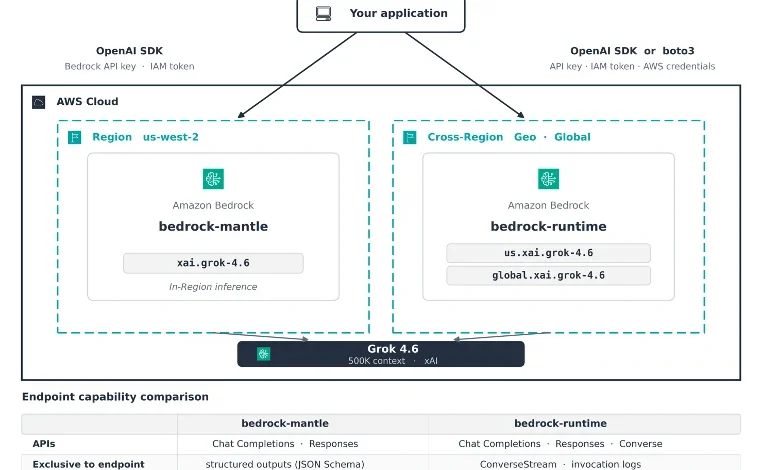
The inclusion of Grok 4.6 follows the earlier, successful deployment of Grok 4.3 on the Amazon Bedrock platform. While the 4.3 release served as the inaugural entry for xAI into the AWS ecosystem, it functioned primarily through the Bedrock Mantle inference engine. The arrival of Grok 4.6 signifies a deepening of this partnership, as the model now enjoys broader integration across both the bedrock-mantle and bedrock-runtime endpoints. This dual-endpoint support is a critical upgrade, as it enables developers to utilize the Converse API, streamlining the integration process by providing a unified message structure across diverse foundation models.
The chronology of this deployment began in mid-August 2026, following extensive testing cycles. By aligning its release with the requirements of enterprise infrastructure, xAI has positioned its model to compete directly with other state-of-the-art models within the Bedrock catalog. This move acknowledges that modern software development is shifting away from simple text-in/text-out interactions toward complex, multi-step agentic behaviors that require error-checking, self-correction, and modular design.
Technical Architecture and Model Capabilities
Grok 4.6 represents an iterative improvement over its predecessor, Grok 4.5. xAI’s technical documentation reveals that the model was subjected to a significantly longer supplemental training regimen. This phase utilized curated, model-generated data focused on advanced technical concepts and reasoning trajectories. By employing Grok 4.5 to regenerate supervised fine-tuning data across various domains—including STEM, kernel optimization, and web development—the engineering team was able to filter out low-quality traces, resulting in a more refined and capable model.
A notable feature of the architecture is the model’s increased tendency toward self-testing. In long-trajectory tasks, Grok 4.6 has demonstrated an inherent capacity to verify its own work, checking for logical inconsistencies before proceeding to subsequent steps. This behavioral trait is particularly valuable for developers building AI agents that manage codebases or perform complex research, where the cost of a hallucination or a logical error is high. Furthermore, the model has been optimized for visual and interactive projects, allowing it to establish the structural foundation of an application in a single, high-quality first pass.
Benchmarking Performance in the Agentic Era
To quantify the performance of Grok 4.6, xAI released data showcasing its capabilities across several industry-standard benchmarks as of August 12, 2026. The results for the "High" effort setting are compelling, particularly in the context of software engineering and agentic intelligence:
- AA Intelligence Index: 61
- GDPVal-AA v2: 1753
- CursorBench v3.2: 69.9%
- DeepSWE v1.1: 65.9%
- FrontierCode v1.1: 61.3%
- APEX-Agents: 57.5%
These figures, verified by third-party data from Artificial Analysis, provide a snapshot of the model’s proficiency. The Artificial Analysis Intelligence Index v4.1.1 is particularly relevant, as it aggregates nine separate evaluations covering reasoning, knowledge reliability, and quantitative analysis. The strong performance in benchmarks like DeepSWE (Deep Software Engineering) and CursorBench suggests that Grok 4.6 is specifically calibrated for the "coding-agent" use case, which is currently one of the most competitive and lucrative segments of the AI market.
Strategic Implementation and Operational Flexibility
The deployment of Grok 4.6 on Amazon Bedrock offers developers unprecedented operational flexibility through multiple access tiers and deployment modes. The introduction of the xhigh reasoning effort level, in particular, allows users to trade off compute-latency for depth of thought. When building agents, the ability to increase reasoning depth for planning stages while keeping it low for simple data extraction offers a granular level of control that can lead to significant cost savings.
The integration also addresses key enterprise concerns, such as security and data governance. Through the use of Amazon Bedrock Guardrails, developers can implement content filters, redact personally identifiable information (PII), and enforce topic restrictions directly at the inference layer. This is a vital feature for businesses that require AI agents to operate within strict compliance frameworks, such as healthcare or financial services, where the model may be processing sensitive user data.
Furthermore, the implementation of Cross-Region inference profiles—specifically us.xai.grok-4.6 and global.xai.grok-4.6—simplifies the management of data residency. Organizations can ensure that their data remains within specified geographic boundaries while still leveraging the high-availability infrastructure of AWS. This, combined with support for prompt caching, where repeated prefixes are billed at a fraction of the standard rate, indicates that AWS is positioning this model for high-volume, production-level workloads.
Industry Implications and Future Outlook
The availability of a model as advanced as Grok 4.6 within the Bedrock ecosystem underscores the industry’s move toward "AI-as-a-Utility." By reducing the friction required to deploy frontier models, Amazon and xAI are lowering the barrier to entry for companies looking to transition from experimental AI proofs-of-concept to robust, agent-based business processes.
The implications for the developer community are twofold. First, the standardization of the Converse API and OpenAI-compatible endpoints means that teams can experiment with Grok 4.6 alongside other foundation models with minimal code changes. This "model-agnostic" approach reduces vendor lock-in and encourages competition, as developers can swap models based on price, latency, or performance benchmarks. Second, the focus on "agentic workflows"—where the model is treated as a coworker rather than a chatbot—is set to accelerate the adoption of autonomous software development tools.
However, the shift toward higher reasoning efforts and more complex model interactions also brings new challenges. As models like Grok 4.6 become more autonomous, the need for robust auditing and observability tools—such as the invocation logging provided by CloudWatch—becomes essential. Enterprises must now account for "reasoning costs" as a distinct line item in their infrastructure budgets, a paradigm shift that requires new financial modeling and performance monitoring strategies.
Conclusion
Grok 4.6’s arrival on Amazon Bedrock is a significant milestone that highlights the maturation of generative AI from text-generation to complex reasoning and autonomous task execution. With its specialized training for STEM and engineering domains, coupled with the security and scalability of the AWS cloud, the model is well-positioned to become a cornerstone tool for developers building the next generation of AI agents. As organizations continue to integrate these systems into their core operations, the focus will likely shift from merely testing the limits of model intelligence to optimizing the reliability, safety, and economic efficiency of the agents themselves. The collaboration between xAI and AWS provides a reliable, secure, and flexible foundation for this evolution, setting a new benchmark for what can be achieved in the enterprise AI space.