The Spectral Dichotomy of Generative AI Post-Training: SFT versus RLVR Mechanics

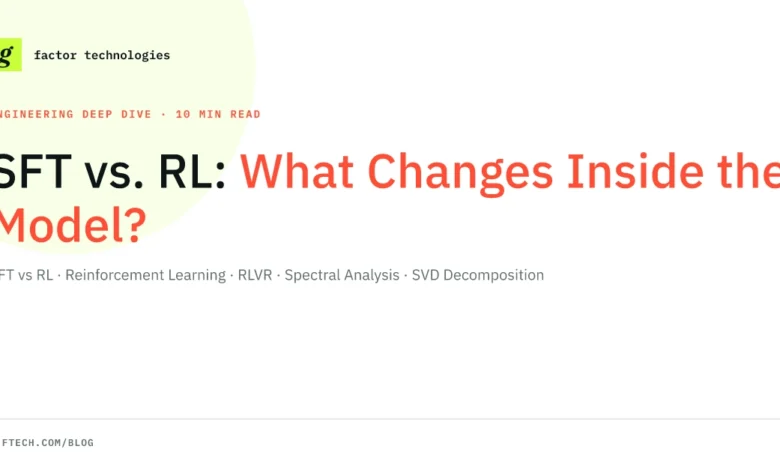
In modern generative AI post-training, two fundamental paradigms dominate the landscape: Supervised Fine-Tuning (SFT) and Reinforcement Learning with Verifiable Rewards (RLVR), often implemented through Group Relative Policy Optimization (GRPO). While practitioners have historically treated these methodologies as interchangeable rungs on an incremental tuning ladder, recent breakthroughs in linear algebraic analysis suggest they perform mathematically and mechanistically distinct operations on a model’s internal parameters. The prevailing industry consensus, supported by rigorous empirical research from July 2026, indicates that these methods reshape neural networks in fundamentally different ways, necessitating a shift in how enterprises approach model optimization and specialized deployments.
The Mathematical Foundation of Neural Weights
To understand the divergence between SFT and RLVR, one must look at the Singular Value Decomposition (SVD) of the transformer weight matrices that define these models. Any weight projection tensor in a transformer layer—whether found in self-attention modules or feed-forward MLP projections—can be factored into three fundamental linear algebraic components: $W = U cdot Sigma cdot V^mathsfT$.
In this equation, $V^mathsfT$ acts as a rotation of the input, $Sigma$ represents the singular value spectrum that scales these inputs, and $U$ represents the final rotation. Historically, engineers viewed these matrices as monolithic blobs of parameters. However, the July 2026 paper, "ISO: An RLVR-Native Optimization Stack" (arXiv:2607.19331) by researchers at UT Austin and Together AI, demonstrated that SFT and RLVR manipulate these components with distinct geometric signatures.
SFT: The Expansion of Spectral Energy
Supervised Fine-Tuning functions as a knowledge-injection mechanism. When a model is subjected to next-token cross-entropy loss, the objective is to force the model to memorize specific target token distributions. Whether an organization is training a model on proprietary Verilog hardware libraries, sensitive legal compliance documents, or niche medical terminology, the SFT process effectively rewrites the diagonal spectrum ($Sigma$).

By amplifying or suppressing specific singular values, the model allocates new "capacity" to store facts. However, this comes at a significant cost: catastrophic forgetting. Because SFT forcefully alters the singular value spectrum, it risks collapsing or distorting the pre-trained reasoning circuits that were established during the model’s initial pre-training phase. The model effectively trades its generalized reasoning capabilities for a higher density of domain-specific factual retrieval.
The RLVR Revolution: Spectral Inheritance
Conversely, Reinforcement Learning with Verifiable Rewards, such as the GRPO framework, operates on an entirely different principle known as "Spectral Inheritance." Empirical analysis reveals that during RLVR post-training, the singular value spectrum ($Sigma$) of the transformer weight matrices remains virtually unchanged from the base model. Instead of expanding spectral energy to "learn" new facts, the model undergoes a structural reorganization.
The adaptation occurs almost entirely through rotations of the singular coordinate frames ($U$ and $V$). In linear algebraic terms, reasoning is a rotation of coordinate frames, not an expansion of spectral energy. Because RLVR is typically driven by outcome verification—such as solving a competitive math problem or verifying a piece of code—the reward signal does not provide new factual data. Instead, it guides the model to route its existing internal knowledge more efficiently through the pre-existing logic paths. The model learns how to navigate its internal "search tree" to reach a verifiable correct answer, effectively mastering multi-step reasoning without altering the foundational factual "knowledge" stored in its singular values.
Chronology of the Isospectral Optimization (ISO) Breakthrough
The discourse surrounding these mechanics intensified following the publication of the ISO paper in July 2026. The researchers introduced "Isospectral Optimization" (ISO) as a new paradigm, proposing that training should be constrained to the frame variables ($U$ and $V$) while keeping the base spectrum ($Sigma_0$) frozen.
By September 2026, the industry moved to validate these claims through high-stakes benchmarks. Independent testing on NVIDIA H200 hardware, using the Qwen3-1.7B-Base model, compared standard AdamW optimization against the proposed ISO-AdamW. The results were nuanced: while ISO-AdamW achieved a slightly higher accuracy rate (75.8% compared to 75.4% on GSM8K math problems), the computational overhead was significant, requiring 47.5% more peak VRAM. This outcome served as a sobering reminder to the AI community that mathematical elegance does not always equate to immediate systems-level superiority, particularly when hardware constraints are considered.

Implications for Enterprise AI Architecture
The recognition of this spectral dichotomy has profound implications for how enterprise AI systems are architected. The traditional "one-size-fits-all" fine-tuning approach is increasingly viewed as inefficient. Instead, modern pipelines are trending toward a "Governed Two-Stage Pipeline."
In this framework, SFT is reserved for the initial "Knowledge Foundation" stage. If an organization requires a model to understand a specific regulatory framework or a niche technical language, SFT is used to inject that knowledge into the weight spectrum ($Sigma$). Once the model possesses the necessary factual base, it enters the second stage: RLVR-driven "Reasoning Calibration." In this phase, the model is trained on verifiable tasks—such as internal coding challenges or logical verification steps—to refine its ability to utilize that knowledge without further altering the underlying factual weight distribution.
Comparative Analysis: SFT vs. RLVR
| Dimension | Supervised Fine-Tuning (SFT) | Reinforcement Learning (RLVR) |
|---|---|---|
| Primary Function | Knowledge injection/Style imitation | Reasoning and search exploration |
| Model Outcome | "What to say" (facts/vocabulary) | "How to think" (logic/backtracking) |
| Weight Spectrum ($Sigma$) | Rewritten (Expansion of values) | Inherited (Near-constant values) |
| Singular Frames ($U, V$) | Adapted to style | Heavily rotated for logic routing |
| Risk Profile | Catastrophic forgetting | Reward hacking/Policy collapse |
Broader Impact and Future Outlook
The transition toward spectral-aware training represents a maturation of the generative AI field. As models grow in size and complexity, the ability to perform surgical, targeted updates becomes a competitive advantage. The ability to compose "specialist" models—where multiple agents share the same base spectrum but employ different logic-routing frames—could revolutionize how enterprises deploy multi-modal AI systems.
Furthermore, the "ISO-Merger" concept, which allows for the composition of specialist models directly in frame space without the need for additional rollouts or distillation data, promises a future where specialized AI capabilities can be modularized and swapped with plug-and-play ease. However, as noted in the September 2026 empirical reports, the path forward requires a balance between the theoretical advantages of these new optimization stacks and the practical realities of GPU memory consumption and training stability.
Ultimately, the dichotomy between SFT and RLVR is not merely an academic exercise in linear algebra; it is the blueprint for the next generation of reliable, specialized, and highly performant artificial intelligence. Organizations that successfully integrate these paradigms—using SFT to build a solid factual bedrock and RLVR to refine the logic that traverses that bedrock—will be best positioned to lead in the era of agentic and reasoning-capable AI. The industry is moving away from the era of "brute force" fine-tuning and into an era of precision architectural engineering, where every matrix rotation is calculated, verified, and optimized for the specific task at hand.