Meet the Startup Automating the Backbone of Industrial Infrastructure Through Robotic Pipefitting Innovation

Industrial infrastructure relies heavily on networks of pipes that transport vital resources such as oil, gas, petrochemicals, water, and chemicals across vast distances. Beneath the visible surface of modern manufacturing, energy production, and municipal utilities lies an intricate web of piping secured by millions of mechanical fasteners. While these systems keep the global economy functioning, maintaining them remains a labor-intensive, physically demanding enterprise. The maintenance and assembly of these structures heavily depend on skilled trade workers, particularly pipefitters, who face significant occupational hazards, chronic physical strain, and a persistent labor shortage across North America.
Addressing these challenges requires reimagining routine maintenance tasks that have remained largely unchanged for decades. Enter Lindsey Elliott, a former engineer and planner at ExxonMobil, who has dedicated her career to solving the mechanical bottlenecks inherent in heavy industry. Recognizing the physical toll that manual flange maintenance inflicts on trade workers, Elliott founded Nexterity, an early-stage industrial automation startup. Selected as one of the Startup Battlefield 200 participants at the TechCrunch Disrupt conference, Nexterity is introducing a remote-controlled robotic solution designed to handle the repetitive, strenuous task of tightening and loosening industrial pipe bolts.
The Genesis of Nexterity and the Industrial Labor Shortage
The modern industrial landscape faces an acute workforce crisis. Skilled trades, including pipefitting, welding, and specialized mechanical maintenance, are experiencing an aging demographic shift combined with a severe shortage of incoming labor. Younger generations have increasingly pursued office-based technology careers, leaving traditional blue-collar sectors understaffed. Consequently, existing workforces are frequently subjected to grueling schedules, including mandatory 12-hour shifts spanning consecutive months during peak maintenance seasons, known as plant turnarounds.
These prolonged shifts lead to severe physical fatigue, diminished productivity, and an elevated risk of workplace injuries. Manual bolting requires workers to apply significant torque using heavy hand tools in awkward postures, often in cramped or elevated environments. Over time, this repetitive strain damages joints and muscles, contributing to high turnover rates and dampening overall operational productivity across the industrial sector.
Recognizing these systemic issues during her tenure at ExxonMobil, Elliott began analyzing the specific operational steps that cause the most physical distress for trade workers. Her research pointed directly to bolted flange joints—the standard mechanical connections used to join sections of pipe, valves, and fittings. Securing these joints requires uniform pressure application across a circle of heavy bolts to prevent leaks of hazardous or high-pressure materials. Traditionally, this is accomplished entirely by hand, making it a prime candidate for technological intervention.
Engineering the Solution: More Dork, Less Torque
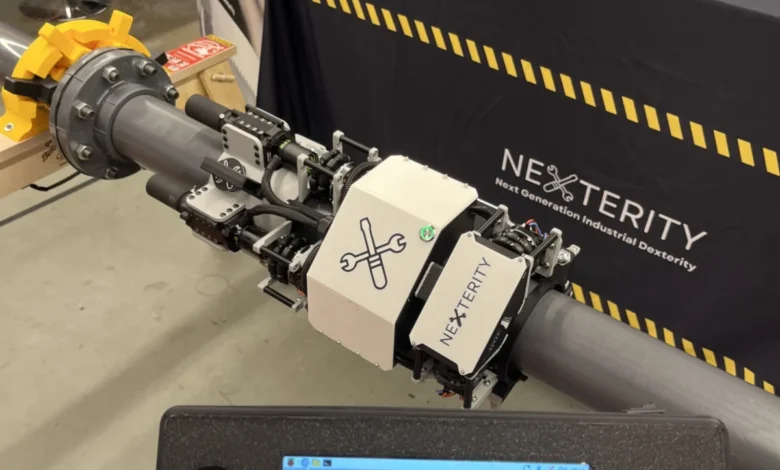
Nexterity’s core innovation is a specialized, battery-powered, remote-controlled robot engineered specifically to navigate industrial piping systems and automate the management of bolted flange joints. The mechanical design is divided into two primary modular components that easily latch around standard pipes. Once secured, the device utilizes an integrated sliding mechanism to traverse the length of the pipe to target flange connections.
Unlike traditional automated heavy machinery that requires permanent installation or cumbersome transport vehicles, Nexterity’s robot is remarkably compact. The entire apparatus is engineered to fit securely inside a standard Pelican utility case, allowing a single technician to transport, deploy, and operate the unit across complex industrial sites. This portability is foundational to the startup’s business strategy, which envisions treating the hardware as rental construction equipment rather than a permanent capital expenditure for plant operators.
Operational flexibility was a primary design criterion. Through extensive consultations with industry professionals—including active engagement at the annual Bolting Symposium and direct collaboration with members of the Pressure Vessels and Piping Division of the American Society of Mechanical Engineers (ASME)—Elliott gathered granular data regarding pipe standardization.
Conversations with specialists colloquially known within the industry as "torque dorks" revealed critical dimensional metrics. According to industry data, approximately 80% of all industrial piping infrastructure falls within a diameter range of two to eight inches, formally designated as NPS2 to NPS8. This high degree of dimensional standardization provided the ideal parameters for scalable automation. By configuring the robots to accommodate these specific, highly prevalent pipe dimensions, Nexterity maximized the market applicability of its technology without requiring custom engineering for every deployment.
The Mechanics of Robotic Flange Maintenance
When deployed on a worksite, the Nexterity robot attaches to the exterior of the pipe infrastructure and moves autonomously or via remote operator guidance to the targeted flange joint. Once positioned, the onboard mechanical systems engage four bolts simultaneously. By distributing the torque evenly and synchronously across multiple fasteners, the robot ensures a uniform seal that exceeds the precision typically achieved through manual hand-wrenching.
This simultaneous multi-bolt operation drastically reduces the time required to break down and reassemble piping sections during routine maintenance or emergency repairs. In industrial settings, facility downtime translates directly to substantial financial losses. By accelerating flange turnaround times while removing workers from the immediate line of fire, the technology delivers dual benefits: enhanced operational efficiency and significantly reduced safety liability.
Furthermore, the integration of battery power eliminates the logistical complications associated with pneumatic hoses or tethered electrical power cords in hazardous Class 1 Division 1 environments, where combustible gases or vapors may be present. While safety certifications for hazardous locations remain an ongoing milestone for early-stage hardware developers, the untethered, low-voltage design philosophy of Nexterity’s hardware aligns with modern industrial safety requirements.
Market Analysis and Broad Industry Applications
While the initial impetus for Nexterity arose from oil, gas, and petrochemical operations—sectors historically plagued by low field productivity and arduous labor conditions—the addressable market extends far beyond traditional fossil fuel extraction. Industrial fluid transport systems are ubiquitous across nearly every major manufacturing and utility sector.
Water treatment facilities, municipal wastewater infrastructure, food and beverage processing plants, mining operations, nuclear power generation facilities, and emerging green energy manufacturing plants all rely on extensive networks of flanged piping. Because these diverse industries utilize nearly identical standardized pipe dimensions, the potential deployment footprint for Nexterity’s robotic system is vast.
Industry analysts note that while maintenance managers are notoriously conservative when adopting novel technologies due to strict regulatory compliance and safety standards, the compounding pressures of labor shortages and rising operational expenditures are forcing a reevaluation of traditional methodologies. Startups that can demonstrate immediate return on investment through labor augmentation rather than complete displacement are finding a more receptive audience among plant operators.
The Road Ahead: Disrupting Traditional Blue-Collar Sectors
Participation in high-profile industry showcases such as TechCrunch Disrupt’s Startup Battlefield 200 provides early-stage companies like Nexterity with critical visibility among venture capitalists, strategic corporate investors, and potential enterprise clients. For hardware startups, securing early pilot programs with major industrial conglomerates is a vital milestone to validate technological reliability in real-world operating environments.
As Nexterity refines its manufacturing processes and expands its suite of interchangeable configurations to address a wider array of pipe diameters, the company represents a broader technological trend: the infusion of targeted robotics into traditional blue-collar environments. Rather than replacing the human workforce entirely, innovations of this nature aim to elevate workers into supervisory and strategic roles, mitigating the physical toll of heavy industrial labor while addressing the chronic labor deficits facing North American manufacturing and energy sectors.