Gritt Secures $26 Million Series A to Revolutionize Solar Panel Installation with AI-Powered Robotics

The global imperative to accelerate the transition to renewable energy sources, particularly solar power, is facing a significant bottleneck: a burgeoning labor shortage. As nations and corporations worldwide race to deploy solar and battery infrastructure to achieve energy independence and combat climate change, the demand for skilled installation workers is outpacing supply. This critical challenge is precisely where Gritt, a nascent artificial intelligence and robotics startup, aims to make a transformative impact. The company announced its successful closure of a $26 million Series A funding round, signaling strong investor confidence in its innovative approach to industrial automation.
The substantial funding, led by Obvious Ventures with participation from Union Square Ventures and Active Impact Investment, brings Gritt’s total funding to $34 million, following an earlier seed round backed by prominent venture capital firms including First Round Capital, Climactic, Congruent Ventures, and VSC Ventures. This influx of capital is earmarked to fuel Gritt’s mission to "help civilization build infrastructure faster," as articulated by CEO Puneet Puri. The company’s strategy hinges on leveraging the latest advancements in AI, specifically large language models, to overcome the historical limitations of industrial robots in unpredictable, outdoor environments.
The AI Revolution in Unstructured Environments
Historically, industrial robots have excelled in controlled, predictable factory settings. Their precision and efficiency are unparalleled in such environments. However, the chaotic and ever-changing nature of construction sites—from uneven terrain and varying weather conditions to the presence of human workers and dynamic material placement—has presented a formidable challenge for robotic deployment. This is where Gritt’s core innovation lies. The company’s founders, Carnegie Mellon-trained roboticists Puneet Puri and Vishal Dugar, recognized that the recent breakthroughs in AI, particularly in areas like computer vision and generalized learning, could finally bridge this gap.
"Our thesis is that if we truly want to speed up construction," Puri explained in an interview, "you need an intelligence which can work in the outdoor, chaotic environments of these construction sites, and it has to be generalizable enough that it can work in these varied environments." This adaptability is key; Gritt’s AI models are designed not for a single, rigid task but to understand and react to the nuances of a dynamic worksite, enabling a broader range of applications beyond just solar panel installation.
A Pragmatic Approach to Hardware
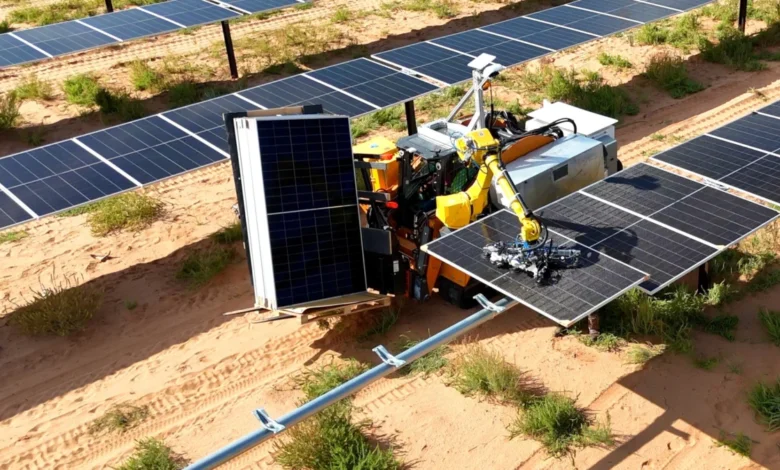
Instead of investing heavily in developing proprietary robotic hardware from scratch, Gritt has adopted a more agile and cost-effective strategy. The company utilizes off-the-shelf hardware, including rented skidders and robotic arms manufactured by established players like Kawasaki. This approach allows Gritt to focus its resources on its core competency: the development and refinement of its intelligent AI software. This "brains over brawn" philosophy is designed to accelerate deployment and reduce the capital expenditure typically associated with robotics startups.
The initial application of Gritt’s systems targets a critical pain point in solar farm construction: the precise and efficient installation of large, heavy solar panels. Gritt’s robots are engineered to autonomously unload these delicate yet cumbersome panels, transport them to their designated locations on the mounting frames, and position them with sub-millimeter accuracy. This level of precision is crucial for ensuring secure installation and optimizing the subsequent fastening process by human workers.
Investor Confidence and Market Potential
The significant Series A funding round underscores the immense potential investors see in Gritt’s solution. Andrew Beebe, a partner at Obvious Ventures who led the investment, highlighted the team’s unique blend of technical expertise and practical application. "There are people who used to build rockets that went into space and had infinite budget for the smallest little part, and then there are people who know what it means to get into dirty, dull, and dangerous jobs and scale them like mad," Beebe commented. "These guys are in the second camp, and that’s a special kind of entrepreneur that has the technical chops, the AI, and the machine vision skills to make it work."
This sentiment reflects a growing investor appetite for technologies that address fundamental industrial challenges with scalable solutions. The solar energy sector, in particular, is experiencing exponential growth, driven by global climate targets and decreasing solar costs. According to the International Energy Agency (IEA), solar PV is projected to become the largest source of electricity generation globally by 2025. This rapid expansion necessitates innovative solutions to overcome workforce limitations.
Demonstrable Impact: Boosting Installation Efficiency
Gritt is not merely operating on theoretical potential; its systems are already deployed in the field, gathering valuable data to continuously improve their performance. The company reports that its robotic systems can dramatically increase installation output. A typical eight-person crew can install approximately 800 solar panels per day. However, when augmented with Gritt’s AI-powered robotic assistance, the same crew can achieve an output of 3,000 to 4,000 panels daily. This represents a four to five-fold increase in productivity, a staggering improvement that can significantly accelerate project timelines and reduce overall construction costs.
The company’s immediate focus is on scaling its operations to meet the surging demand. Gritt is currently contracted to assist in the installation of 2.8 gigawatts (GW) of solar panels within the next 18 months. Its client roster includes three of the top 10 solar construction companies in the United States, a testament to the tangible value Gritt’s technology is already delivering. The company aims to have 48 of its systems operational within the next six months, a rapid expansion that speaks to the urgency of the labor challenge it addresses.
A Customer Perspective: Safety and Scalability
While competitive sensitivities prevent direct customer attribution in many cases, the positive feedback from those utilizing Gritt’s technology is compelling. One anonymous Gritt customer expressed enthusiasm for the system’s ability to enhance operations, particularly in remote areas where attracting and retaining labor is a significant hurdle. Furthermore, the customer anticipates a notable reduction in workplace injuries. The repetitive and physically demanding task of lifting heavy solar panels overhead is a common cause of strain and injury. By automating this process, Gritt’s robots can alleviate this burden on human workers, contributing to a safer and more sustainable work environment.
The Competitive Landscape and Gritt’s Differentiator
Gritt operates in a burgeoning field of robotic automation for solar installation. It faces competition from companies like Luminous Robotics and Cosmic, as well as international players such as China’s Trinabot, which are also developing robotic solutions for panel installation. A key differentiator for Gritt, however, is its reliance on off-the-shelf hardware. While competitors may be investing heavily in designing and manufacturing their own specialized robots, Gritt’s model of integrating its AI with existing, widely available robotic components could lead to faster scaling and a more flexible cost structure as the market expands. This strategic choice allows Gritt to remain nimble and adapt quickly to technological advancements in both AI and robotic hardware.
Expanding the Scope: Beyond Panel Installation
Gritt’s vision extends far beyond simply placing solar panels. The company is actively developing its AI system to perform a wider array of construction tasks. Future capabilities include the precise fastening of solar panels, drilling installation posts, and even the construction of the supporting racks. Longer term, Gritt aims to tackle other labor-intensive construction challenges, such as the intricate process of tying rebar before concrete pouring. This ambitious roadmap positions Gritt as a comprehensive solution provider for the future of infrastructure development.
The foundational enabler of this expanded vision, according to Gritt’s founders, is the rapid evolution of AI models. "Making a system for one solution was still possible to some extent five years ago, right?" Puri remarked, contrasting it with the current landscape. AI is now facilitating a paradigm shift towards generalized intelligence, where a single underlying software pipeline can be reused and continuously improved across diverse tasks. This adaptability is a significant leap forward. For instance, Gritt found that training its system to stack cinder blocks, a task that previously took weeks, could now be achieved in just a day for a similar task like rebar tying, using the same underlying software architecture.
A Layer of Physical Intelligence for Decision Making
Beyond the direct automation of physical tasks, Gritt envisions its systems acting as a sophisticated layer of "physical AI" on construction sites. The suite of sensors and intelligent processing power integrated into its robotic platforms can provide valuable insights for management and decision-making. For example, a Gritt system might detect an open trench as a storm approaches, proactively alerting workers to cover it and prevent potential damage to components or materials. It could also flag missing inventory or identify potential safety hazards in real-time.
"Gritt becomes now this layer of physical AI, which is doing this dextrous, labor-intensive task, plus it can help you take decisions on the site," Puri stated. This dual functionality—performing essential physical labor and providing real-time operational intelligence—could revolutionize how construction projects are managed, leading to greater efficiency, reduced waste, and enhanced safety.
The Broader Implications for Infrastructure Development
The success of companies like Gritt signals a profound shift in the construction industry. As labor shortages persist and the demand for new infrastructure—particularly renewable energy facilities—continues to surge, AI-powered robotics offers a critical solution. The ability to automate repetitive, dangerous, and labor-intensive tasks not only increases productivity but also creates opportunities for a more skilled and safer workforce.
The investment in Gritt highlights a broader trend of venture capital flowing into deep technology solutions that address tangible, large-scale problems. The fusion of advanced AI with practical robotics applications has the potential to accelerate the development of everything from solar farms and wind turbines to housing and transportation networks. As Gritt and its competitors mature, the construction industry may witness a transformation akin to what the manufacturing sector experienced with automation decades ago, ushering in an era of faster, more efficient, and more sustainable infrastructure development. The challenge of building a clean energy future, it appears, is being met with an innovative and intelligent robotic response.
Related posts: