How a Self-Healing Data Pipeline Won the Zero Downtime Hackathon and Redefined Resilience in Automation

On Saturday, August 22, 2026, a software engineer armed with a laptop and a bold hypothesis walked into a San Francisco hackathon space with the goal of solving one of the most pervasive, silent killers in modern software engineering: the "quiet failure" of data pipelines. By the time the clock ran out on the Zero Downtime Hackathon—an event organized by WeMakeDevs in collaboration with industry partners Port, Bright Data, and SigNoz—the project, dubbed "Scraper Factory," had secured the solo grand prize for Best Full-Stack Integration. The win was not merely a recognition of a clever movie-guide aggregator; it was a validation of a robust, AI-assisted architecture designed to detect, adapt, and verify data integrity without human intervention.
The Anatomy of a Silent Failure
Data pipelines are the circulatory system of the modern internet. From financial feeds and weather services to streaming metadata, companies rely on external sources to populate their applications. However, these pipelines are notoriously fragile. A website redesign, a subtle change in an API response, or a shift in CSS selectors can render a scraper useless.
The most dangerous aspect of these failures is that they often do not trigger traditional error alerts. Instead, they produce "zombie data"—technically valid code that delivers incorrect information. Titles may be swapped with descriptions, timestamps may be shifted into the wrong fields, or critical rows may simply disappear. Because the system continues to process data, the failure remains invisible to monitoring tools until a downstream stakeholder notices a statistical anomaly or a user reports a broken experience.
This vulnerability extends far beyond web scraping. Any organization consuming third-party APIs, partner data feeds, or manual CSV exports faces the same fundamental challenge: the source of truth is external, and the pipeline lacks the inherent intelligence to realize when the ground has shifted beneath its feet.
The Hackathon Chronology
The Zero Downtime Hackathon was designed to push developers to solve high-stakes infrastructure problems under pressure. For the creator of Scraper Factory, Nitish Mane, the competition served as a live laboratory to test a theory of automated, verifiable recovery.
- 09:00 AM: Setup and initial environment configuration, establishing the three-pronged architecture using Port for state management, Bright Data for extraction, and SigNoz for telemetry.
- 12:00 PM: Implementation of the deterministic detection layer, focusing on seven key integrity checks, including field null rates, hash verification of field names, and channel lineup consistency.
- 03:00 PM: Development of the "repair loop." Rather than allowing an AI to arbitrarily modify code, the system was configured to generate a repair proposal based on high-level descriptions of the data, followed by a preview phase.
- 06:00 PM: Integration of the verification gate, which compared proposed fixes against a "frozen" fixture—a curated dataset of real-world pages with known, correct outputs.
- 08:00 PM: Final stress testing, including the intentional injection of faults to ensure the system correctly rejected bad repairs.
The Architecture of Resilience: Detect, Adapt, Verify
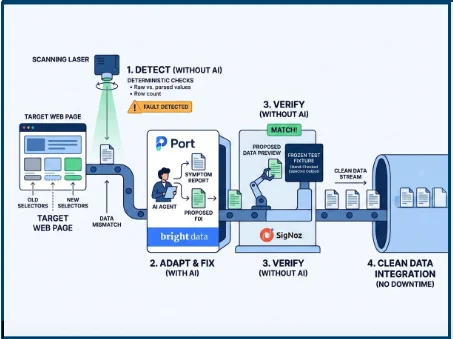
The winning design relied on a tripartite framework that separated the "judge" from the "actor." The core philosophy was that models should suggest changes, but the system’s integrity must be protected by immutable, deterministic code.
Detection Without Models
Mane’s system avoided the temptation to use AI for initial detection. Instead, it employed seven rigid, deterministic checks. Among these, the most innovative was the "Raw-to-Parsed" verification. The system stored the raw string exactly as it appeared on the source page alongside the parsed value. If a timestamp field was empty after parsing, but the raw text clearly contained a time, the system flagged a high-confidence failure. By using a "banded" approach to row counts and null rates, the system could identify drift before it caused a total crash.
Adaptive Repair via AI
When the detection layer identified drift, the system did not attempt to "fix" the production code directly. Instead, it sent a repair request to an AI agent. The agent received a plain-language description of the data requirement—such as "capture the program title and the start time as displayed"—and returned a proposed scraper fix. Crucially, this proposal included a preview of the extracted data, which served as a safeguard against hallucinated logic.

The Verification Gate
The final, and perhaps most critical, step was the verification gate. The system compared the AI-generated output against a frozen fixture—a trimmed, hand-verified dataset. If the AI’s proposed fix resulted in even a minor deviation from expected output, the system rejected the repair entirely. The scraper was then marked as "broken," and human intervention was requested. This prevented the common AI pitfall of "hallucinating" a fix that seems correct but destroys data quality.
Integration and Tooling
The success of Scraper Factory was heavily reliant on the seamless integration of three specific platforms, which formed the project’s backbone:
- Port (State Management): Port acted as the central nervous system. It tracked the health of every scraper and every repair attempt. When a scraper’s status shifted from "healthy" to "drifting," it triggered a predefined workflow that initiated the repair cycle.
- Bright Data (Extraction): This provided the engine for scraping and served as the source for the proposed repairs, offering the necessary throughput to handle large volumes of guide data.
- SigNoz (Audit and Alerting): By using OpenTelemetry auto-instrumentation, the project maintained a granular audit trail. Every step—fetch, extract, validate, repair, and verify—was logged as a span. SigNoz alerts were configured to trigger not just on error codes, but on "silence," notifying the system if data ceased to arrive at all.
Analysis: Why This Approach Matters
The implications of the Scraper Factory model are significant for enterprise software development. By treating automated repairs as untrusted entities that must be verified against a "source of truth" fixture, developers can effectively mitigate the risks associated with AI-driven automation.
Industry experts note that the primary reason many companies hesitate to deploy AI agents in production is the fear of "cascading failures"—where a minor AI mistake ripples through an entire ecosystem. The Scraper Factory approach solves this by enforcing a hard, deterministic gate. Even if the AI suggests a faulty patch, the verification layer acts as a circuit breaker, preserving the last known "good" state of the application.
The Unhappy Path: A Masterclass in Failure
During the final presentation, the most compelling part of the demo was the simulation of a failure. By injecting a synthetic fault into the scraper, the team demonstrated the system’s ability to trigger the workflow, generate a symptom report, and produce a faulty repair proposal.
The system’s refusal to accept a fix that produced only 2 rows instead of the expected 30 was a pivotal moment. It proved that the system prioritized data accuracy over uptime. If a model had been allowed to approve its own repair, the guide would have displayed incomplete information without alerting administrators. Instead, the system successfully rolled back, maintained the previous day’s valid data, and provided a detailed trace of the failure—a "perfect" log entry that allowed for rapid post-mortem analysis.
Lessons Learned and Future Scaling
Reflecting on the weekend, the project highlighted several key takeaways for productionizing similar systems:
- Idempotency is Non-Negotiable: Because multiple triggers (alerts, scheduled jobs, manual re-runs) can race, the repair endpoint must be idempotent, ensuring that multiple attempts to fix the same issue do not cause side effects.
- Alerting on Silence: Most monitoring systems focus on error rates. However, for data pipelines, "silence" (the absence of data) is often a clearer signal of failure than a 500-level error.
- The Growth of the Fixture Library: In a production environment, a single fixture is insufficient. As breaks occur, the library of "known good" fixtures must grow, creating a regression test suite that protects the pipeline against future regressions.
- The "Human-in-the-Loop" Requirement: At scale, automated systems will inevitably encounter edge cases they cannot resolve. The transition from automated repair to human oversight must be managed through structured queues with clear ownership.
As software continues to shift toward agentic workflows, the lesson from San Francisco is clear: automated repair is only as safe as the verification that surrounds it. Whether the agent is a sophisticated large language model, a simple script, or a tired engineer working at 2:00 AM, the necessity for independent, deterministic verification remains the cornerstone of resilient software infrastructure.