Mastering Answer Engine Optimization: How Content Structure is Redefining Digital Visibility in the Era of AI Search

The landscape of digital information retrieval is undergoing its most significant transformation since the inception of the World Wide Web, as traditional search engines evolve into sophisticated answer engines. As more user queries are answered directly by Google’s AI Overviews, OpenAI’s ChatGPT, and Perplexity, the fundamental mechanics of online visibility are shifting from ranking in a list of "blue links" to becoming the primary source cited in a synthesized AI response. This transition has birthed a new discipline known as Answer Engine Optimization (AEO), a strategic framework designed to ensure brand content is not just indexed, but extracted and attributed by Large Language Models (LLMs).
The urgency of this shift is underscored by recent industry data. According to the HubSpot 2026 State of AEO Report, approximately 58% of forward-thinking marketers have already begun optimizing their digital assets specifically for answer engines. What was once considered a fringe experimental tactic has rapidly moved into the mainstream of corporate strategy. The consensus among digital architects is clear: visibility is no longer about occupying the top spot on a results page; it is about whether an AI engine can identify a clean, self-contained passage from a website and confidently present it as a definitive answer to a user’s query.
The Evolution of Search: A Chronology of the AI Integration
To understand the current state of AEO, one must look at the rapid progression of search technology over the last decade. The journey from keyword matching to semantic understanding began in earnest with Google’s 2013 "Hummingbird" update, which focused on the intent behind words. However, the true catalyst for the current era arrived in 2018 with the introduction of BERT (Bidirectional Encoder Representations from Transformers), which allowed engines to understand the context of words in a sentence more like a human.
The timeline accelerated dramatically in late 2022 with the public launch of ChatGPT, which proved that users were hungry for direct, conversational answers rather than a directory of websites. In response, 2023 saw the announcement of Google’s Search Generative Experience (SGE), which eventually rolled out as AI Overviews (AIO) in 2024. By 2025 and 2026, the integration of generative AI into search had become the global standard, forcing a total rethink of content architecture. Today, the focus is on "passage-level optimization," where the structural integrity of a webpage determines its likelihood of being cited by an LLM.
The Mechanics of Extraction: Why Structure Dictates Success
Answer engines do not "rank" pages in the traditional sense; they parse, score, and cite them. Before a brand earns a citation in an AI Overview, the engine must first split a page into distinct "chunks" or passages. Each passage is then scored against the user’s query for relevance, accuracy, and clarity. This process highlights why page structure has become the primary mechanism for visibility.
Research from AirOps in their 2026 State of AI Search Report indicates that sequential heading structures—specifically those that mirror the natural phrasing of user questions—increase the odds of a citation by 2.8 times. This data confirms that AI engines prefer content that is "ready-to-lift." If a paragraph can stand alone and provide a complete answer without requiring the surrounding context of the page, it becomes a prime candidate for an AI citation.
Core Structural Themes for AEO Excellence
To compete in this new environment, content creators are adopting five primary structural themes that align with how LLMs interpret and attribute information.

1. Question-Led Headings and Direct-Answer Summaries
The most effective AEO strategy involves mirroring the exact queries of the audience. By using H2 or H3 tags as questions (e.g., "What are the benefits of AEO?") and immediately following them with a one-to-two-sentence "TL;DR" summary, marketers provide the engine with a pre-packaged answer. This format reduces the computational "effort" required by the AI to synthesize a response, thereby increasing the likelihood of attribution.
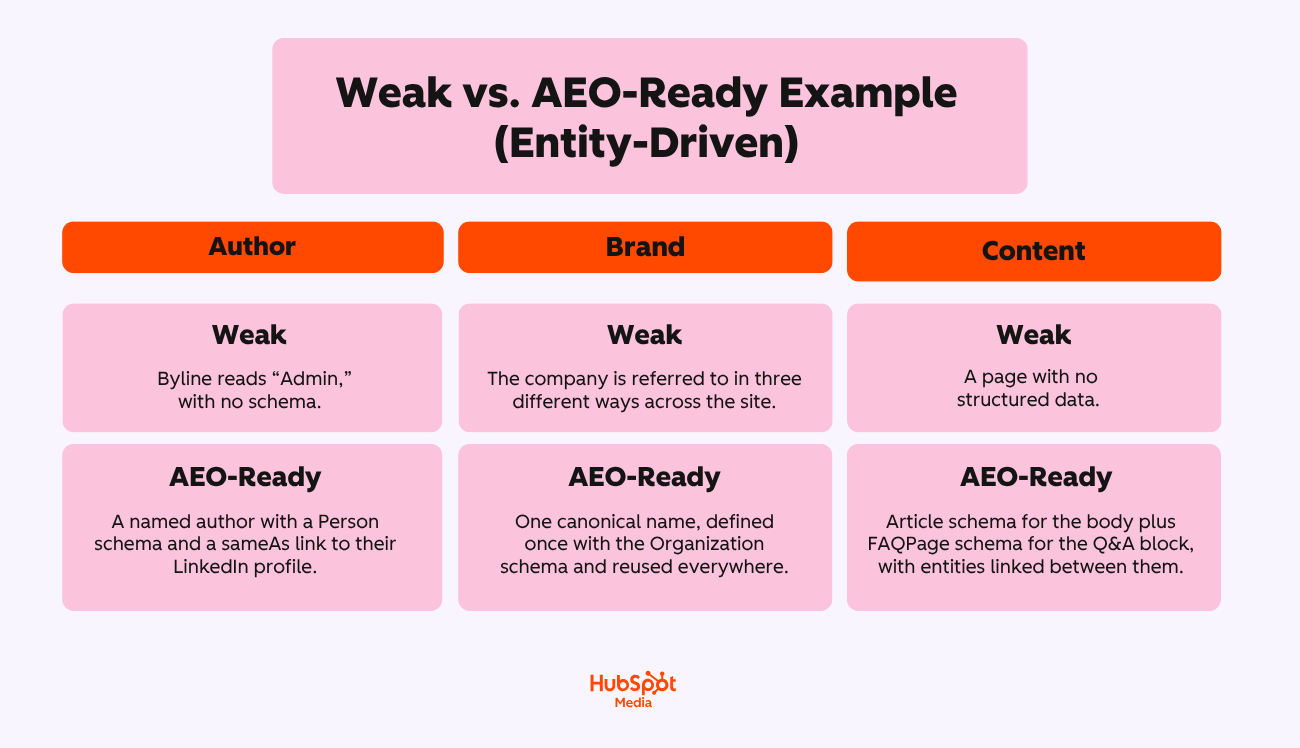
2. Semantic Schema and Entity Modeling
While humans read prose, machines read schema. Structured data—the machine-readable layer of a website—labels the specific parts of a page so an engine does not have to guess. Key schema types such as Organization, Product, FAQPage, and Person are essential. Furthermore, entity modeling involves defining the people, brands, and products on a site as consistent, connected "things" rather than just strings of text. This consistency builds an engine’s confidence in the source over time.
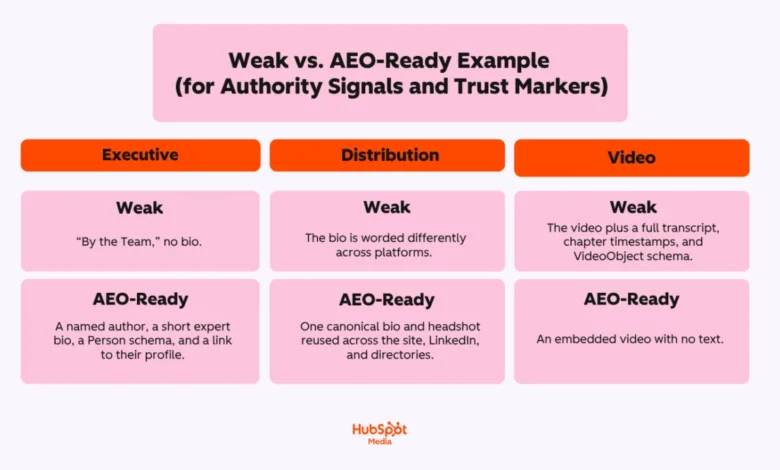
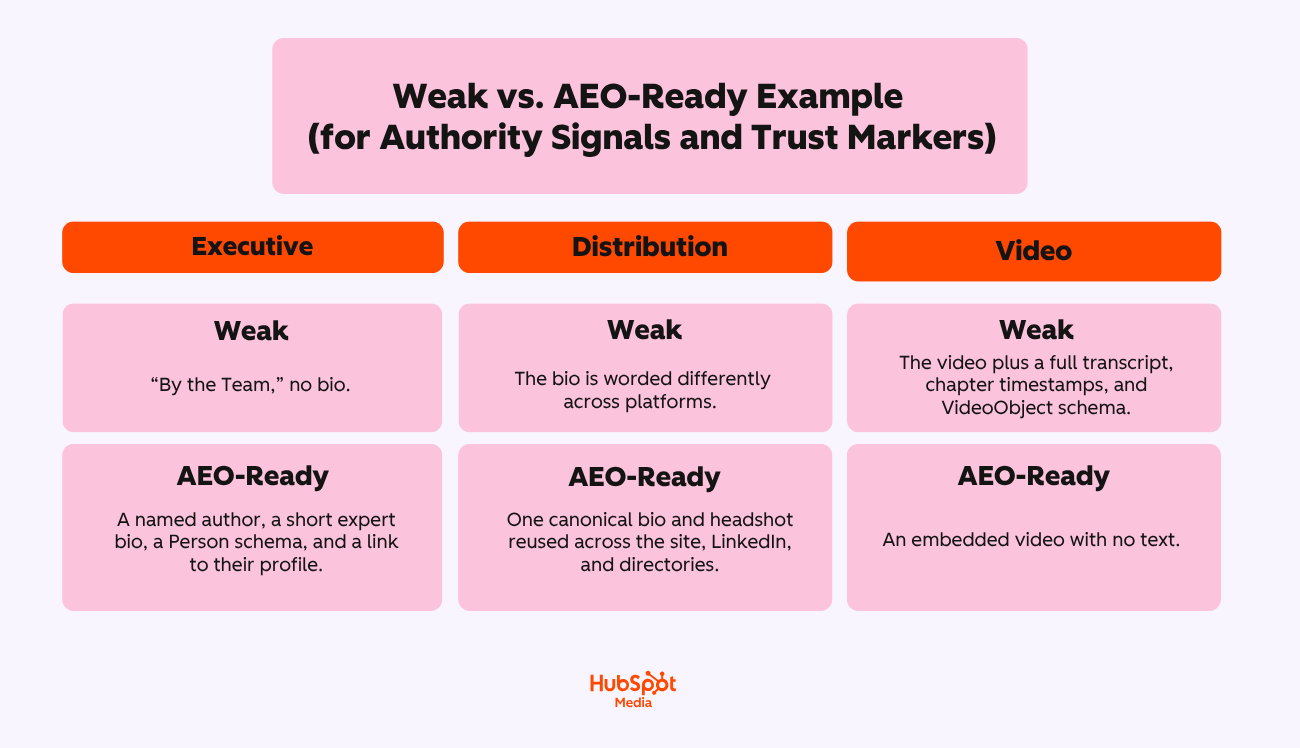
3. Authoritative Signals and Trust Markers
Answer engines prioritize trust before they cite. Two pages may offer the same factual answer, but the engine will favor the source it can verify. This is achieved through robust executive profiles, transparent "About Us" pages, and distribution across trusted ecosystems like LinkedIn, industry journals, and reputable news outlets. Corroboration across multiple high-authority sources acts as a powerful trust signal for AI models.
4. Strategic Internal Linking Architecture
Internal linking serves as the site-level expression of structure. A "hub-and-spoke" model—where a central authoritative page links to focused supporting pages—helps engines crawl and group related content. When internal links use clear, descriptive anchor text and are placed early in a passage, they signal the hierarchy and importance of information to the AI, preventing valuable answers from being "stranded" or ignored.
5. Passage-Level Optimization for Extraction
The goal of modern content writing is to ensure that every paragraph, list, or table can be lifted and cited on its own. This requires avoiding vague pronouns (like "this" or "that") which rely on previous paragraphs for meaning. Instead, each passage should be self-contained. Technical formatting, such as the use of bulleted lists and definition boxes, significantly improves "snippet-friendliness."
Measuring Impact: The New Key Performance Indicators
As the methodology of search changes, so too must the metrics for success. Traditional metrics like "organic sessions" are becoming less reliable as "zero-click" searches increase. In response, the industry is gravitating toward three critical KPIs:
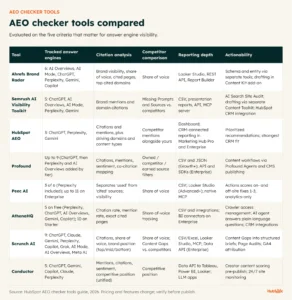
- Share of Model (SoM): This measures how often a brand is mentioned or cited across various AI engines (ChatGPT, Perplexity, Gemini) relative to its competitors.
- Citation Rate: This tracks the percentage of a brand’s high-value pages that are currently being used as sources in AI-generated answers.
- Entity Sentiment: This analyzes the tone and context in which an AI engine describes a brand, ensuring that the machine-generated summaries align with the brand’s intended identity.
Industry Reactions and the Governance Gap
The transition to AEO has met with a mix of enthusiasm and caution from the marketing community. While many celebrate the opportunity to earn high-authority citations, others express concern over the "governance gap"—the difficulty in maintaining consistent quality and structural standards across large content teams.
"The challenge isn’t just writing the content; it’s operationalizing the structure," notes one senior digital strategist. "If every writer has a different way of formatting an H2 or a list, the AI gets confused. Consistency is the new currency." To combat this, organizations are increasingly turning to role-based checklists and reusable templates within their Content Management Systems (CMS). By making AEO the default setting for every published page, companies can ensure a unified front to AI crawlers.
Broader Implications for the Digital Economy
The rise of AEO has profound implications for the future of the internet. As AI engines become the primary gatekeepers of information, the value of "human-first" content is actually increasing. Google’s quality guidelines continue to emphasize accuracy, relevance, and user context. Strategies that attempt to "game" the system with AI-generated fluff often fail because they lack the authoritative signals and original insights that LLMs are trained to find.
Furthermore, the integration of AEO with the traditional sales funnel is becoming more sophisticated. By mapping content structure to specific funnel stages—from broad "top-of-funnel" definitions to specific "bottom-of-funnel" product comparisons—businesses are using AI citations to drive actual revenue, not just brand awareness. When a user asks an AI for a product recommendation, the brand that has optimized its "Entity" and "Product" schema is the one that will be recommended.
In conclusion, winning in the AI search era requires a shift from thinking about "keywords" to thinking about "structure." By providing clear, direct, and machine-readable content, brands can ensure they remain relevant in a world where answers are generated in real-time. The transition from SEO to AEO is not merely a technical update; it is a fundamental realignment of how human knowledge is organized and accessed in the 21st century. Those who master the discipline of structure today will be the authoritative voices cited by the engines of tomorrow.