Tech Pioneer Jeff Atwood and Retired Army Colonel Alexander Vindman Unite at Cooper Union to Reexamine the American Dream

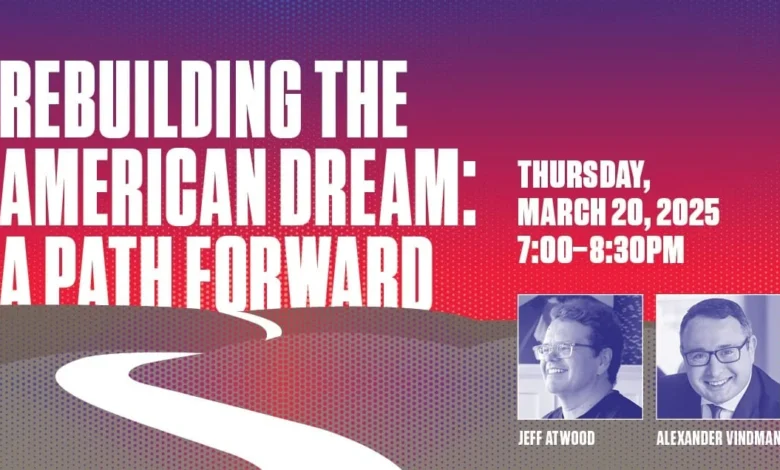
The historic Cooper Union Great Hall in New York City recently played host to a compelling dialogue between two figures from vastly different professional spheres: software developer and Stack Overflow co-founder Jeff Atwood, and retired U.S. Army Lieutenant Colonel and national security expert Alexander Vindman. The event, titled "Rebuilding the American Dream: A Path Forward," drew a diverse audience interested in exploring the intersection of democratic integrity, civic duty, and the structural foundations required to foster economic mobility and community resilience in modern America.
Against the backdrop of shifting sociopolitical landscapes in 2025, the conversation centered on a fundamental question: How can the foundational promise of the American Dream—traditionally defined as a pathway to a better future through hard work, fairness, and opportunity—be recalibrated to serve all members of society equitably?
Main Facts and the Genesis of the Collaboration
The partnership between Atwood and Vindman represents an unconventional pairing of digital governance and traditional statecraft. Atwood, widely recognized for building foundational internet infrastructure such as the Q&A platform Stack Overflow and open-source discussion software Discourse, has spent decades analyzing how human beings interact, self-organize, and establish norms in digital spaces. Vindman, a former Director for European Affairs for the National Security Council and a decorated combat veteran, gained international prominence for his public testimony during the 2019 congressional impeachment hearings, a decision that ultimately curtailed his 21-year military career.
Despite their divergent career paths—one originating in the commercial technology sector and the other rooted in military service and defense diplomacy—both speakers share a common thesis: that the preservation of democratic ideals is not a passive inheritance, but an active, labor-intensive responsibility. The Cooper Union event served as a public forum to articulate how lessons learned from scaling digital communities might inform the structural challenges facing contemporary democratic institutions.
Background Context of the Event and Venue
The choice of the Cooper Union Great Hall carried significant historical symbolism. Long recognized as a bastion for free speech and public discourse in New York City, the venue has hosted pivotal historical addresses, notably Abraham Lincoln’s Cooper Union speech in February 1860, which propelled him to the national political stage. By staging the conversation in a hall historically dedicated to the abolition of slavery, labor rights, and democratic expansion, the organizers sought to frame the discussion on economic mobility and civic duty within a broader historical continuum.
The event, which was broadcast globally via the Cooper Union Great Hall’s official YouTube channel, addressed the transition from individualistic models of philanthropy and charity toward systemic reforms capable of guaranteeing security, dignity, and upward mobility for a broader segment of the population.
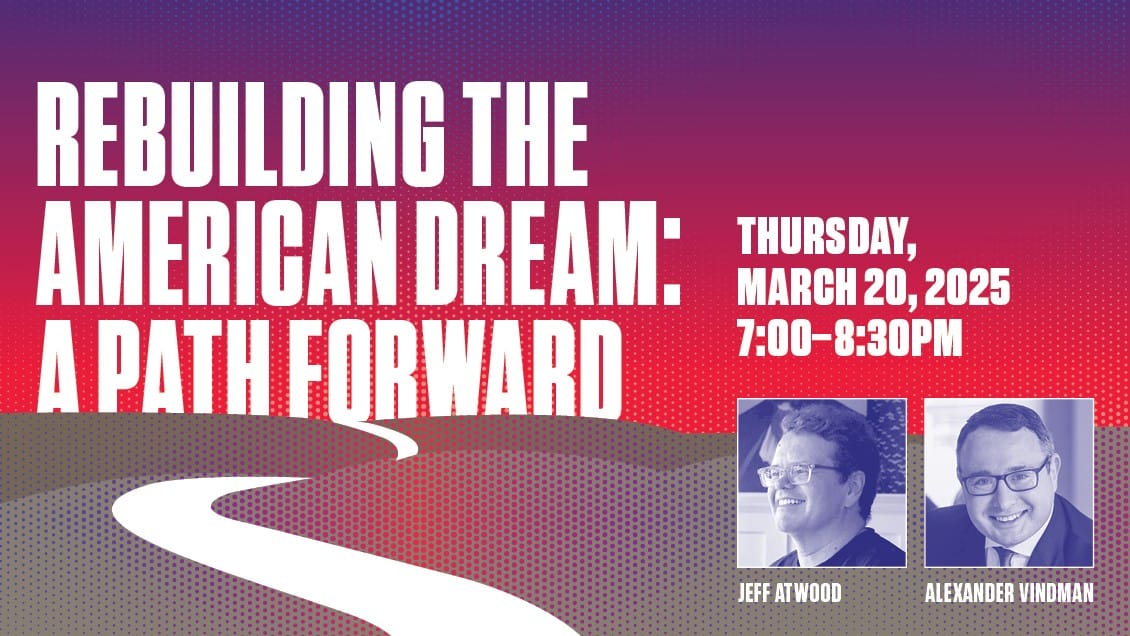
Chronology of the Speakers’ Public Trajectories
To understand the weight of their joint appearance, it is helpful to examine the distinct trajectories that led both men to the stage:
- Early Life and Immigration: Alexander Vindman was born in the Soviet Union and immigrated to the United States as a young child, settling in Brooklyn, New York. His early exposure to the contrasts between Soviet authoritarianism and American constitutional democracy deeply influenced his subsequent dedication to public service.
- Military Career and Public Scrutiny: Vindman enlisted in the U.S. Army, serving for over two decades. He was deployed to Iraq, where he earned a Purple Heart for injuries sustained in combat. By 2018, he assumed the role of Director for European Affairs on the National Security Council. His career reached a critical juncture in July 2019 during a phone call between U.S. and Ukrainian leadership, prompting him to report concerns through official channels regarding adherence to standard diplomatic protocols and national security norms. His subsequent testimony before the U.S. House of Representatives led to severe political blowback, culminating in his retirement from the military in 2020.
- Digital Infrastructure Development: Concurrently, in the technology sector, Jeff Atwood was addressing a different set of scaling and governance challenges. Following the launch of Coding Horror, his influential software development blog, Atwood co-founded Stack Overflow in 2008 alongside Joel Spolsky. The platform revolutionized peer-to-peer technical problem solving by implementing a sophisticated, community-driven moderation and reputation system. In 2013, Atwood launched Discourse, an open-source platform designed to modernize internet forum software through transparent governance structures, trust metrics, and constructive discourse incentives.
- Converging Philosophies: In late 2024 and early 2025, Atwood published essays exploring the concept of "staying gold"—a literary reference to holding onto core societal values—and began arguing that software architecture and political governance share fundamental parallels: both require clear expectations, equitable rule enforcement, robust boundaries, and a shared sense of purpose to function effectively at scale.
Supporting Data and Structural Considerations
Modern sociological and economic data highlight the urgency of the issues discussed at Cooper Union. According to metrics from organizations such as the Pew Research Center and the Organisation for Economic Co-operation and Development (OECD), economic mobility in the United States has faced increasing friction over recent decades. While gross domestic product (GDP) has grown, income and wealth distribution disparities have complicated the traditional narrative of generational advancement.
Furthermore, civic engagement data indicates a declining trust in traditional institutional frameworks, paralleled by a rise in polarization across both geographic and digital communities. Atwood’s commentary during the event drew heavily from his empirical observations of online communities, where he noted that scaling human cooperation requires engineered systems rather than mere goodwill. Just as an unmoderated internet forum degrades into toxicity and inefficiency, large-scale democratic societies require transparent, enforced guardrails to prevent the erosion of social trust.
Vindman complemented this perspective by addressing the geopolitical and institutional vulnerabilities that arise when leaders and citizens fail to uphold the ethical frameworks underpinning the rule of law. Drawing from his experience in national security, he emphasized that democratic erosion rarely happens overnight; rather, it occurs incrementally through the erosion of norms, the weakening of institutional checks and balances, and the normalization of self-interest over public duty.
Implications and Broader Impact
The collaborative dialogue at Cooper Union points toward an emerging interdisciplinary approach to civic revitalization. By bridging the gap between technologists who design digital architectures and practitioners who defend physical states, the event underscored that the future of democratic resilience relies on modernizing how societies organize themselves.
Observers and political analysts note that events of this nature signal a growing appetite for substantive, non-partisan discussions addressing the structural roots of economic and political discontent. Rather than offering superficial talking points, Atwood and Vindman focused on the mechanical realities of institution-building—examining how policy frameworks, digital tools, and community organizing can intersect to rebuild trust and economic security.
The dialogue concluded with a call to action directed not merely at elected officials or institutional leaders, but at individual citizens. The central premise advanced by both speakers was that safeguarding the American Dream requires a collective commitment to designing and maintaining systems that ensure fairness, accountability, and opportunity for all participants in the democratic experiment.