The Middle Market M&A Landscape: A Comprehensive Analysis of 2026 Transaction Trends and Capital Deployment Strategies


The middle-market merger and acquisition landscape has undergone a significant transformation throughout 2026, marking a robust recovery from the more subdued transactional environment that characterized the previous calendar year. According to the latest market intelligence report from Intrepid Investment Bankers, the sector is currently defined by a confluence of ample private equity dry powder, stabilizing financing conditions, and a renewed appetite for strategic growth among both corporate acquirers and financial sponsors. This shift signals a broader return to form for the dealmaking community, as organizations leverage improved visibility to pursue long-term scaling objectives.
The current economic environment remains complex, shaped by lingering geopolitical uncertainties and fluctuating macroeconomic indicators. However, the data suggests that middle-market participants have become increasingly adept at navigating these variables. Rather than retreating, the market has pivoted toward a model of selective, high-conviction dealmaking. Business owners who possess strong fundamentals and clear value propositions are finding themselves in a favorable position, as competitive tension for quality assets remains high.
Chronology of the 2026 M&A Recovery
To understand the current state of the market, one must examine the progression of capital deployment over the past eighteen months. The year 2025 was largely defined by a "wait-and-see" approach, as interest rate volatility and inflationary pressures prompted many firms to pause major capital expenditures. This caution resulted in a cooling of M&A volume across most sectors.
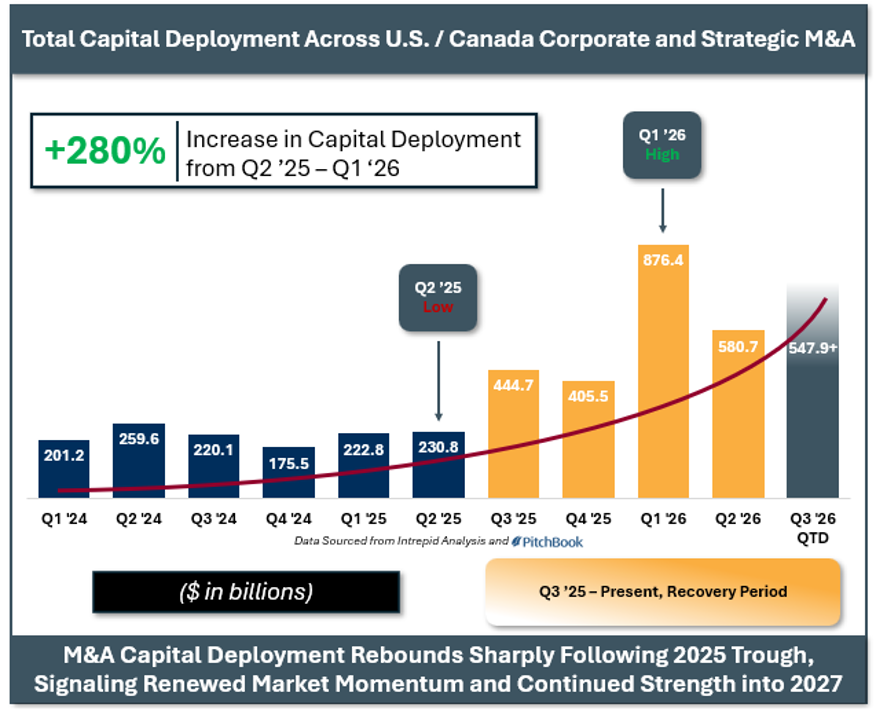
However, the tide began to turn in the final months of 2025, setting the stage for a dramatic surge in early 2026. The transition from Q2 2025 to Q1 2026 serves as the primary benchmark for this recovery. In the second quarter of 2025, aggregate capital deployment stood at approximately $230.8 billion. By the first quarter of 2026, that figure had climbed to $876.4 billion—an increase of nearly 280 percent. This rapid expansion in deal value was not merely a seasonal anomaly but a clear indicator of institutional confidence returning to the middle market.
While the blistering pace seen in Q1 2026 moderated slightly in the subsequent quarters of the year, the absolute levels of capital deployment have remained substantially higher than the 2025 trough. This sustained activity confirms that the underlying drivers of the market—namely, the need for technological integration, market consolidation, and private equity portfolio turnover—have regained their dominance over short-term macroeconomic fears.

The Role of Private Equity and Strategic Acquirers
The recovery is anchored by two primary forces: the massive reservoir of "dry powder" currently held by private equity firms and the strategic imperative for corporate growth. Private equity sponsors, having spent much of 2025 optimizing their existing portfolios, returned to the market in 2026 with a dual mandate: deploying accumulated capital into new platforms and capitalizing on the exit opportunities that improved market conditions have facilitated.
Simultaneously, strategic acquirers—typically larger corporations seeking to bolster their competitive positioning—have prioritized M&A as a primary vehicle for growth. In an era where organic growth is increasingly difficult to achieve, acquiring established, high-quality middle-market businesses allows these corporations to rapidly secure new market share, acquire proprietary technology, or integrate essential supply chain components. This demand has kept valuations for high-quality assets at premium levels, even as buyers have become more discerning regarding the operational efficiencies of their targets.
Deep Dive: The Industrials Sector Surge
Perhaps no segment of the middle market has demonstrated as much resilience and growth as the Industrials sector. Data analyzed by Intrepid Investment Bankers reveals a staggering upward trajectory in capital deployment within this space. From a baseline of $26.7 billion in Q1 2024, capital deployment within Industrials ballooned to $224.4 billion by Q2 2026. This represents an 8.6x increase over the two-year period, a figure that far outpaces broader market growth averages.
The catalyst for this surge is multifaceted. First, the ongoing transition toward industrial automation and advanced manufacturing has necessitated a wave of acquisitions aimed at modernizing production capabilities. Second, the global push to re-shore critical manufacturing and build resilient infrastructure has created a pipeline of high-quality industrial assets that are essential to national economic strategies. Investors and strategic buyers are viewing these businesses not just as traditional manufacturing plays, but as high-growth technology and infrastructure platforms. The persistent upward march of deployment in this sector underscores a long-term thematic shift toward industrial modernization that is likely to continue well beyond the current fiscal year.
Financing Conditions and Transaction Timelines
One of the most critical factors influencing the 2026 recovery has been the normalization of financing markets. Throughout much of 2025, the cost and availability of debt were significant barriers to entry for many mid-sized transactions. However, as financing conditions have improved and interest rate expectations have stabilized, the credit markets have opened up. This accessibility has provided the necessary leverage for private equity firms to return to the bargaining table.
It is important to note, however, that the current environment is not without its friction. While capital is available, transaction timelines have noticeably lengthened in several key sectors. Buyers are conducting deeper due diligence, placing a greater emphasis on unit economics, historical performance, and long-term sustainability rather than projected future growth. For business owners, this means that the road to a liquidity event or a capital raise requires more rigorous preparation. The "quality-first" mentality of current buyers demands transparent financial reporting and a clear articulation of how the business can withstand potential future volatility.
Implications for Business Owners and Stakeholders
The current market environment offers a distinct window of opportunity for owners of middle-market businesses who are contemplating a transition, whether that be a full exit, a partial recapitalization, or the search for a growth partner. The willingness of both sponsors and strategic buyers to pay for quality creates a competitive landscape that can favor the seller, provided the business is positioned correctly.
However, the complexity of the 2026 market also presents risks. With buyers becoming more selective, businesses that are unable to demonstrate strong, defensible fundamentals are likely to find the market less forgiving than in previous cycles. Implications for stakeholders include:
- Strategic Positioning is Paramount: Businesses that can prove they are indispensable to their customers—particularly in the Industrials, Tech, and Healthcare sectors—are commanding the highest multiples. Owners should focus on operational streamlining before entering the market.
- Increased Diligence Requirements: Sellers must be prepared for a deeper dive into their operations. Environmental, Social, and Governance (ESG) factors, supply chain stability, and cybersecurity infrastructure are increasingly scrutinized during the M&A process.
- Capital Availability as a Lever: With credit markets functioning more efficiently, there is a clear path for growth-oriented companies to raise capital for acquisitions of their own. Middle-market firms that have not historically considered an M&A strategy may find that now is an opportune time to explore "buy-and-build" strategies.
Looking Ahead: Navigating Uncertainty
While the M&A market has shown undeniable resilience, the broader economic outlook remains marked by caution. The interaction between ongoing geopolitical developments and domestic policy shifts will continue to influence capital markets in the coming months. Nevertheless, the fundamental need for consolidation and growth in the middle market remains a constant.
Intrepid Investment Bankers suggests that the companies most likely to succeed in the near term are those that maintain a proactive posture. Whether a company is seeking to capitalize on current valuation trends or is looking to secure a capital partner to navigate the next phase of its growth, the key remains agility. The 2026 data confirms that while the environment has changed, the fundamental engine of the middle market—the efficient deployment of capital into high-quality, high-growth assets—is operating at a high level.
For business owners, the current environment is a call to action. It is a period that rewards the prepared and highlights the importance of professional guidance in navigating the complexities of valuation, financing, and deal structuring. As the year draws to a close, the focus for many will shift toward ensuring that their long-term objectives are aligned with the realities of this active, albeit selective, dealmaking climate. The ability to articulate a clear vision for the future, backed by the strong performance data that investors now demand, will be the ultimate differentiator for those seeking to maximize value in the current M&A landscape.