Where Is Everybody? The Fermi Paradox, the Great Filter, and the Case for the Microscopic Universe


The question of whether humanity is alone in the cosmos has captivated philosophers, scientists, and astronomers for centuries. With a staggering 13-billion-year head start on stellar and planetary evolution, the universe has offered ample time for complex life to emerge, mature, and expand across the galaxy. Yet, despite decades of radio astronomy, deep-space observation, and the deployment of advanced telescopes like the James Webb Space Telescope, no verifiable signal, artifact, or footprint of extraterrestrial intelligence has ever been detected.
This stark contradiction forms the foundation of the Fermi Paradox. Named after the legendary physicist Enrico Fermi—who famously blurted out, "Where is everybody?" during a lunch conversation with colleagues in 1950—the paradox highlights the glaring disconnect between high statistical probabilities of alien life, such as those calculated by the Drake Equation, and the total lack of empirical evidence supporting it. As scientific exploration continues to advance, researchers and thinkers are increasingly forced to re-examine the fundamental assumptions we make about intelligence, technology, and the ultimate trajectory of advanced civilizations.
The Historical Evolution of the Search for Extraterrestrial Intelligence
The intellectual journey of humanity’s search for extraterrestrial life has evolved from philosophical musings into rigorous empirical science. In the 16th century, Giordano Bruno argued for an infinite universe populated by countless worlds, a view that led to his execution for heresy. However, by the mid-20th century, the advent of quantum mechanics, astrophysics, and radio technology transformed astrobiology into a quantifiable discipline.

In 1961, astronomer Frank Drake formulated the Drake Equation at the National Radio Astronomy Observatory in Green Bank, West Virginia. The equation is a probabilistic argument used to estimate the number of active, communicative extraterrestrial civilizations in the Milky Way galaxy. It multiplies factors such as the rate of star formation, the fraction of stars with planets, the number of habitable planets per system, the fraction of those planets where life actually appears, the fraction that develop intelligent life, the fraction that develop interstellar communication, and the average lifespan of such civilizations.
While the variables in the Drake Equation remain largely speculative, multiplying even conservative estimates often yields thousands, if not millions, of technological civilizations in our galaxy alone. Given that the Milky Way is roughly 13.6 billion years old—while Earth is a relative newcomer at 4.5 billion years—the probability that humanity should be the first or only technological species seems vanishingly small. This temporal disparity forms the core of the Fermi Paradox: if space is teeming with potential, why has the cosmic silence remained unbroken?
The Great Filter and Cosmic Roadblocks
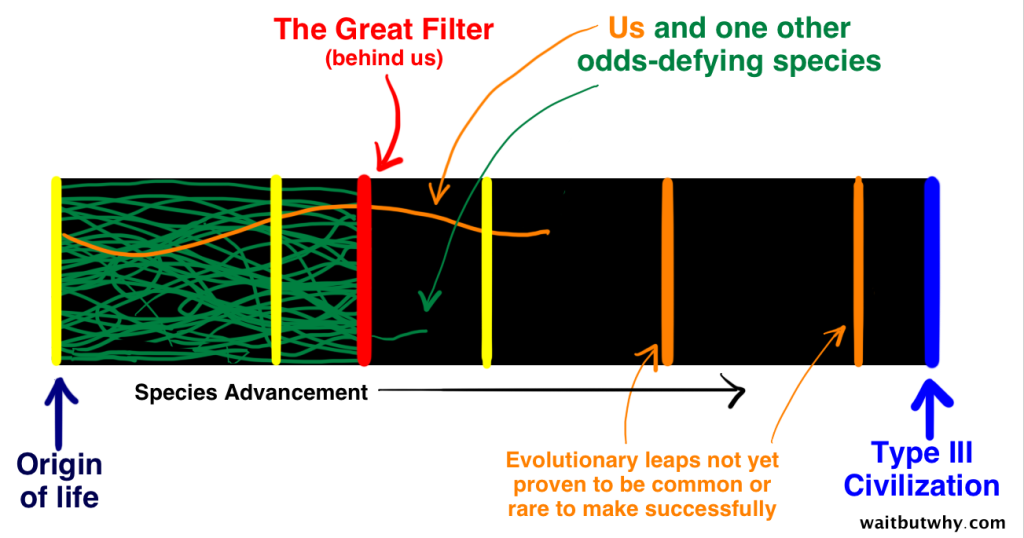
To account for the profound quietude of the observable universe, economists, astronomers, and philosophers have proposed various theoretical frameworks. One of the most prominent is the "Great Filter" theory, popularized by economist Robin Hanson. The Great Filter hypothesis suggests that between the genesis of life (abiogenesis) and the attainment of a Type III civilization on the Kardashev scale—which is capable of harnessing the entire energy output of a galaxy—there lies a developmental barrier so formidable that nearly all evolutionary lines fail to cross it.
Under this hypothesis, life must navigate a series of extremely difficult evolutionary steps. These hurdles could include:

- The transition from simple prokaryotic cells to complex eukaryotic cells.
- The development of sexual reproduction.
- The emergence of multi-cellular organisms.
- The evolution of tool-using, high-level intelligence.
- The survival of self-destruction risks, such as nuclear warfare, runaway climate change, or engineered pandemics.
The central question surrounding the Great Filter is terrifyingly simple: Is the filter behind us, or is it ahead of us? If the filter is behind us—meaning that abiogenesis or the rise of complex consciousness
is exceptionally rare—then humanity has beaten astronomical odds, and the galaxy may genuinely be devoid of competing intelligence. Conversely, if the filter lies ahead, it implies that every technological civilization inevitably encounters an insurmountable barrier—be it ecological collapse, existential technological annihilation, or resource depletion—leading to self-destruction before interstellar expansion can be achieved.
This line of reasoning bears striking similarities to the ongoing theoretical debates surrounding time travel. Just as the complete absence of historical or contemporary time travelers suggests that temporal mechanics may be fundamentally impossible, prohibitively resource-intensive, or strictly self-limiting, the absence of extraterrestrial visitors points toward profound systemic constraints on galactic expansion.
The Physics of Scale: The Case for the Technological Microcosm
While many classical solutions to the Fermi Paradox assume that advanced civilizations will inevitably engage in large-scale cosmic engineering—such as building Dyson spheres around stars or launching massive colonization fleets across the interstellar void—alternative perspectives suggest a radically different trajectory. Rather than expanding outward into macroscopic physical space, advanced civilizations may inherently contract inward.

This paradigm shift mirrors the historical evolution of modern computing technology. In the mid-20th century, electronic computers were massive, room-filling machines powered by thousands of vacuum tubes, consuming immense amounts of electrical energy while processing data at sluggish speeds. Over the ensuing decades, the relentless pursuit of efficiency driven by Moore’s Law has dramatically reduced physical size while exponentially increasing processing power and energy efficiency. Today, billions of microscopic transistors operate at molecular scales inside handheld devices.
Applying this principle to astrobiology yields a compelling hypothesis: intelligence does not scale up; it scales down. Large physical structures are inherently inefficient. They require vast amounts of raw materials, suffer from high transportation and communication latencies imposed by the speed of light, and demand immense energy reserves to function.
As civilizations mature, the laws of physics heavily incentivize the miniaturization of technology. Seth Shostak, a senior astronomer at the SETI Institute, has argued that the most logical progression for advanced intelligence involves the creation of nanotechnological systems and highly compressed computational networks rather than visible, mega-scale planetary architecture. Smaller machines operate at higher speeds, require negligible energy, and suffer minimal internal communication delays.
If advanced alien species systematically transition into nanobots, synthetic biology, or digital substrates operating within microscopic spaces or localized computational matrices, their presence would be virtually undetectable to traditional macroscopic observation techniques. Humanity’s search for radio waves and colossal megastructures may be as futile as an ant attempting to perceive the internal data processing of a microchip.
Broader Implications and Future Outlook
The implications of the Fermi Paradox and the miniaturization hypothesis extend far beyond theoretical astrophysics, profoundly shaping humanity’s philosophical self-understanding and our approach to technological development.
From an astrobiological standpoint, the ongoing absence of extraterrestrial signals underscores the extreme fragility and uniqueness of terrestrial existence. Whether protected by past evolutionary milestones or inching closer to a future Great Filter, humanity occupies a remarkably isolated position within the cosmos. This realization has catalyzed increased international investments in deep-space monitoring, technosignature detection, and planetary defense initiatives.
Simultaneously, the recognition that technological advancement trends toward micro-scale efficiency rather than macro-scale expansion offers a cautionary framework for our own civilization. As artificial intelligence, nanotechnology, and quantum computing accelerate on Earth, the primary existential threats shift from external cosmic encounters to internal regulatory and structural control.
Ultimately, whether the universe is truly empty, or simply operating at a scale too subtle for our current instruments to perceive, the Fermi Paradox remains humanity’s ultimate mirror. It forces us to confront our technological limitations, our evolutionary vulnerabilities, and our place in a vast, silent universe that we are only just beginning to comprehend.